
Healthcare ERP Solutions: Optimizing Medical Processes & Patient Care
In today’s rapidly evolving healthcare landscape, efficiency and accuracy are no longer optional but essential for delivering quality patient care. Healthcare ERP systems have emerged as vital tools for modern healthcare providers seeking to streamline operations, reduce costs, and improve patient outcomes.

This comprehensive guide explores how ERP solutions for the healthcare industry are transforming medical processes and elevating patient care standards across the industry. As healthcare ERP adoption increases, understanding these systems becomes essential for healthcare leaders.
1. Healthcare ERP overview
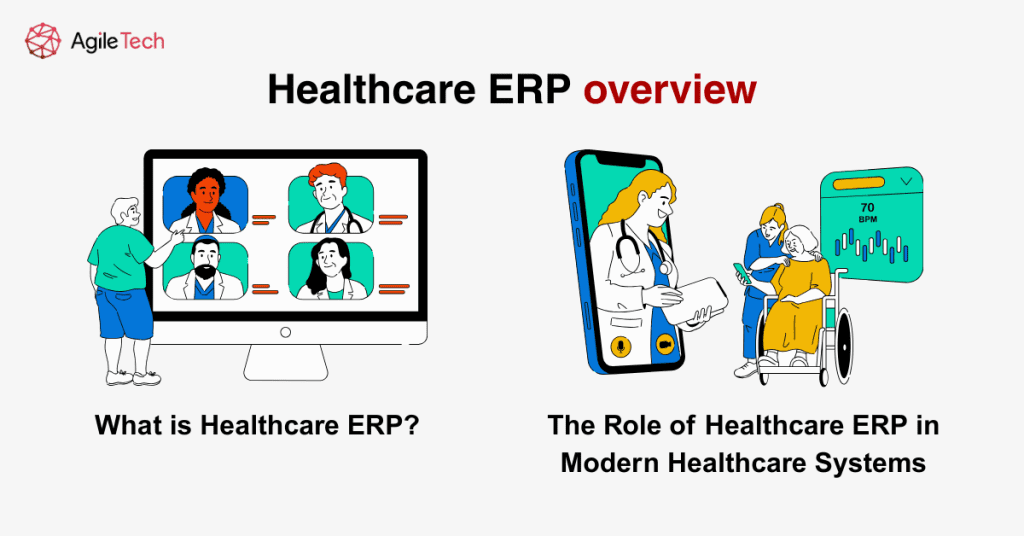
1.1. What is Healthcare ERP?
Healthcare Enterprise Resource Planning (ERP) refers to integrated software systems specifically designed to manage and coordinate key operational functions across healthcare organizations. Unlike traditional ERP systems used in other industries, healthcare ERP systems incorporate specialized features tailored to medical environments, including patient management, clinical workflows, regulatory compliance, and healthcare-specific financial processes.
A modern ERP for healthcare platform serves as a centralized data repository and management system, connecting various departments—from patient registration and clinical care to billing and inventory management—into a cohesive operational framework. By integrating these functions, healthcare providers can access real-time information, automate routine tasks, and make data-driven decisions that ultimately enhance both operational efficiency and patient care quality.
ERP in healthcare typically comprises several integrated modules, such as:
- Electronic Health Records (EHR) management
- Patient relationship management
- Hospital resource planning
- Inventory and supply chain management
- Financial management and billing
- Human resources and staff scheduling
- Regulatory compliance and reporting
1.2. The Role of Healthcare ERP in Modern Healthcare Systems
The healthcare industry faces unique challenges, including complex billing procedures, strict regulatory requirements, critical inventory management needs, and the paramount importance of accurate patient data. Modern healthcare ERP solutions have evolved specifically to address these challenges, becoming indispensable components of successful healthcare delivery.
ERP healthcare platforms now play several crucial roles in medical organizations:
Central Nervous System for Data: ERP in healthcare serves as the information backbone, connecting disparate systems and ensuring data consistency across all departments and functions.
Operational Efficiency Driver: By automating routine tasks and streamlining workflows, healthcare ERP systems reduce manual work, minimize errors, and allow staff to focus more on patient care rather than administrative tasks.
Decision Support Mechanism: Through advanced analytics and reporting capabilities, ERP for healthcare industry systems provide administrators and clinicians with actionable insights to make informed decisions about resource allocation, treatment protocols, and strategic planning.
Patient Experience Enhancer: Modern healthcare ERP solutions incorporate patient-facing features like online appointment booking, access to medical records, and communication tools that improve patient engagement and satisfaction.
Compliance Guardian: With built-in compliance frameworks and automated reporting features, ERP for healthcare systems helps healthcare organizations navigate the complex regulatory landscape while reducing the risk of violations and penalties.
As healthcare continues to evolve toward value-based care models, healthcare ERP systems are increasingly vital for tracking outcomes, managing costs, and optimizing resource utilization across the entire care continuum.
2. Types of Healthcare ERP Systems
Healthcare organizations can choose from several ERP for healthcare deployment models, each with distinct advantages depending on organizational size, resource availability, and specific requirements.
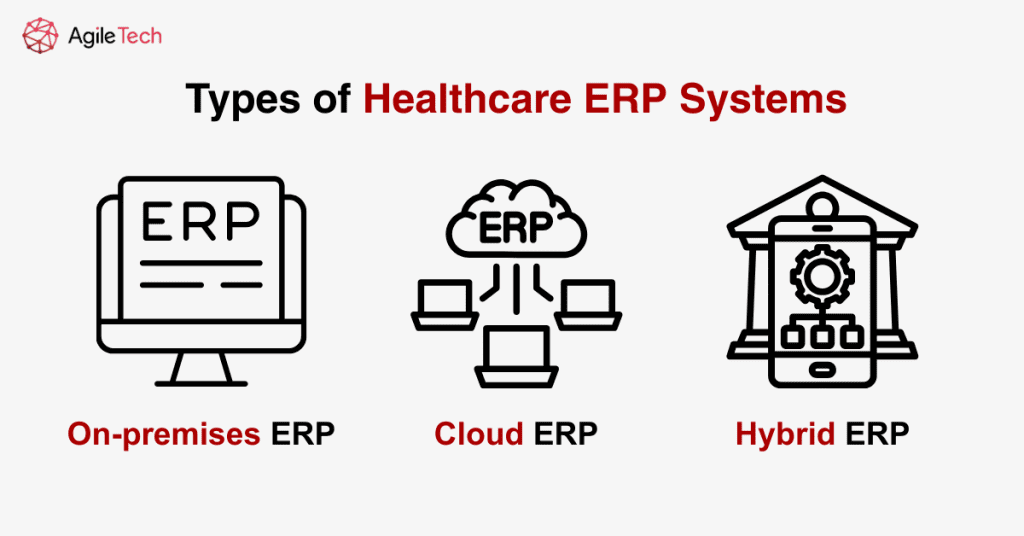
2.1. On-premises ERP
On-premises healthcare ERP systems are installed and operated from a healthcare organization’s in-house servers and computing infrastructure. This traditional deployment model offers several distinct advantages for certain types of healthcare providers.
Key characteristics of on-premises healthcare ERP:
- Complete data control: The healthcare organization maintains full ownership and control over all data and systems, which can be particularly important for organizations with stringent data sovereignty requirements.
- Customization flexibility: On-premises ERP healthcare systems often allow for more extensive customization to meet highly specific operational requirements unique to certain healthcare environments.
- One-time licensing model: Rather than recurring subscription fees, on-premises solutions typically involve an upfront license purchase plus ongoing maintenance fees.
- Independence from internet connectivity: Critical functions remain operational even during internet outages, ensuring continuous access to patient information in emergency situations.
2.2. Cloud ERP
Cloud-based healthcare ERP solutions are hosted on remote servers and accessed through web browsers or dedicated applications. These ERP for healthcare industry systems have gained significant popularity due to their accessibility, scalability, and reduced IT maintenance requirements.
Key characteristics of cloud healthcare ERP:
- Reduced infrastructure costs: Cloud ERP in healthcare eliminates the need for extensive on-site hardware investments, reducing capital expenditures.
- Automatic updates and maintenance: The vendor handles system updates, security patches, and technical maintenance, freeing healthcare IT staff to focus on other priorities.
- Scalability: Cloud healthcare ERP systems can easily scale to accommodate growth in users, data volume, or organizational expansion.
- Remote accessibility: Authorized users can securely access the system from anywhere with internet connectivity, facilitating telehealth services and remote work arrangements.
- Subscription-based pricing: Typically offered through monthly or annual subscription fees, creating a predictable operational expense rather than large capital investments.
2.3. Hybrid ERP
Hybrid ERP healthcare solutions combine elements of both on-premises and cloud deployments, offering healthcare organizations the flexibility to determine which components reside in the cloud and which remain on local infrastructure.
Key characteristics of hybrid healthcare ERP:
- Strategic deployment options: Organizations can keep sensitive patient data on-premises while moving less critical functions to the cloud.
- Phased migration capability: Allows healthcare providers to gradually transition from legacy systems to cloud healthcare ERP systems without disrupting critical operations.
- Disaster recovery advantages: Cloud components provide built-in backup and recovery options while critical systems remain under local control.
- Best-of-both-worlds approach: Combines the security and control of on-premises systems with the accessibility and reduced maintenance of cloud ERP for healthcare solutions.
Read more: Hospital Management System: Top Choices, Costs & Development Steps
3. Top 5 Key Benefits of Healthcare ERP
The implementation of comprehensive ERP in healthcare solutions offers numerous advantages for healthcare organizations seeking to optimize their operations and enhance patient care quality.
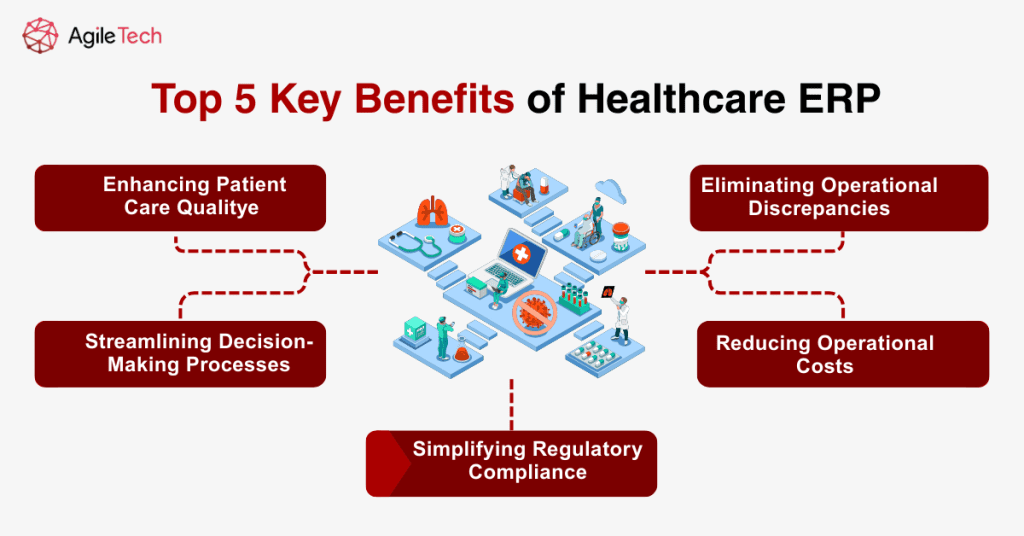
3.1. Enhancing Patient Care Quality
At its core, healthcare ERP directly contributes to improved patient outcomes by creating a more efficient, coordinated care environment:
- Comprehensive patient information access: Healthcare professionals gain immediate access to complete patient histories, test results, medication records, and treatment plans, enabling more informed clinical decisions.
- Reduced medical errors: By standardizing procedures and implementing automated checks, ERP for healthcare industry systems helps prevent medication errors, duplicate tests, and other potentially harmful mistakes.
- Improved care coordination: Integrated ERP healthcare systems facilitate seamless communication between departments and providers, ensuring that all members of the care team remain aligned and informed.
- Personalized care delivery: Advanced healthcare ERP systems incorporate patient preference data and historical information to support more personalized treatment approaches.
- Reduced wait times: Optimized scheduling and resource allocation lead to shorter wait times for appointments, procedures, and test results, enhancing the overall patient experience.
Patient care quality improvements through ERP in healthcare implementation often translate to measurable outcomes such as reduced readmission rates, shorter hospital stays, higher patient satisfaction scores, and better health outcomes across various metrics.
3.2. Streamlining Decision-Making Processes
Healthcare ERP systems transform data into actionable intelligence, empowering administrators and clinicians to make better-informed decisions:
- Real-time analytics and reporting: Decision-makers receive up-to-date information on key performance indicators, resource utilization, and clinical outcomes.
- Predictive analytics capabilities: Advanced ERP for healthcare solutions can forecast patient admission rates, resource needs, and potential bottlenecks, allowing for proactive rather than reactive management.
- Evidence-based decision support: By analyzing treatment outcomes across patient populations, healthcare ERP systems can help identify the most effective protocols and interventions.
- Resource optimization: Data-driven insights enable more effective allocation of staff, equipment, and facilities based on actual usage patterns and demand forecasts.
- Strategic planning support: Comprehensive data analysis facilitates more accurate long-term planning for facility expansions, service line development, and technology investments.
With streamlined decision-making processes, healthcare organizations can respond more rapidly to changing conditions, optimize resource utilization, and align operational decisions with strategic objectives.
3.3. Simplifying Regulatory Compliance
The healthcare industry faces some of the most stringent regulatory requirements of any sector. ERP healthcare systems significantly ease this compliance burden:
- Automated compliance tracking: Built-in monitoring tools automatically flag potential compliance issues before they become violations.
- Standardized documentation: ERP in healthcare systems enforces consistent documentation practices that meet regulatory requirements while reducing the administrative burden on clinical staff.
- Streamlined reporting: Automated generation of required regulatory reports saves countless hours of manual data compilation and reduces reporting errors.
- Audit trail capabilities: Comprehensive logging of all system activities creates an immutable record for audit purposes, demonstrating due diligence in compliance efforts.
- Regulatory update integration: Leading healthcare ERP vendors continuously update their systems to reflect changing regulations, ensuring organizations remain compliant with minimal effort.
For healthcare providers, this simplified compliance approach not only reduces the risk of penalties and sanctions but also decreases the administrative overhead associated with regulatory adherence.
3.4. Eliminating Operational Discrepancies
Healthcare ERP systems excel at identifying and resolving operational inconsistencies that can undermine efficiency and quality:
- Standardized workflows: By implementing consistent processes across departments and facilities, ERP for healthcare industry systems reduces variations that can lead to errors and inefficiencies.
- Automated reconciliation: Financial discrepancies between departments, such as billing and service delivery, are automatically identified and flagged for resolution.
- Inventory management precision: Real-time tracking eliminates discrepancies between recorded and actual inventory levels, preventing shortages of critical supplies and reducing waste.
- Resource utilization transparency: Clear visibility into how resources are allocated and utilized helps identify and address discrepancies between planned and actual usage.
- Performance variance identification: ERP healthcare analytics quickly highlight operational areas performing outside expected parameters, enabling targeted improvement initiatives.
By minimizing these operational discrepancies, healthcare organizations can achieve more predictable outcomes, better resource utilization, and higher levels of service quality across all departments.
3.5. Reducing Operational Costs
Perhaps one of the most compelling benefits of healthcare ERP implementation is its impact on the bottom line:
- Administrative efficiency: Automation of routine tasks reduces labor costs associated with manual data entry, record keeping, and basic administrative functions.
- Inventory optimization: Just-in-time inventory management reduces carrying costs while preventing shortages, optimizing cash flow, and storage requirements.
- Revenue cycle improvement: Integrated billing and claims management features reduce claim rejections, accelerate reimbursements, and capture previously missed charges.
- Resource utilization enhancement: Better scheduling and allocation of staff, equipment, and facilities maximize productivity and eliminate wasteful overlaps or gaps.
- Preventative maintenance: Scheduled maintenance of equipment based on usage data prevents costly emergency repairs and extends the useful life of capital investments.
Healthcare organizations implementing comprehensive ERP in healthcare solutions typically report cost reductions of 10-20% across various operational areas, representing significant savings that can be reinvested in patient care improvements or strategic initiatives.
4. Top 3 Notable Healthcare ERP Systems
The healthcare ERP market features several leading solutions, each with unique strengths and specializations tailored to different types of healthcare organizations.
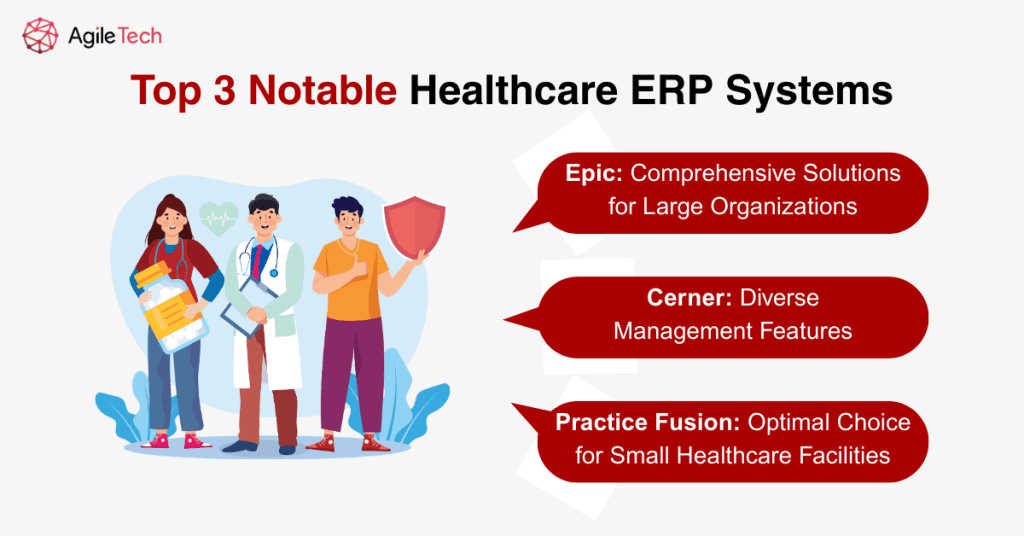
4.1. Epic: Comprehensive Solutions for Large Organizations
Epic stands as one of the most widely adopted enterprise solutions among large healthcare systems and academic medical centers in the United States.
Key features and strengths:
Comprehensive clinical and operational integration: Epic excels at creating a unified ecosystem where clinical care, administrative functions, and financial processes work seamlessly together.
Advanced interoperability: Epic’s Care Everywhere network facilitates secure patient data sharing between different healthcare organizations using their system.
Robust analytics platform: Epic’s Cogito analytics suite provides powerful data visualization and analysis tools for population health management and operational optimization.
Mobile solutions: Epic offers extensive mobile capabilities, including apps for both providers and patients that extend healthcare ERP systems functionality beyond fixed workstations.
Industry-leading implementation support: Epic’s implementation methodology is highly structured and comprehensive, though it requires significant organizational commitment.
4.2. Cerner: Diverse Management Features
Cerner offers a robust set of ERP healthcare solutions that particularly excel in clinical data management and population health capabilities.
Key features and strengths:
- Clinical excellence focus: Cerner’s solutions place particular emphasis on supporting clinical decision-making and optimizing patient care workflows.
- Flexible deployment options: Cerner offers a range of implementation approaches, including on-premises, cloud, and hybrid models to suit various organizational needs.
- Strong population health management: Cerner’s HealtheIntent platform provides advanced capabilities for managing health outcomes across patient populations.
- Revenue cycle integration: Cerner has strengthened its financial management capabilities, creating tighter integration between clinical and revenue cycle functions.
- Scalable architecture: Cerner’s ERP in healthcare systems can effectively serve organizations ranging from small community hospitals to large healthcare networks.
Read more: Cerner vs Epic: Which EHR/EMR System Is the Best?
4.3. Practice Fusion: Optimal Choice for Small Healthcare Facilities
Practice Fusion (now part of Veradigm, formerly Allscripts) offers a cloud-based EHR and practice management solution designed specifically for smaller healthcare providers.
Key features and strengths:
- Cloud-native architecture: As a true SaaS solution, Practice Fusion eliminates the need for on-site servers or extensive IT infrastructure.
- Intuitive user interface: The system features a user-friendly design that reduces training requirements and accelerates adoption.
- Affordable pricing model: Practice Fusion offers transparent, subscription-based pricing that makes comprehensive healthcare ERP capabilities accessible to smaller practices.
- E-prescription capabilities: Robust electronic prescription features, including controlled substance e-prescribing in compliance with regulatory requirements.
- Integrated telehealth: Built-in virtual visit capabilities enable small practices to offer telehealth services without additional technology investments.
5. Why choose AgileTech for custom healthcare ERP development?
At AgileTech, we specialize in delivering enterprise-grade healthcare ERP solutions that meet the strict demands of modern medical environments. With years of experience in EHR/EMR integration, system modernization, and healthcare data migration, we empower healthcare providers to operate more efficiently and deliver superior patient care.
Highly Skilled and Experienced Engineering Team
Our software engineers, business analysts, and solution architects have deep domain expertise in healthcare IT. From building scalable ERP infrastructures to integrating with systems like Epic and Cerner, our team ensures your ERP system is optimized for real-world clinical use.
Tailored ERP Solutions with Cutting-Edge Technology
We build robust and future-proof ERP systems tailored to your unique workflows, whether you’re running a hospital, clinic, or multispecialty network. Our development approach ensures interoperability, performance, and long-term scalability.
Standards-Based, Secure, and Compliant Development
We follow ISO 9001:2015 standards and implement strict data protection measures, including end-to-end encryption, role-based access control (RBAC), and multi-factor authentication (MFA) — ensuring your healthcare ERP meets both regulatory and security requirements.
Modernization and Interoperability Expertise
Whether upgrading legacy ERP systems or migrating to new platforms, AgileTech ensures smooth transitions with minimal disruption. We specialize in seamless integration with existing healthcare software ecosystems, including EHR/EMR platforms.
Agile Development for Faster Delivery
Our Agile development methodology ensures rapid iteration, flexible customization, and continuous improvement. This approach allows us to quickly adapt to industry changes and your evolving operational needs.
Conclusion
Healthcare ERP systems are a new approach to managing the complex processes of modern healthcare organizations. By bringing clinical, administrative, and financial functions under a single system, the systems enable healthcare professionals to deliver more quality care while optimizing resource utilization and reducing costs.
Whether developing an off-the-shelf solution like Epic, Cerner, or Practice Fusion, or designing a custom ERP for a healthcare industry system with a vendor like AgileTech, success hinges on determining the most appropriate methodology for your organization’s specific needs, budget, and strategic vision.
As care becomes more value-based and increasingly digital, healthcare ERP systems will play an increasingly important role in helping organizations navigate these transformations with their eyes on the prize: providing exceptional patient care. Forward-thinking healthcare leaders know that selecting the best ERP healthcare solution isn’t an IT decision—it’s a strategic investment in ensuring the long-term sustainability and success of their organization. In the competitive health care market today, successful health care implementation of ERP can make the difference between surviving and flourishing.