 Nguyen Manh Thang
Chief Executive Officer, AgileTech Vietnam
Nguyen Manh Thang
Chief Executive Officer, AgileTech Vietnam
- Published
- Last updated
- Read time
- 13 min
- Views
- 97
Read the AI overview
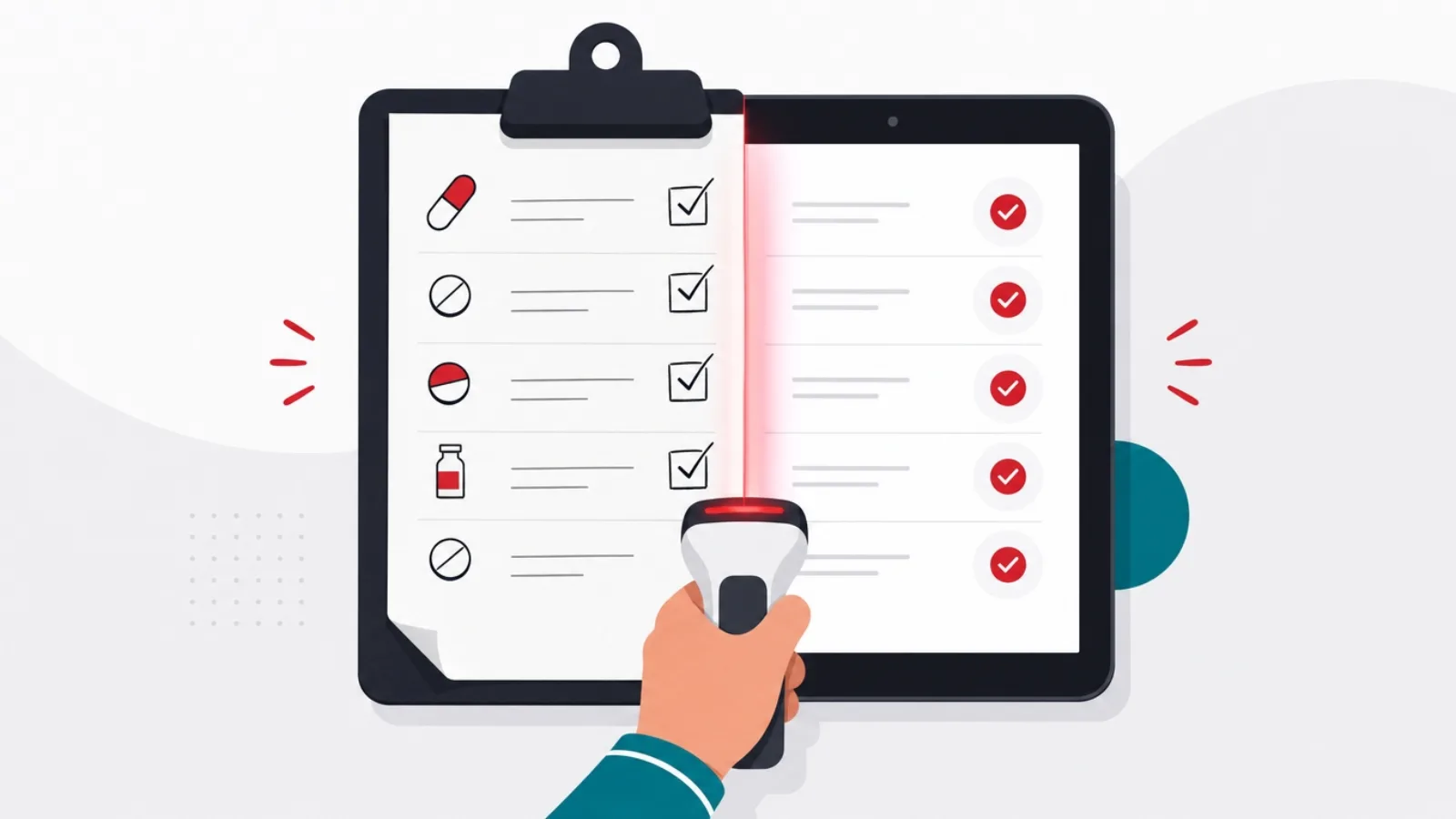
eMAR stands for electronic medication administration record: the digital system nurses and care staff use to document every medication given to every patient, in real time, at the point of care. It replaces the paper MAR chart, enforces the five rights of medication administration (right patient, drug, dose, route, time), and typically uses barcode scanning to verify patient and medication before a dose is recorded. eMAR is a workflow layer, not a full medical record: it usually runs inside or alongside an EMR or EHR, and in long-term care and assisted living it is often a standalone product connected to a pharmacy.
eMAR is one of those healthcare acronyms that gets defined in a sentence and misunderstood for years. The sentence: electronic medication administration record, the digital system that documents every dose given to every patient. The misunderstanding: treating it as either a trivial checklist app or as interchangeable with the EMR. It is neither. The medication pass is the highest-frequency, highest-risk routine in institutional care, and eMAR is the system that makes it verifiable.
This article explains eMAR operationally rather than by acronym: what actually happens during an electronic medication pass, the five rights the system enforces, how eMAR differs by care setting, where it sits relative to EMR, EHR and pharmacy systems, and what an implementation genuinely involves. The acronym triangle itself, EMR versus EHR versus eMAR as record types, has its own dedicated guide in our EMR, EHR and eMAR comparison; this piece assumes those definitions and goes deeper on the eMAR side.
The closing sections serve the builder and buyer audience this blog exists for: what an eMAR implementation costs a facility, and what building eMAR software involves for the health-tech founders and operators who ask us to scope it, a conversation that connects to the compliance groundwork in our pharmacy software requirements guide.
Key takeaways
- eMAR is the digital replacement for the paper medication chart: a real-time record of what was administered, by whom, when, and what happened when a dose was refused, held or missed.
- Its core safety mechanism is verification at the bedside: barcode or QR scanning of patient and medication closes the loop the paper MAR left open, and the published evidence ties this step to large reductions in administration errors.
- eMAR is not EMR or EHR: the [[EMR/EHR|/industries/healthcare-software-development/emr-ehr-software/]] is the patient's whole record, while eMAR is the medication administration workflow inside or beside it. Confusing the three leads to buying the wrong system.
- The types differ by care setting: hospital eMAR lives inside the EHR and leans on barcode verification; long-term care and assisted living eMAR is usually a standalone pharmacy-connected product; home care eMAR is mobile-first with offline tolerance.
- Implementation is a workflow project wearing a software badge: medication pass timing, pharmacy interfaces, and staff training decide success far more than feature lists do.
- For builders, eMAR is a regulated, integration-heavy niche with real openings in long-term care, home care and emerging markets, and none of them are quick builds: pharmacy integration and audit-grade records are the actual product.
eMAR defined: the medication chart, made verifiable

Every institutional care setting runs on the medication administration record, the MAR: the chart listing each resident or patient's prescribed medications, doses, routes and schedules, with a signature space for every administration. On paper, the MAR is a grid that gets initialed dozens of times per shift, and its failure modes are famous: illegible entries, missed signatures that are indistinguishable from missed doses, transcription errors when orders change, and no way to know at 3 p.m. whether the 8 a.m. pass actually happened correctly.
eMAR is that record made electronic, and the electronic part matters less than what it enables: real-time capture at the point of care, automatic scheduling from the live order list, alerts when a dose is late or missed, forced documentation of refusals and holds with reasons, and an audit trail that regulators and pharmacists can actually read. The record stops being a retrospective grid and becomes a live operational system that knows the state of every medication pass in the building.
The scope boundary is worth stating precisely, because it is where buyers get confused. eMAR covers administration: what was given, by whom, when, and what happened. It does not itself prescribe (that is CPOE, computerized provider order entry), dispense (that is the pharmacy system), or hold the full clinical record (that is the EMR or EHR). A complete medication loop runs order, pharmacy verification, dispensing, administration, and eMAR is the system of record for that last, most frequent step.
The vocabulary around eMAR, precisely
- MAR
- Medication administration record. The chart, paper or electronic, of every scheduled and administered dose per patient. eMAR is its electronic form.
- CPOE
- Computerized provider order entry. Where prescribers create and change medication orders. eMAR consumes these orders; it does not create them.
- BCMA
- Barcode medication administration. The scan-patient, scan-drug verification step at the bedside. Usually implemented as part of eMAR in hospitals.
- PRN
- Pro re nata, as-needed medication. eMAR systems handle PRN doses with reason codes and effectiveness follow-ups, a workflow paper handled badly.
- Five rights
- Right patient, right drug, right dose, right route, right time. The canonical administration safety checklist eMAR is built to enforce.
How an electronic medication pass actually works
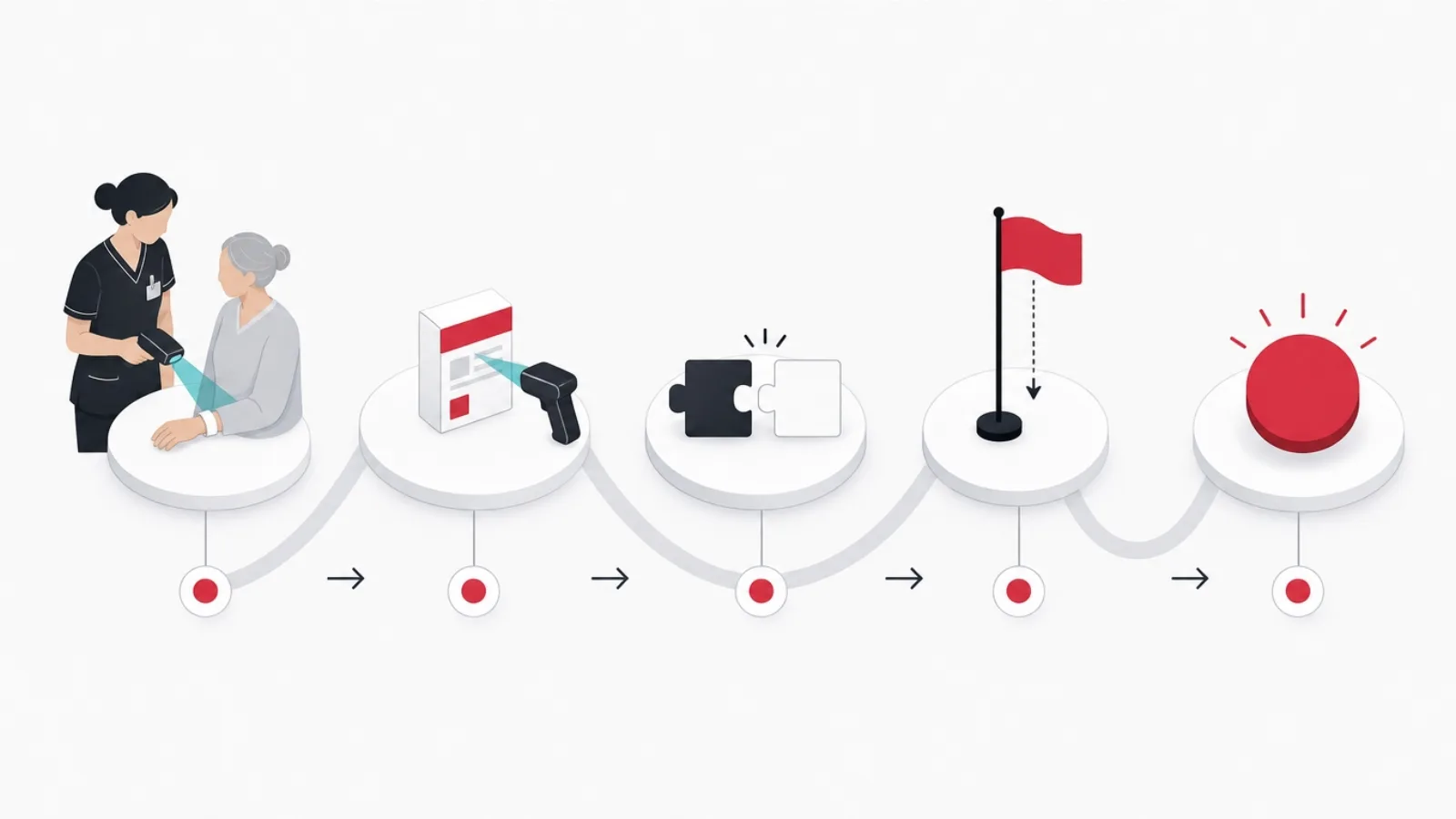
A medication pass under eMAR starts with the worklist. The nurse or med tech opens the shift view and sees every due medication across their assigned patients, sequenced by time window, with late doses flagged. This alone changes the job: on paper, knowing what is due requires reading every chart; under eMAR, the schedule is computed from live orders, including the changes the physician made an hour ago.
At the bedside or med cart, verification happens before administration. In hospital-grade deployments the nurse scans the patient's wristband, then scans the medication's barcode; the system confirms the match against the five rights and blocks or warns on mismatches, wrong patient, wrong drug, wrong dose strength, wrong time window, or a duplicate of a dose already given. In long-term care deployments the verification may be photo-and-profile based rather than wristband-based, but the principle is identical: the system, not memory, confirms the match.
Documentation happens at administration, not after the round. The dose is recorded with a timestamp and the administrator's identity; refusals, holds and unavailable doses are recorded with structured reasons; PRN doses capture the reason given and schedule a follow-up effectiveness check. Exceptions escalate: a missed critical medication can page a supervisor rather than waiting to be discovered at shift change. The result, aggregated, is what the paper MAR never was: a live, queryable, audit-ready account of the facility's highest-volume clinical activity.
One dose through an eMAR, step by step
-
Workliststart of round
The system computes due medications from live orders and presents the shift worklist, flagging late and upcoming doses.
-
Identifyright patient
Patient verified at the point of care: wristband barcode scan in hospitals, photo and profile confirmation in most long-term care settings.
-
Verifyrights 2-5
Medication scanned or selected; the system checks drug, dose, route and time window against the order, and warns or blocks on mismatch.
-
Administer and documentthe record
Dose given and recorded in one motion, with timestamp and administrator identity. Refusals and holds take structured reasons.
-
Escalate and follow upthe loop closes
Missed criticals alert supervisors; PRN doses schedule effectiveness checks; the pharmacy sees consumption against supply.
eMAR versus EMR and EHR: the boundary that decides what you buy
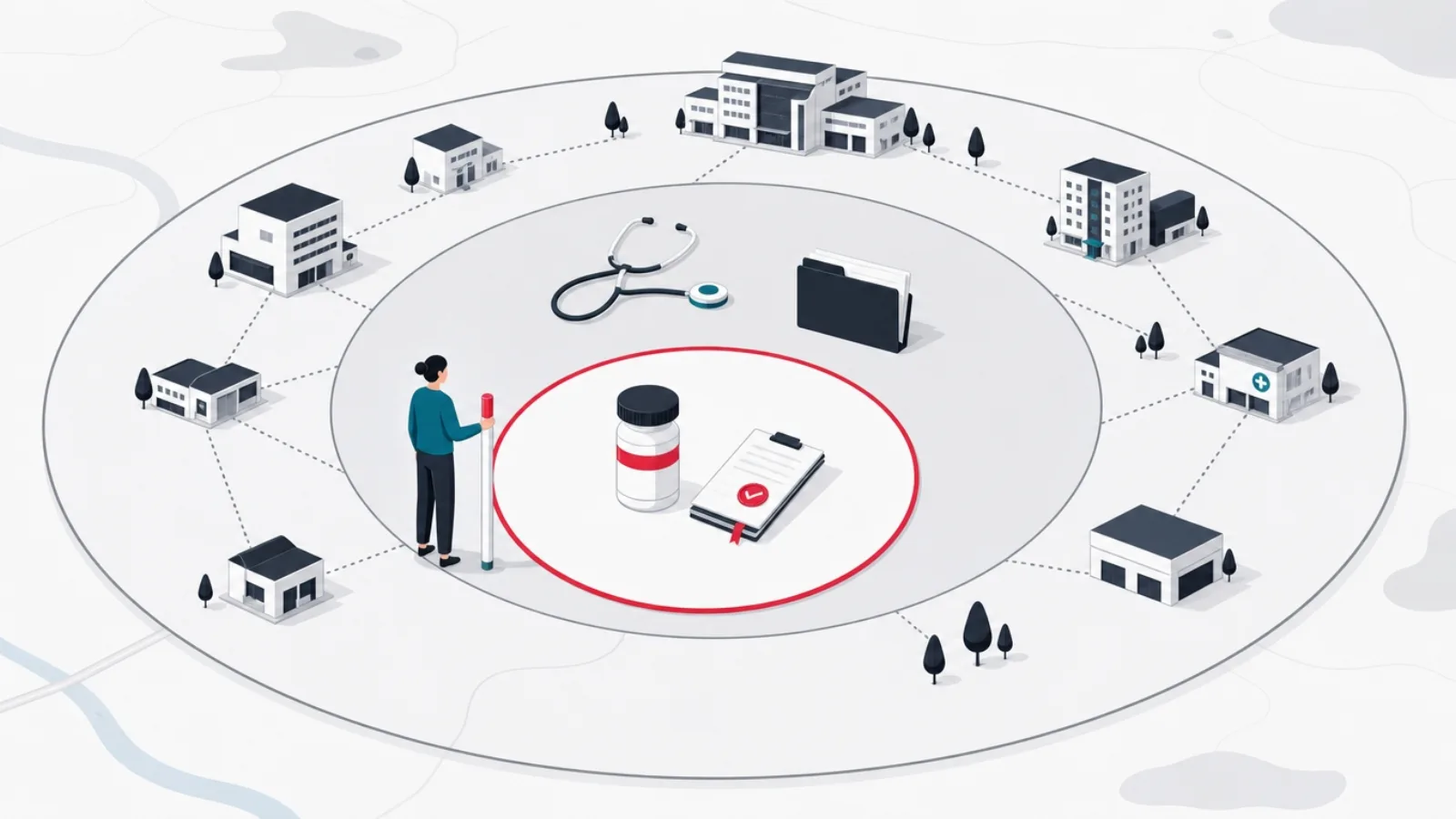
The acronym confusion is commercially expensive, so here is the boundary in operational terms. The EMR or EHR is the patient's clinical record: diagnoses, notes, orders, results, history. eMAR is the medication administration workflow and its record. In a hospital, eMAR is almost always a module of the EHR, Epic's and Cerner's eMAR screens are part of the same system the physician orders in, and buying it separately makes no sense.
Outside hospitals the picture inverts. Long-term care facilities, assisted living communities and group homes frequently run a standalone eMAR product connected to their pharmacy, because their clinical-record needs are lighter and their medication workflow is the dominant clinical activity. In these settings the eMAR effectively is the daily clinical system, with the fuller record living in a care-management platform or, still too often, on paper. Home care pushes further: the eMAR becomes a mobile app in a caregiver's pocket, and offline tolerance becomes a hard requirement.
The practical buying rule that falls out: hospitals choose an EHR and receive its eMAR; long-term and residential care choose an eMAR the way they choose a pharmacy partner, as an operational system, and should evaluate it on medication workflow depth rather than on record-keeping breadth. The full three-way comparison, including where EMR and EHR themselves diverge, lives in the EMR, EHR and eMAR explainer.
eMAR against the systems it is confused with
| System | What it is | Primary user | Where eMAR sits relative to it |
|---|---|---|---|
| EMR / EHR | The full clinical record: notes, orders, results, history | Physicians, clinical teams | eMAR is a module inside it (hospitals) or a companion beside it (residential care) |
| eMAR | The medication administration workflow and record | Nurses, med techs, caregivers | The subject of this article |
| Pharmacy system | Dispensing, supply, verification | Pharmacists | Feeds the eMAR with verified orders and receives consumption data |
| CPOE | Order creation and changes by prescribers | Physicians, NPs | Upstream: eMAR consumes its orders as the administration schedule |
Types of eMAR: the same record, four very different products

Hospital eMAR is the most standardized type: embedded in the EHR, wristband-and-barcode verified, tightly coupled to CPOE and the hospital pharmacy, and governed by the strictest regulatory expectations. Its defining constraint is acuity: IV medications, titrations, and high-alert drugs mean the verification and documentation logic is deep, and the system assumes a clinical nurse as the user.
Long-term care and assisted living eMAR is a different product wearing the same name. The users include med techs and caregivers, not only nurses; the medication list per resident is long and stable rather than acute and changing; and the pharmacy relationship is the system's backbone, with orders, refills and cycle fills flowing electronically from a contracted long-term-care pharmacy. Regulatory context shifts from hospital accreditation to state survey requirements, and the product's job is making a compliant medication pass achievable by a realistic staff mix.
Home and community care eMAR strips the concept to its portable core: a caregiver's phone, a visit schedule, the client's medication list, and documentation that tolerates dead zones and syncs later. Verification leans on photos and geolocation rather than wristbands. And a fourth type is worth naming because founders keep proposing it: consumer medication apps, reminders and adherence trackers for individuals, which share DNA with eMAR but are a different category, without the institutional accountability that defines a true administration record.
The four eMAR types, compared where they differ
| Hospital | LTC / assisted living | Home care | Consumer app | |
|---|---|---|---|---|
| Typical form | EHR module | Standalone, pharmacy-linked | Mobile-first app | Personal phone app |
| Primary user | Clinical nurses | Nurses and med techs | Caregivers | The individual |
| Verification | Wristband + barcode | Photo, profile, barcode | Photo + geolocation | Self-attested |
| Pharmacy link | Hospital pharmacy, integrated | LTC pharmacy, the backbone | Retail pharmacy, loose | None or retail refill |
| Offline tolerance | Rarely needed | Sometimes needed | Hard requirement | Native |
What eMAR measurably changes, and what it does not

The published evidence for barcode-verified electronic administration is unusually strong for health IT. The landmark hospital studies found administration-error reductions around 40 percent and transcription errors approaching elimination when barcode eMAR replaced paper, and the finding has replicated across settings for over a decade. The mechanism is unglamorous: most administration errors are identification and timing slips under workload, exactly the class of error a forced verification step catches.
The operational gains are as valuable as the safety ones. Missed doses become visible the hour they happen rather than at audit; late-pass patterns become measurable and fixable; pharmacy reconciliation shrinks from a monthly archaeology project to a report; and survey or accreditation preparation changes character entirely, because the record is complete by construction. Facilities consistently report the audit trail, not the error rate, as the benefit they feel first.
Honesty about limits belongs in the definition. eMAR does not fix prescribing errors, which happen upstream at the order. It can be worked around, scanning the sheet of barcodes at the nurses' station instead of the wristband is the canonical workaround, and workaround culture is a leadership problem no software solves. And a bad implementation can slow a medication pass enough that staff resist it, which is why the implementation section below is really the heart of any honest eMAR guide.
Implementing eMAR: a workflow project wearing a software badge

The implementation pattern that succeeds treats the medication pass, not the software, as the project. Before configuration, map the current pass honestly: cart layout, timing windows, who administers on nights and weekends, how PRNs are actually handled, where the Wi-Fi dies. The facilities that skip this discover their new system enforces a workflow their building cannot physically perform, and the workaround culture starts on day one.
The pharmacy interface is the technical heart of a residential-care implementation. Orders, changes, refills and cycle fills must flow electronically from the pharmacy into the eMAR, because manual transcription reintroduces the exact error class the system exists to remove. This is a real integration project with testing and edge cases, discontinuations, dose tapers, split doses, and it is the reason LTC eMAR vendors and LTC pharmacies come pre-paired; choosing an eMAR your pharmacy cannot interface with is a self-inflicted wound.
Training and cutover follow a known playbook: super-users on each shift, a parallel-run or unit-by-unit rollout rather than a big bang, deliberate slack in the schedule for the first slow weeks, and leadership attention on the scan-rate and late-dose dashboards for the first quarter. Typical timelines run eight to sixteen weeks for a residential facility and considerably longer inside hospital EHR programs; typical costs for a standalone LTC deployment run a few thousand dollars per facility in setup plus per-bed monthly subscription, with hardware, carts, scanners, tablets, as the variable line.
The eMAR readiness checklist buyers should run first
- Pharmacy interface confirmed in writingYour pharmacy and the eMAR vendor have live, tested integrations, not a roadmap slide. Ask for reference facilities using both.
- Wi-Fi surveyed where medication happensCoverage at every med cart position, room doorway and stairwell on the pass route. Dead zones become workarounds.
- Staff mix matches the product's user modelA system designed for RNs will fail a med-tech workforce, and vice versa. Watch a real user demo, not a sales demo.
- Reports match your survey obligationsPull the exact reports your state surveyors or accreditor requests, from the demo system, before signing.
- Downtime procedure exists on paperThe system will be down during a pass eventually. The paper fallback and re-entry procedure is part of the implementation, not an afterthought.
For builders: what eMAR software actually consists of
Founders and operators approach us about eMAR builds more than the niche's size would suggest, usually from one of three positions: an LTC or home-care operator whose vendor options feel dated, a pharmacy group wanting to own the facility interface, or a health-tech founder targeting an emerging market where the incumbent products never localized. All three are legitimate; none of them is a quick build, and the reason is that the visible app is the smallest part of the system.
The real product is the order-to-administration pipeline: an orders model that survives real prescribing (tapers, ranges, PRNs with conditions, holds), a scheduling engine that computes due-lists correctly across time zones, shift patterns and daylight saving, a verification layer with barcode or photo confirmation, an offline-tolerant client that never loses a documented dose, and an audit trail built to evidentiary standards, append-only, attributable, exportable. Around that core sit the integrations that decide market entry: pharmacy systems, and in hospital-adjacent settings, HL7 or FHIR interfaces to the EHR. Regulatory posture, HIPAA in the US and its equivalents elsewhere, shapes hosting, access control and logging from the first sprint; our telemedicine platform guide walks the same compliance terrain from an adjacent angle.
On budget: a credible single-setting eMAR MVP, LTC or home care, one pharmacy integration path, offline-capable mobile clients, audit-grade records, typically lands between 120,000 and 250,000 US dollars with an experienced offshore health-tech team, with the scheduling engine and pharmacy interface consuming more of that than founders expect and the UI less. The strategic filter is the same as every regulated niche: the moat is the integration and compliance work, which is exactly why the market has room for serious new entrants and no room for weekend projects.
The build question, as one decision
What position are you building eMAR from?
-
A care operator with facilities of your own
Build against your own workflow, pilot in one building, and treat your pharmacy as a co-design partner
You own the distribution and the test bed. The product risk is generalizing beyond your own workflow too late.
-
A pharmacy group serving facilities
Build the facility-facing eMAR as an extension of your dispensing pipeline
The pharmacy interface is the hardest integration, and you own one side of it. That is a structural advantage over software-only entrants.
-
A founder targeting an underserved market
Pick one care setting and one country, and let its survey regulations write your spec
eMAR does not generalize across settings or jurisdictions at MVP. Depth in one regulated niche beats breadth in four.
The honest conclusion
eMAR is a simple answer with a serious system behind it: the electronic record of medication administration, built to make the most frequent clinical routine in institutional care verifiable. The definition takes a sentence; the substance is the worklist, the bedside verification, the structured exceptions and the audit trail, and the evidence says that substance measurably reduces the administration errors paper charts invited.
For buyers, the guidance compresses well: hospitals get eMAR through their EHR; residential and home care should choose a standalone eMAR on workflow depth and pharmacy compatibility, and should treat implementation as a workflow project with a software component. For builders, the niche is real and the bar is honest: the product is the pipeline and the compliance, not the screens.
And for the reader who arrived from the acronym side, wanting eMAR placed against EMR and EHR: the one-line map is that the EMR/EHR is the record of care, and eMAR is the record of the care that happens most often. The full triangle is drawn in our dedicated comparison, and the medication pass, now you have seen it properly, is the reason the third acronym earned its own article.
Frequently asked questions
What does eMAR stand for in healthcare?
Electronic medication administration record: the digital system nurses, med techs and caregivers use to document every medication dose given to every patient, in real time, at the point of care. It replaces the paper MAR chart, enforces the five rights of administration, and typically verifies patient and medication by barcode or photo before a dose is recorded.
What is the difference between eMAR and EMR?
The EMR (or EHR) is the patient's full clinical record: diagnoses, notes, orders, results and history. eMAR is specifically the medication administration workflow and its record. In hospitals, eMAR is usually a module inside the EHR; in long-term care, assisted living and home care it is often a standalone product connected to a pharmacy. They answer different questions: the EMR records care, eMAR records the care that happens most often.
What are the five rights of medication administration?
Right patient, right drug, right dose, right route, right time: the canonical safety checklist for giving medication. eMAR systems are built to enforce them mechanically, by computing the due list from live orders (right time), verifying the patient by wristband or photo (right patient), and checking the scanned medication against the order (right drug, dose and route) before the dose can be documented.
Does eMAR actually reduce medication errors?
The published evidence is unusually strong: landmark studies of barcode-verified electronic administration found administration-error reductions around 40 percent and near-elimination of transcription errors, and the findings have replicated across settings. The mechanism is that most administration errors are identification and timing slips under workload, exactly what a forced verification step catches. The main caveat is workarounds: a facility that tolerates scan-sheet shortcuts gives back much of the benefit.
What are the types of eMAR systems?
Four, by care setting. Hospital eMAR lives inside the EHR with wristband-and-barcode verification. Long-term care and assisted living eMAR is usually a standalone product whose backbone is the electronic interface to an LTC pharmacy. Home care eMAR is a mobile-first app with offline tolerance and photo or geolocation verification. Consumer medication apps share DNA with eMAR but lack the institutional accountability that defines a true administration record.
How much does eMAR software cost to implement or build?
For a facility implementing a standalone LTC eMAR: typically a few thousand dollars in setup plus a per-bed monthly subscription, with hardware (carts, scanners, tablets) as the variable line and eight to sixteen weeks as a realistic timeline. For a team building eMAR software: a credible single-setting MVP with one pharmacy integration path, offline-capable clients and audit-grade records typically runs 120,000 to 250,000 US dollars with an experienced offshore health-tech team, with the scheduling engine and pharmacy interface consuming more of that than founders expect.
Medication and care-workflow systems live or die on integration depth and audit-grade records. If your roadmap includes a health-tech build, engage AgileTech, a software development partner in Hanoi that ships the pipelines, compliance architecture and clinical integrations this category demands.
Source: https://agiletech.vn/blog/what-is-emar/ · (c) AgileTech Vietnam. Printed from agiletech.vn.