Global delivery from Hanoi, Vietnam ISO 9001:2015   ISO 27001:2013 hello@agiletech.vn (+84) 989 324 830

Why the Best Agency Advice Is Sometimes “Don’t Build It”: An Exclusive Interview with Nguyen Manh Thang, CEO of AgileTech Vietnam

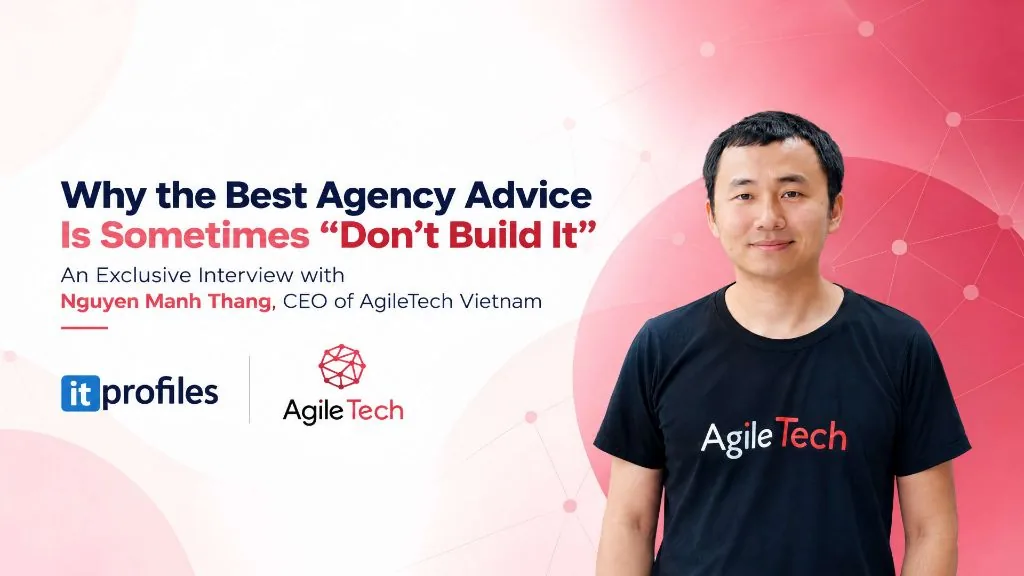
Nguyen Manh Thang, CEO of AgileTech Vietnam, smiling in a black AgileTech T-shirt beside the headline Why the Best Agency Advice Is Sometimes Don't Build It, with the ITProfiles and AgileTech logos on a red and white network background
Nguyen Manh Thang, CEO of AgileTech Vietnam, interviewed by ITProfiles on why the most valuable agency advice is sometimes a well-reasoned no.

When buyers evaluate technology agencies, they are often trying to answer a question that goes beyond whether a team can write code: can they trust this agency with important product decisions? ITProfiles spoke with technology agency leaders about what buyers notice before and during those crucial early conversations. The broader findings are covered in “Agencies Are Losing Deals in the First 10 Minutes: What Buyers Decide Before You Even Pitch.” Among the perspectives is that of Nguyen Manh Thang, CEO of AgileTech Vietnam, whose approach centers on technical judgment, commercial restraint, and knowing when not to build.

On this page
  1. Buyers Are Looking for Judgment, Not Just Execution
  2. The Signal That Builds Trust: Knowing What Not to Build
  3. Put Technical Judgment Into the First Conversation
  4. When Expertise Becomes Visible

Buyers Are Looking for Judgment, Not Just Execution

For Thang, buyers already know an agency can develop software. What they really want to establish is whether the team can think beyond a task list.

“They are trying to determine whether we are an active product engineering partner or just another passive order-taker.”

That distinction becomes visible in the questions an agency asks. Buyers listen for whether the team understands user workflows, scalability, integrations, and the business logic behind the product.

They are also assessing the risk of handing over architectural decisions.

As Thang Nguyen explains, “In those first few minutes, they are calculating the operational risk of trusting us with their product architecture.”

That is why he believes an agency can be eliminated quickly when “The agency doesn't seem to understand the actual problem.”

What buyers are listening for in the first conversationA two-column comparison of a passive order-taker and an active product engineering partner across three rows: what the agency asks about, whether it understands the actual problem, and the role it plays in the product. Passive order-taker Engineering partner What the questions cover The task list Workflows, scale,integrations, logic Understanding of the actualproblem Missing, so the agency iseliminated quickly Visible within the firstminutes Trust with productarchitecture Too risky to hand over Worth the operational risk
The contrast Thang describes: buyers already assume an agency can write code, so they judge whether its questions reach past the task list to the product itself.

The Signal That Builds Trust: Knowing What Not to Build

Thang’s strongest trust signal is surprisingly simple: tell the client when a complex feature may not be worth building.

“The strongest signal is when the agency actively advises the client not to build a certain complex feature right away.”

He gives a specific example of what that conversation can sound like:

“We can build this custom module, but using a ready-made service or simpler workflow will save you 2 months of development and 40% of your budget.”

For Thang, that kind of recommendation communicates something difficult to fake. The agency is prioritizing the client’s outcome rather than maximizing development hours.

“Demonstrating commercial restraint and prioritizing the client's timeline over maximizing billable hours creates immediate trust.”

This is where technical expertise becomes more than implementation capability. It becomes the ability to challenge an assumption, identify a simpler path, and explain the trade-off clearly.

The recommendation that builds trust, in Thang's own exampleA horizontal bar chart comparing the budget of building a custom module, shown as 100 percent, with using a ready-made service or simpler workflow, shown as 60 percent, annotated with the saving of 2 months of development and 40 percent of the budget. 0 25 50 75 100% Build the custom module 100 Ready-made service orsimpler workflow 60 Saves 2 months and 40% of budget
Thang's example of commercial restraint: a ready-made service or simpler workflow instead of a custom module saves 2 months of development and 40% of the budget.

Put Technical Judgment Into the First Conversation

Thang believes agencies should also rethink who leads their initial buyer conversations.

His advice is direct: “Stop letting non-technical sales representatives conduct first calls alone, and bring a solution architect into the meeting.”

But having a technical expert present is only part of the equation. The agency should already have done its homework.

According to Thang, teams should study “the buyer's product, industry regulations, and existing software stack before picking up the phone.”

That preparation changes the nature of the conversation. Instead of asking basic questions and promising to return with answers from engineering, the agency can discuss actual architectural and business challenges from the beginning.

Two ways to run a first callA swimlane diagram with two lanes across three stages, before the call, during the call and after the call. The sales rep alone lane has no preparation, asks basic questions and returns later with answers from engineering. The lane with a solution architect (labeled with an architect) studies the buyer product, industry regulations and software stack, discusses actual architectural and business challenges, and moves on from real challenges. Before the call In the first call After the call Sales repalone Asks basic questions Returns with answers fromengineering With anarchitect Studies the buyer'sproduct, regulations andsoftware stack Discusses actualarchitectural andbusiness challenges Next step starts from thereal problem
Thang's advice in sequence: a solution architect who has studied the buyer beforehand can discuss real architectural and business challenges from the beginning, instead of promising answers later.

When Expertise Becomes Visible

Thang points to a complex AI platform deal as an example.

During the first technical discussion, AgileTech Vietnam did not simply request the client's product requirements document. The team identified potential latency problems in the proposed data pipeline and presented two architectural fixes.

The client saw that the developers were prepared to take ownership rather than wait for instructions.

As Thang explains, “The client realized right away that we would actively protect their product from bad design choices.”

That recognition removed pricing friction and helped the agreement close within days.

For buyers comparing agencies that appear equally capable, Thang says the deciding factor is ultimately “Understanding of the business problem.”

And that may be the clearest lesson from his approach: the strongest technology partner is not necessarily the one that says yes to every feature. Sometimes, the most valuable answer an agency can give is a well-reasoned no.

How the AI platform deal unfoldedA single lane timeline in four steps for AgileTech Vietnam: the first technical discussion did not stop at requesting the requirements document, the team identified latency problems in the proposed data pipeline and presented two architectural fixes, the client saw a team ready to take ownership, and pricing friction was removed so the agreement closed within days. First discussion Findings Client reaction Outcome AgileTechVietnam Went past askingfor the PRD Found latencyrisks, offered twofixes Client saw a teamtaking ownership Pricing frictiongone, closed indays
The complex AI platform deal Thang describes, step by step: the expertise was visible in the first technical discussion, and the agreement closed within days.

Consult Industry Specialists

Connect with us today to discuss your software development needs and discover how our tailored outsourcing services can propel your business forward.

Start a conversation
AgileTech Vietnam team at the office

Privacy choices

We use one category of strictly necessary first-party storage, which keeps the site working and remembers this choice; it is always active. Every other category is optional and stays off until you switch it on, wherever you are in the world. Two optional categories have something behind them today: Analytics, which is Google Analytics, and External content, which is the Google map of our Hanoi office on the Contact page. Neither runs until you allow it.

Our worldwide approach. We apply one standard to everyone: nothing outside strictly necessary storage runs until you allow it. That meets the EU and UK requirement for prior consent, Vietnam's Law 91/2025/QH15 on personal data protection, the notification and consent requirements of Singapore's PDPA, and US state privacy law. You can withdraw or change your choice at any time, as easily as you gave it, from Privacy choices in the footer.

Where you are connecting from. Our network tells us the country associated with your connection, and we use it to choose which consent policy to apply. We do not use it to work out your address, we do not put it in a cookie, and we never send your IP address to the page. Today every country receives the same strict policy, so it makes no difference to what you see. If your country cannot be determined, or you are using Tor, you get the strict policy too: an unknown location always means the more protective setting, never the weaker one.

If you are in the United States. We do not sell your personal information and we do not share it for cross-context behavioral advertising, so there is nothing to opt out of. We still honor an opt-out preference signal from your browser: if your browser sends Global Privacy Control, the optional categories stay off without you having to do anything.

Full detail, including the name and lifetime of the one cookie we set, is in the Cookie Policy.