 Nguyen Manh Thang
Chief Executive Officer, AgileTech Vietnam
Nguyen Manh Thang
Chief Executive Officer, AgileTech Vietnam
- Published
- Read time
- 13 min
Read the AI overview
Blockchain is useful in healthcare when several independent organizations need to share a tamper-evident history without giving any one participant full control: pharmaceutical supply chain traceability, patient consent audit trails, and clinician credential verification are the use cases that pass this test. It is usually the wrong choice when a hospital merely needs to store, update, or query patient records efficiently, which is why storing electronic health records on-chain and replacing claims platforms with ledgers keep failing. The practical decision test is one sentence: if a trusted organization can operate the system of record without creating an unacceptable governance problem, use a normal database. Where a ledger is justified, the defensible architecture keeps sensitive medical data off-chain, stores only proofs and events on the ledger, runs on a permissioned network, and treats HIPAA, GDPR and FHIR integration as the main body of work rather than an afterthought.
Blockchain in healthcare is useful when several independent organizations need to share a tamper-evident history without giving one participant full control. It is usually the wrong choice when a hospital merely needs to store, update, or query patient records efficiently. That distinction sounds simple, but it eliminates most of the proposals that circulate under this heading, which is exactly why it is worth applying before any budget is spent.
Many healthcare blockchain projects start with the technology and search for a problem. A stronger evaluation starts with the workflow, the participants, the trust boundaries, and the regulatory obligations, and only then asks whether a shared ledger changes anything a well-run database could not. This guide runs that evaluation across the use cases healthcare teams actually propose, from pharmaceutical traceability to on-chain health records, and is blunt about which side of the line each one lands on.
The stakes are practical rather than ideological. Teams that pick a passing use case, such as supply chain traceability, spend their budget on integration and governance and end up with something auditable. Teams that pick a failing one spend the same budget rediscovering why EMR and EHR systems are built on conventional databases. The sections below exist to make that discovery cheaper.
Key takeaways
- Start from the workflow, not the technology. Blockchain adds value at organizational boundaries, where several parties write to one process and none should own the authoritative record. Inside one organization it is nearly always the wrong tool.
- The one-sentence test eliminates most proposals: if a trusted organization can operate the system of record without an unacceptable governance problem, use a normal database.
- The use cases that pass are pharmaceutical traceability, consent audit trails, and clinician credentials, because each involves multiple independent issuers and verifiers who need a shared history.
- The use cases that fail are on-chain electronic health records and general claims processing: record size, privacy law, correction obligations and the real causes of claims delay all point back to conventional systems.
- Immutability proves a record was not changed after submission. It cannot prove the record was true when submitted, so validation and participant accountability remain the hard work.
- A credible pilot is narrow: two to four organizations, one workflow, a permissioned ledger, off-chain storage for anything sensitive, and a go or no-go measure defined before the first transaction.
What does blockchain actually add to healthcare?

Blockchain provides a shared, tamper-evident record that multiple parties can verify. That is the entire value proposition, and it is worth stating plainly because the surrounding marketing often implies more. Its primary value is not faster storage, stronger encryption, or automatic regulatory compliance. A conventional database can already encrypt medical information, enforce access controls, record audit events, and process large transaction volumes, and it is easier to modify, scale, and integrate than any distributed ledger.
Blockchain becomes relevant when a healthcare workflow has most of a specific set of conditions: several organizations write to the same process, those organizations do not fully trust one another, no single organization should own the authoritative record, participants need a common transaction history, disputes about when or whether an event occurred are costly, and the historical record should be difficult to alter silently. If one hospital controls the application, the database, and the users, blockchain rarely adds enough value to justify its complexity.
The practical decision test compresses all of this into one sentence: if a trusted organization can operate the system of record without creating an unacceptable governance problem, use a normal database. This test eliminates many proposed healthcare use cases in the first meeting, and it focuses blockchain investment on situations where decentralization solves a genuine organizational problem rather than decorating an ordinary one.
The implementation trap that survives even a passing use case is assuming that cryptographic immutability makes data accurate. Blockchain can show that a submitted record has not been changed since submission. It cannot prove that the original entry was truthful, that the scanner was pointed at the right pallet, or that the clinician entering a consent event was authorized to do so. Data validation, identity management, and participant accountability remain necessary, and they remain the majority of the work.
- Multiple writers. Several organizations submit events to the same process, not one organization with many departments.
- Limited mutual trust. Participants benefit from verifying rather than simply believing each other, because incentives diverge.
- No natural owner. Assigning the record to any single participant would create a governance problem the others cannot accept.
- Costly disputes. Arguments about when or whether an event occurred carry real financial or regulatory consequences.
Which blockchain healthcare use cases pass the test?
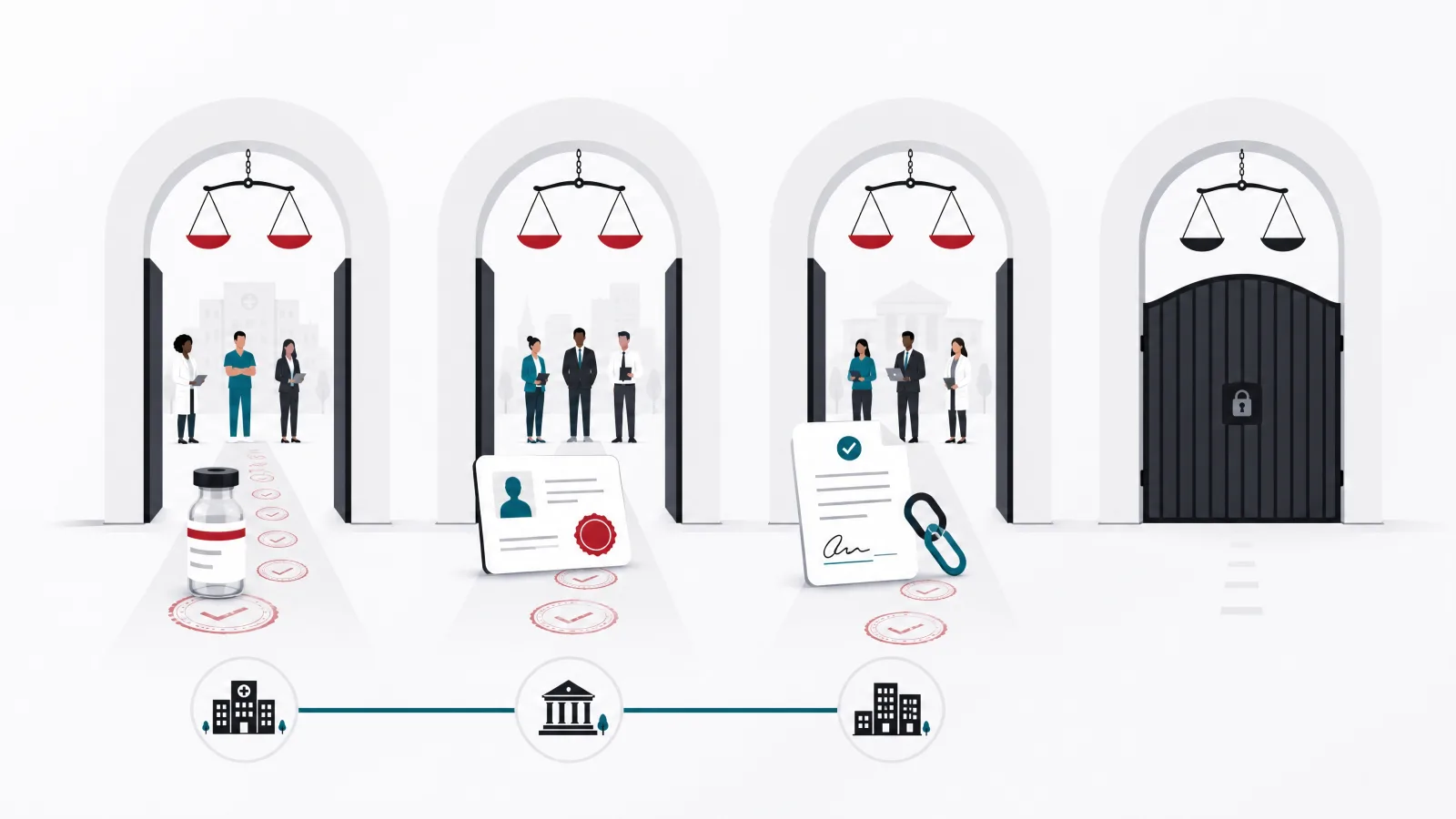
The strongest healthcare use cases involve cross-organizational verification, traceability, and shared audit history. Pharmaceutical supply chains, consent records, and professional credentials fit this pattern far better than direct clinical data storage, because each involves multiple independent issuers and verifiers who genuinely lack a neutral central operator.
Pharmaceutical supply chain and anti-counterfeit tracking is the canonical passing case. A drug supply chain involves manufacturers, distributors, logistics providers, pharmacies, hospitals, and regulators, each maintaining separate systems while product custody changes hands repeatedly. A shared ledger can record custody events, product identifiers, and status changes, letting participants compare a product against its recorded history without relying entirely on one trading partner. It passes because no single commercial participant is a neutral owner for the whole network. But the ledger does not solve physical verification by itself: a counterfeit product can carry copied identifiers, so serialization, scanners, packaging controls and exception management remain essential, and the genuinely hard part is onboarding distributors and pharmacies to submit reliable data in a consistent format.
Patient consent and access audit trails pass a narrower version of the test. A ledger can hold a shared record of consent grants, withdrawals, and data access events, storing a cryptographic reference to each event while the sensitive medical data stays in an authorized off-chain system. This is useful when research institutions, hospitals, and laboratories need to demonstrate which permission existed at a particular time. The design discipline is to separate the immutable evidence that an event occurred from the current authorization decision: patients withdraw consent, laws impose new restrictions, and each connected application must still interpret the live consent state and block unauthorized access. The practical failure mode is synchronization, because a ledger has not protected a patient if one hospital revokes consent while a connected system keeps using stale local state.
Clinician credential verification passes because the issuers are structurally plural. Licenses, qualifications, and training records come from universities, licensing authorities, employers, and specialist boards, while many healthcare organizations need to verify them repeatedly. A blockchain-based credential network lets authorized issuers sign credentials and lets employers verify them, reducing repeated document collection and making altered credentials easier to identify. The challenge is governance rather than cryptography: the network must define which issuers are trusted, how credentials are revoked, how corrections are handled, and what happens when an issuing organization leaves. Without those rules, the ledger becomes one more incomplete registry.
What the passing use cases require, and what sinks them
Do this
- Shared governance from day oneIssuer rules, revocation procedures, dispute resolution and exit terms agreed before the network launches, not after the first conflict.
- Off-chain storage for sensitive payloadsThe ledger holds proofs, identifiers and events. Medical documents, images and personal data live in controlled systems built for them.
- Physical and procedural controlsSerialization, scanners, and exception handling for supply chains; identity and role management for consent and credentials.
- A data quality onboarding programThe ledger is only as good as what distributors, pharmacies and issuers submit. Format discipline is the real adoption work.
Not this
- Treating immutability as truthA tamper-evident lie is still a lie. Validation at the point of entry remains the control that matters.
- Making the ledger the enforcement pointConsent enforcement happens in each connected application. The ledger is evidence, not a gatekeeper.
- Launching without participant commitmentA technically sound network with two reluctant members is a demo, not infrastructure.
Which healthcare use cases usually fail the test?
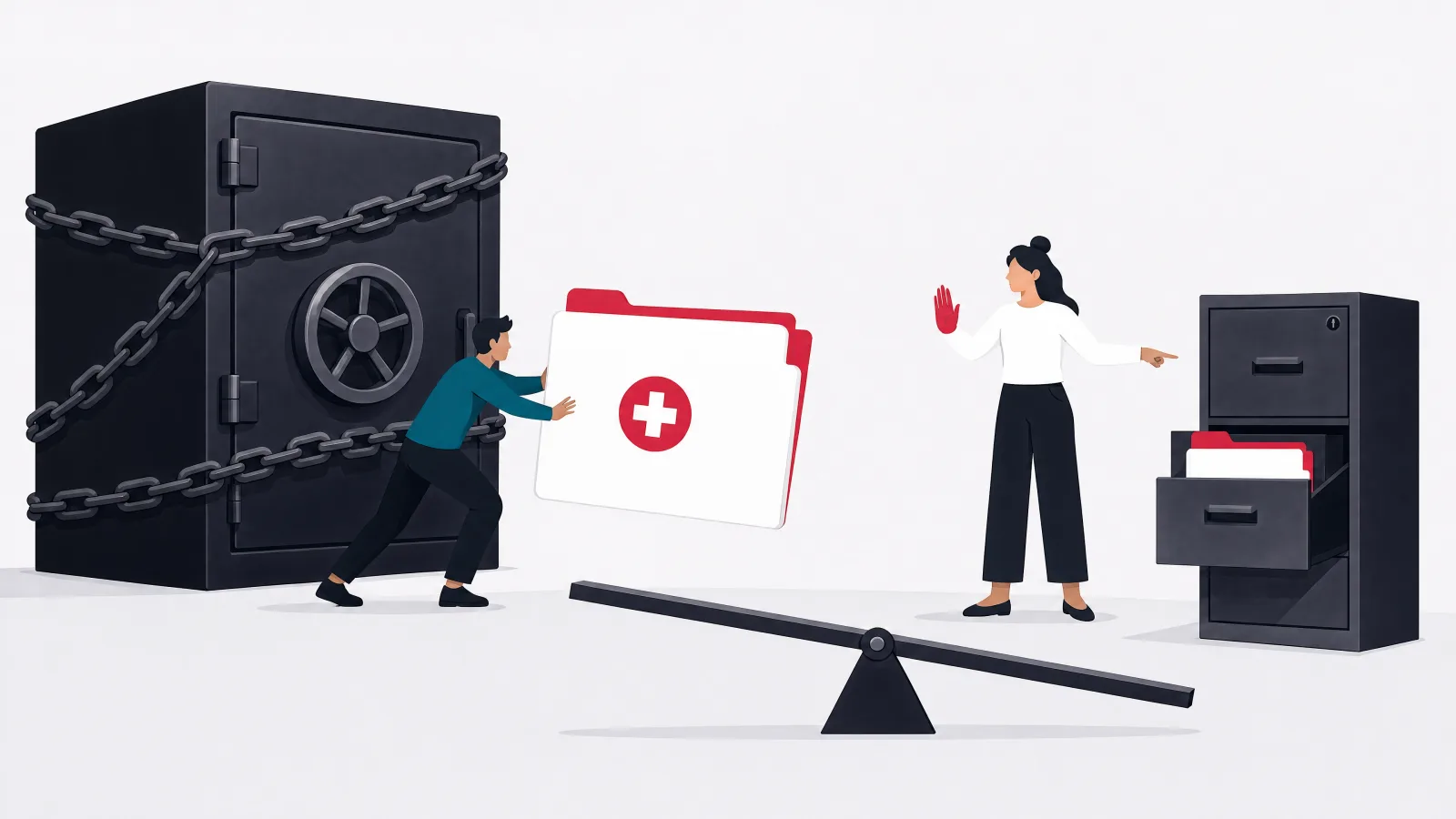
Storing complete electronic health records on a blockchain and replacing ordinary claims systems are the two proposals that surface most often and fail most reliably. Both can be implemented more safely and efficiently with conventional databases, controlled exchanges, and strong audit logging, and both fail for reasons that are structural rather than fixable by a better chain.
On-chain electronic health records fail on four independent grounds. First, medical records are too large and operationally complex for direct ledger storage: clinical notes, laboratory results, diagnostic images and corrections belong in storage systems built for large objects, lifecycle policies, backup, and rapid retrieval. Second, permanent replication multiplies privacy risk, because ledger data may be copied across many nodes, and encryption only narrows the exposure while keys, access policies, and future cryptographic weaknesses still need managing. Third, immutability collides with correction and erasure obligations: GDPR provides a right to erasure in applicable circumstances, and providers must amend records while preserving an audit trail, which a permanent ledger structurally resists. Fourth, placing a hash on-chain does not solve interoperability, since two hospitals can agree a record is unchanged while disagreeing about its structure, coding, patient identity, or clinical meaning. The defensible pattern keeps medical data off-chain entirely, with the ledger storing limited proofs, identifiers, consent events, or transaction references.
Claims processing fails for a subtler reason: it looks like a multi-party trust problem but is actually a workflow and interpretation problem. Claims involve providers, payers, patients, intermediaries, coding rules, contracts, and regulatory controls, yet they are not delayed primarily because parties lack a shared record. They are delayed by eligibility questions, coding errors, missing documentation, coverage rules, fraud checks, and clinical review. A ledger can establish when a claim or status update was submitted; it cannot resolve a disagreement over medical necessity or contract interpretation. Where the payer already operates adjudication, a blockchain layer duplicates existing databases without changing authority, and workflow automation, standardized APIs, and better data validation deliver more value with less complexity. A narrow reconciliation ledger between genuinely independent parties can still make sense, but it should never be sold as a claims platform replacement.
The pattern across both failures is worth naming, because it predicts the next fashionable proposal too: whenever the sensitive data itself is pushed on-chain, or the ledger is asked to resolve questions of meaning rather than questions of history, the project is fighting the technology instead of using it. Teams evaluating a proposal can apply this in one pass, before any architectural debate, and teams that need the records infrastructure itself are better served by conventional healthcare software development with rigorous audit logging.
Blockchain can show that a submitted record has not been changed. It cannot prove that the original entry was truthful. Everything that matters in a medical record sits in that gap.
How do the main healthcare use cases compare?
The best option depends on whether the problem is shared trust or ordinary information management. The comparison below separates what blockchain can add from features a conventional database already provides, and gives a practical verdict for each of the seven use cases healthcare teams propose most often.
Reading the table, one column matters more than the others: the simpler alternative. In every row there is one, and the question is never whether blockchain could technically be made to work but whether the alternative carries the workflow with less integration cost, less governance overhead, and fewer regulatory complications. For traceability, consent, and credentials the answer can favor the ledger when the participant structure is genuinely plural. For records and claims it essentially never does.
A recurring lesson across the table is the one stated at the top of this article: blockchain is most useful at organizational boundaries. The rows that pass all involve several independent organizations issuing or verifying information. The rows that fail all describe work that one organization, or one clearly accountable operator, already performs.
Seven healthcare use cases against the decision test
| Use case | What blockchain can add | Simpler alternative | Practical verdict |
|---|---|---|---|
| Pharmaceutical traceability | Shared custody history across independent organizations | Federated tracing platform with signed events | Strong candidate when governance is shared |
| Anti-counterfeit verification | Tamper-evident product event history | Central serialization database | Useful only with reliable physical controls |
| Patient consent history | Verifiable record of grants and withdrawals | Central consent service with immutable audit logs | Viable for cross-organization consent |
| Clinician credentials | Verification of credentials from multiple issuers | Central credential registry | Strong candidate if issuers participate |
| Electronic health record storage | Distributed copies and historical integrity | Encrypted clinical database | Usually a poor fit |
| Claims processing | Shared submission and status history | API-based workflow and reconciliation platform | Usually unnecessary for core adjudication |
| Clinical research audit events | Evidence that defined events occurred | Validated audit database | Potential fit across independent institutions |
What the ledger adds, what the simpler alternative is, and the practical verdict for each commonly proposed use case.
Private versus public chains, and the off-chain pattern

Public chains allow broad participation and rely on public network governance, a model that creates serious privacy, predictability, and control questions for regulated medical workflows: transaction visibility, fee volatility, and protocol changes decided by communities with no obligation to healthcare participants. A permissioned network is usually more practical. Participants are approved, identities are managed, access is limited by role, and the network can establish rules for node operation, software updates, dispute resolution, and participant removal.
Permissioned does not mean simple. Someone still has to operate the network, monitor nodes, manage certificates, and coordinate upgrades, and those duties need an owner with a budget rather than a committee with enthusiasm. The honest warning sign is concentration: if one organization ends up controlling every decision, the network has quietly become a distributed database with extra steps, and the team should reconsider whether a blockchain is necessary at all.
The architecture that survives regulatory review keeps as little on-chain as possible. Sensitive documents, images and personal data live in controlled off-chain systems; the ledger stores event records, cryptographic references, identifiers, and status changes. Even hashed data deserves caution, because a hash can create privacy questions if it can be connected to an identifiable person or used to confirm sensitive information by comparison. Teams building this pattern typically pair a blockchain engineering partner with the clinical systems integrators who own the off-chain side, because the boundary between the two is where most defects live.
Chain selection, in other words, is the smallest of the architecture decisions. Identity and key management, the off-chain storage design, the synchronization contract between ledger state and application state, and the integration surface with existing hospital systems each consume more engineering effort than the ledger itself, and each is a place where a mistake is expensive to reverse.
- Permissioned by default. Approved participants, managed identities, role-limited access, and written rules for operation and exit.
- Proofs on-chain, data off-chain. The ledger records that something happened. The thing itself lives in systems built for it.
- Caution even with hashes. A hash linkable to a person is personal data in practice, whatever the whitepaper says.
- An operating owner. Node monitoring, certificates and upgrades need a named owner and a budget, not a consortium press release.
HIPAA, GDPR and FHIR: the constraints that shape everything
HIPAA requires covered entities and relevant business associates to protect electronic protected health information using appropriate administrative, physical, and technical safeguards. Blockchain does not make a system HIPAA compliant, and no vendor claim survives contact with an auditor on this point. The complete architecture must address identity, access control, encryption, monitoring, incident response, backup, vendor agreements, and operational policies, exactly as it would without a ledger, plus the new question of what the ledger itself replicates and to whom.
Under GDPR, personal data requires a lawful basis and appropriate controls, and the regulation is where permanent ledgers feel the most tension. Data minimization argues for storing almost nothing on-chain. The right to erasure, where it applies, is structurally incompatible with immutable replication of personal data. The safer designs store event proofs rather than personal information, keep every erasable fact off-chain, and document the reasoning, because a design decision that cannot be explained to a regulator is a liability whatever its technical merits.
FHIR is the standard for exchanging healthcare information electronically, representing resources such as patients, observations, medications, and appointments. Blockchain does not replace FHIR or older HL7 interfaces, and the two solve different problems: interoperability standards define how healthcare information is structured and exchanged, while the ledger records agreed events or proofs about that information. In a well-shaped project the hard work lands in the integration layer, on patient matching, code mapping, legacy interface behavior, incomplete source data, and different interpretations of the same field. Those problems routinely consume more effort than the ledger, and budgeting as if the chain were the project is the most common estimating error in this category.
The regulatory vocabulary this architecture answers to
- HIPAA
- The United States framework requiring safeguards for electronic protected health information. A property of the whole system, never of a component.
- GDPR
- The European regulation governing personal data, whose minimization and erasure principles push sensitive data firmly off-chain.
- FHIR
- The interoperability standard defining how healthcare information is structured and exchanged. Complements a ledger; is never replaced by one.
- Protected health information
- Individually identifiable health data. The category of data that should essentially never appear on a ledger, hashed or otherwise.
- Permissioned network
- A ledger whose participants are approved and identified, with governance rules for operation, disputes and exit. The default for healthcare.
- Off-chain storage
- Controlled conventional systems holding the actual documents and data, referenced from the ledger by proofs and identifiers.
What does a realistic blockchain healthcare pilot look like?

A credible pilot proves one narrow cross-organization workflow. It does not attempt to replace electronic health records, claims platforms, or supply chain systems in its first release, and a proposal that promises otherwise is describing a rewrite wearing a pilot badge. The right scope is two to four participating organizations, one product, credential, or consent workflow, a permissioned ledger, off-chain storage for sensitive documents, identity and role management, one or two integrations with existing systems, an audit dashboard, exception handling with reconciliation, and a security and privacy review.
The team for that scope is compact: a product owner, a blockchain engineer, a backend engineer, an integration engineer, a QA specialist, a security advisor, and a part-time healthcare domain expert, with frontend support if participant portals or administrative dashboards are in scope. A focused technical pilot takes roughly three to five months. A production network takes considerably longer, because legal agreements, participant onboarding, data standards, operational support, and governance must be established, and those workstreams run at the speed of institutions rather than sprints.
The go or no-go decision should measure more than whether transactions appear on a ledger, because transactions appearing on a ledger is the one outcome a pilot cannot fail to produce. The measures that matter are whether multiple organizations actually participated with real data, whether disputes fell, whether reconciliation became easier, and whether the network has a sustainable owner willing to fund operations. A pilot that cannot name its go or no-go metrics before the first transaction has already chosen its conclusion.
Pilot readiness: confirm these before funding anything
- A workflow that passes the testMultiple independent writers, no acceptable single owner, costly disputes. If the sentence test fails, stop here.
- Named participating organizationsTwo to four real institutions with signed intent, not a list of logos from a partnership slide.
- Off-chain storage designed firstWhere sensitive documents live, who controls access, and what the ledger references. This design leads, the chain follows.
- Identity and role managementWho may submit which events, how issuers are trusted, and how a compromised credential is revoked.
- Go or no-go metrics in writingParticipation, dispute reduction, reconciliation effort, and a named sustainable owner, defined before launch.
- Security and privacy review scheduledHIPAA and GDPR analysis on the actual architecture, by someone empowered to fail it.
A pilot missing three or more of these is a technology demonstration, and should be budgeted and described as one.
How to run the evaluation in your own organization
The evaluation that keeps projects honest takes one structured week, not a quarter. Day one names the workflow and lists every organization that writes to it, because the census alone often settles the question: a workflow with one writer has no blockchain case. Day two applies the sentence test and forces the alternative design, meaning someone must sketch the conventional system that would solve the same problem, with real audit logging and signed events, so the ledger is compared against a genuine competitor rather than a strawman.
Day three prices governance, which is the cost dimension conventional comparisons omit. Who operates nodes, who admits and removes participants, who arbitrates disputes, who pays for the security reviews, and what happens if the largest participant leaves: each answer is a line item, and a network that cannot answer them is not cheaper than a database, it is merely unpriced. Day four takes the regulatory pass, walking the proposed data flows against HIPAA safeguards and GDPR principles with particular attention to anything personal that anyone proposed putting on-chain.
Day five writes the recommendation, and the discipline is to write it as a falsifiable claim: this workflow involves these independent writers, a neutral operator is unacceptable because of these named reasons, the ledger beats the alternative design on these measured dimensions, and the pilot will be judged by these metrics. Teams that cannot fill in that template have their answer, and it is the cheaper one. Teams that can are ready to scope a pilot with confidence, and the same template becomes the first page of the pilot charter.
Either outcome is a success. The purpose of the evaluation is not to justify a blockchain project but to route the budget to whichever architecture actually serves the workflow, and organizations that internalize the sentence test tend to run fewer, better ledger projects while their records, claims and clinical systems stay on the infrastructure that suits them.
The five-day evaluation, one artifact per day
-
Census the writersDay one
Name the workflow and every organization that submits events to it. One writer ends the evaluation.
-
Apply the test, build the rivalDay two
Run the sentence test, then sketch the conventional alternative with signed events and audit logs.
-
Price the governanceDay three
Node operation, admission, disputes, exit. Every unanswered question is an unpriced cost.
-
Run the regulatory passDay four
HIPAA safeguards and GDPR principles against the actual proposed data flows.
-
Write the falsifiable recommendationDay five
Named writers, named reasons a neutral operator fails, measured advantages, pilot metrics.
Frequently asked questions
What is blockchain in healthcare?
Blockchain in healthcare is the use of a shared, tamper-evident ledger to record transactions or verification events across healthcare organizations. It is most relevant when several independent parties need a common history without assigning full control to one participant, which is why the strongest applications sit at organizational boundaries: supply chains, consent trails, and credential networks rather than internal record keeping.
What are the best blockchain healthcare use cases?
The strongest candidates are pharmaceutical traceability, patient consent audit trails, and clinician credential verification, with clinical research audit events as a fourth where institutions are genuinely independent. These use cases share the same structure: several independent organizations issue or verify information, no single participant is a neutral owner, and the on-chain payload can be limited to proofs and events rather than sensitive data.
Can blockchain store electronic health records?
It can technically store health information, but complete electronic health records should rarely be placed directly on-chain. Record size and update frequency, privacy obligations under HIPAA and GDPR, correction and erasure requirements, and integration complexity all make secure off-chain storage more practical. The defensible pattern keeps medical data in controlled clinical systems and puts only proofs, identifiers, or event references on the ledger.
Does blockchain make medical data more secure?
Not automatically, and this is the most common misunderstanding in the category. Blockchain can make transaction history harder to alter silently, which is a specific and narrow security property. The surrounding applications, credentials, devices, integrations, and storage systems can still be compromised, and immutability cannot prove a record was truthful when submitted. Validation, identity management and access control remain the real security work.
How does blockchain work with FHIR?
FHIR defines how healthcare information is structured and exchanged, representing resources such as patients, observations, and medications. A blockchain records proofs, permissions, or transaction events related to that information, while FHIR handles the clinical data format in the systems that actually hold it. They are complements rather than alternatives, and in practice the FHIR and HL7 integration work usually consumes more engineering effort than the ledger itself.
Is blockchain necessary for healthcare data sharing?
Usually not. Secure APIs, conventional databases, and strong audit controls are sufficient when participants trust a central operator, and most healthcare data sharing happens inside exactly that trust structure. Blockchain becomes relevant in the narrower situation where shared governance and cross-organization verification are the core problems, meaning no participant can acceptably own the authoritative record. Applying that test before any architecture work is the cheapest decision a project can make.
If a use case in this evaluation belongs on your roadmap, AgileTech is an AI native software development company in Vietnam that builds both sides of the boundary: permissioned ledgers and the healthcare systems they reference.
Source: https://agiletech.vn/blog/blockchain-in-healthcare/ · (c) AgileTech Vietnam. Printed from agiletech.vn.