 Nguyen Manh Thang
Chief Executive Officer, AgileTech Vietnam
Nguyen Manh Thang
Chief Executive Officer, AgileTech Vietnam
- Published
- Last updated
- Read time
- 10 min
- Views
- 124
Read the AI overview
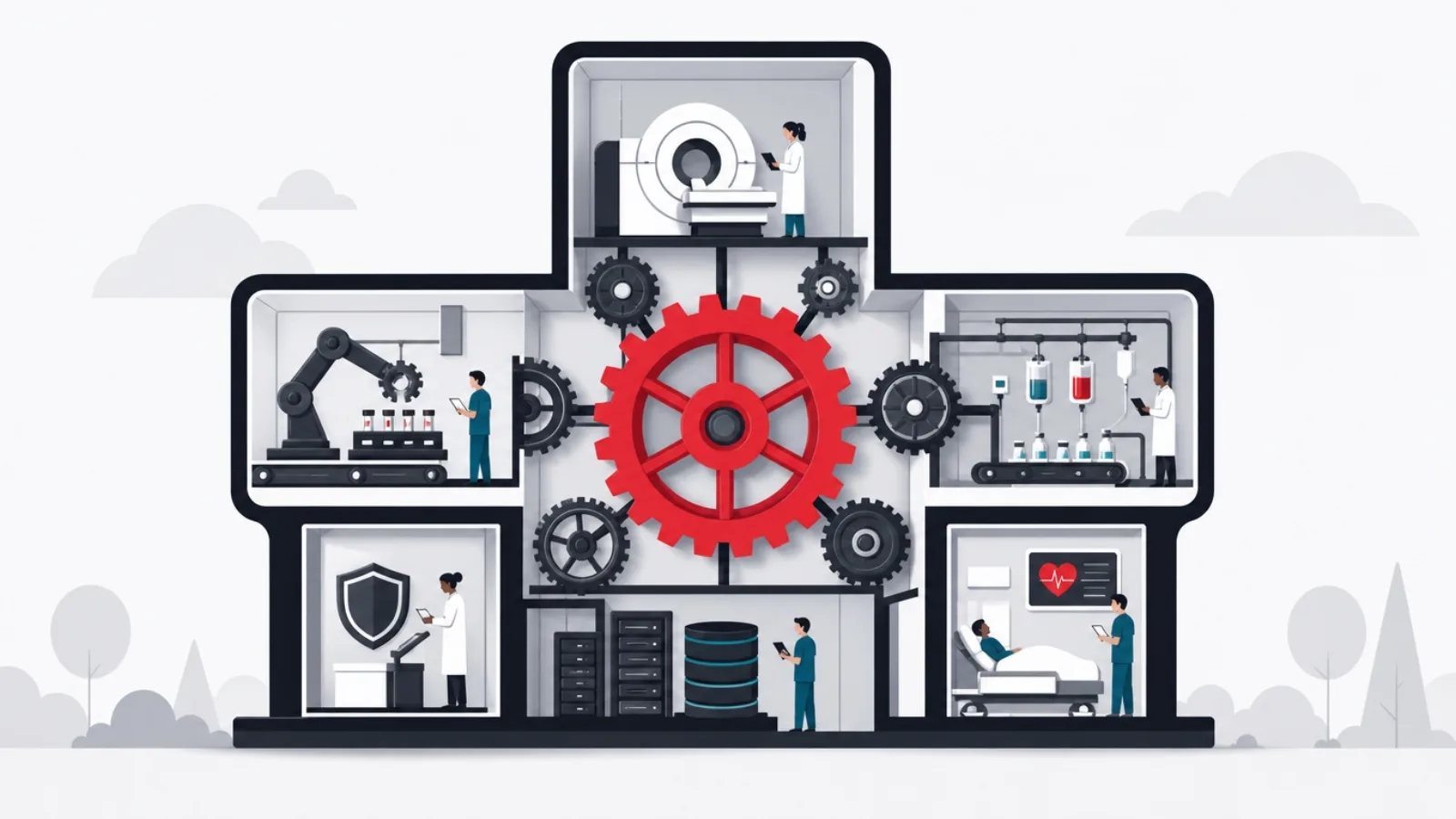
A hospital information system (HIS) is not one product but a federation of modules around a clinical core. The core is the EHR: the patient record, orders and clinical documentation. Around it sit the ancillary systems, laboratory (LIS), pharmacy, radiology (RIS/PACS), each a specialized workflow engine; the operational layer, admissions and bed flow (ADT), scheduling, and supply; and the revenue layer, charge capture, coding and billing. The modules talk over an integration fabric of HL7 v2 messages and, increasingly, FHIR APIs, and a single admission touches most of them within hours. Hospitals acquire this stack as an integrated suite from one vendor, as best-of-breed modules stitched together, or as a hybrid, and the realistic decisions today are less about greenfield builds than about modernization: replacing, wrapping or extending the estate a hospital already runs.
Walk through a mid-size hospital and count the software: the record system at every workstation, the lab's analyzer network, the pharmacy's dispensing chain, the imaging archive, the bed board on the ward wall, the scheduling screens at every desk, and the billing engine nobody sees. The industry shorthand for all of it is HIS, the hospital information system, and the first thing to understand is that it is a federation of systems, not a product, held together by an integration fabric that is itself the hardest engineering in the building.
This guide maps the federation: the clinical core and what it owns, the ancillary systems that run lab, pharmacy and imaging as specialized workflow engines, the operational and revenue layers, and the journey of a single patient admission through all of them, which is the fastest way to understand why the modules must interlock. It then covers the practical decisions: the integration standards, suite versus best-of-breed acquisition, what implementations genuinely cost, and the modernization postures for the aging estates most hospitals actually run.
It pairs with the records-layer guides in this cluster: EMR, EHR and eMAR explained covers the clinical record itself, the Cerner versus Epic comparison covers the dominant suite vendors, and the EMR integration guide goes deep on the connectivity this page can only survey. This page is the map; those are the territories.
Key takeaways
- A hospital runs a federation, not a product: a clinical core (EHR, orders, documentation), ancillary engines (lab, pharmacy, imaging), an operational layer (ADT, scheduling, beds) and a revenue layer, wired by an integration fabric.
- ADT is the heartbeat: admission, discharge and transfer events drive nearly every other module, and bed status accuracy is the operational metric hospitals feel hourly.
- The ancillary systems are workflow engines, not databases: a lab order triggers specimen tracking, analyzers, validation and results delivery, with equivalents in pharmacy and imaging.
- Integration is the real product: HL7 v2 still carries most hospital traffic, FHIR APIs carry the modern edge, and an interface engine in the middle is standard equipment.
- Suite versus best-of-breed is the permanent tradeoff: one-vendor suites buy coherence at the price of flexibility; best-of-breed buys fit at the price of integration burden.
- Most hospital software work today is modernization: wrapping legacy modules behind APIs, replacing them one at a time, and extending the estate with portals, telemedicine and analytics rather than rebuilding the core.
Not one system: the hospital software federation

The useful mental model is four layers around one spine. The clinical core is the EHR: the longitudinal patient record, the orders system through which clinicians request everything (CPOE, computerized provider order entry), clinical documentation, and decision support, allergy checks, interaction alerts, protocol reminders, woven through all of it. The ancillary layer contains the departmental engines: the laboratory information system, the pharmacy system with the eMAR closing the medication loop at the bedside, and radiology's RIS/PACS pair for workflow and images. The operational layer runs the building: ADT (admission, discharge, transfer), scheduling, bed and capacity flow, and supply. The revenue layer turns care into claims: charge capture, coding, billing and the payer conversation. Under all four runs the integration fabric, the message traffic that makes a federation behave like a system.
Why a federation rather than one program? Because the workflows are genuinely different disciplines. A lab system orchestrates specimens, analyzers and validation rules; a pharmacy system orchestrates formularies, compounding and dispensing hardware; an imaging archive moves gigabyte studies to diagnostic-grade displays; a billing engine speaks payer formats and adjudication rules. No single codebase does all of these well, which is why even the most integrated commercial suites are internally modular, and why every hospital, whatever its vendor strategy, operates an integration layer as permanent infrastructure. The architectural consequence follows: in hospital software, the interfaces are not plumbing around the product; they are the product.
The acquisition postures map onto the federation directly. The integrated suite, one vendor supplying the core and most modules, buys coherence: one patient identity, one user experience, one throat to choke, at the price of vendor lock-in, module-by-module mediocrity where the suite is weak, and the license economics the Cerner versus Epic guide describes. Best-of-breed, choosing the strongest system per department, buys departmental fit at the price of owning the integration burden and the patient-identity reconciliation across systems. The hybrid is the practical norm: a suite core with best-of-breed ancillaries where the department's stakes justify it, lab and imaging most commonly, wired through the interface engine that both postures end up needing.
Scale changes the federation's shape more than its structure. A clinic runs a practice-management-plus-EMR pair and outsources nearly everything else. A community hospital runs the full four layers at modest depth. An academic medical center adds research systems, trial matching and biobanking, teaching workflows, and a data platform that feeds both. And multi-facility health systems add the enterprise tier: a master patient index reconciling identity across facilities, enterprise scheduling, consolidated revenue cycle, and the governance machinery that keeps forty hospitals' worth of configuration coherent. The layers persist at every scale; only their depth and their politics change.
The federation vocabulary
- HIS
- Hospital information system: the umbrella term for the federation of clinical, ancillary, operational and revenue systems a hospital runs.
- ADT
- Admission, discharge, transfer: the event stream that tracks where every patient is, and the trigger feed most other modules subscribe to.
- CPOE
- Computerized provider order entry: clinicians ordering medications, labs and imaging electronically, with decision support at the point of ordering.
- LIS / RIS / PACS
- The ancillary engines: laboratory information system, radiology information system, and the picture archiving system that stores and serves imaging.
- Interface engine
- The integration hub that routes, transforms and monitors HL7 and FHIR traffic between the federation's modules.
- Master patient index
- The identity backbone reconciling one patient across modules and facilities; its failure mode, duplicate records, is a clinical safety issue.
The clinical core: record, orders, documentation
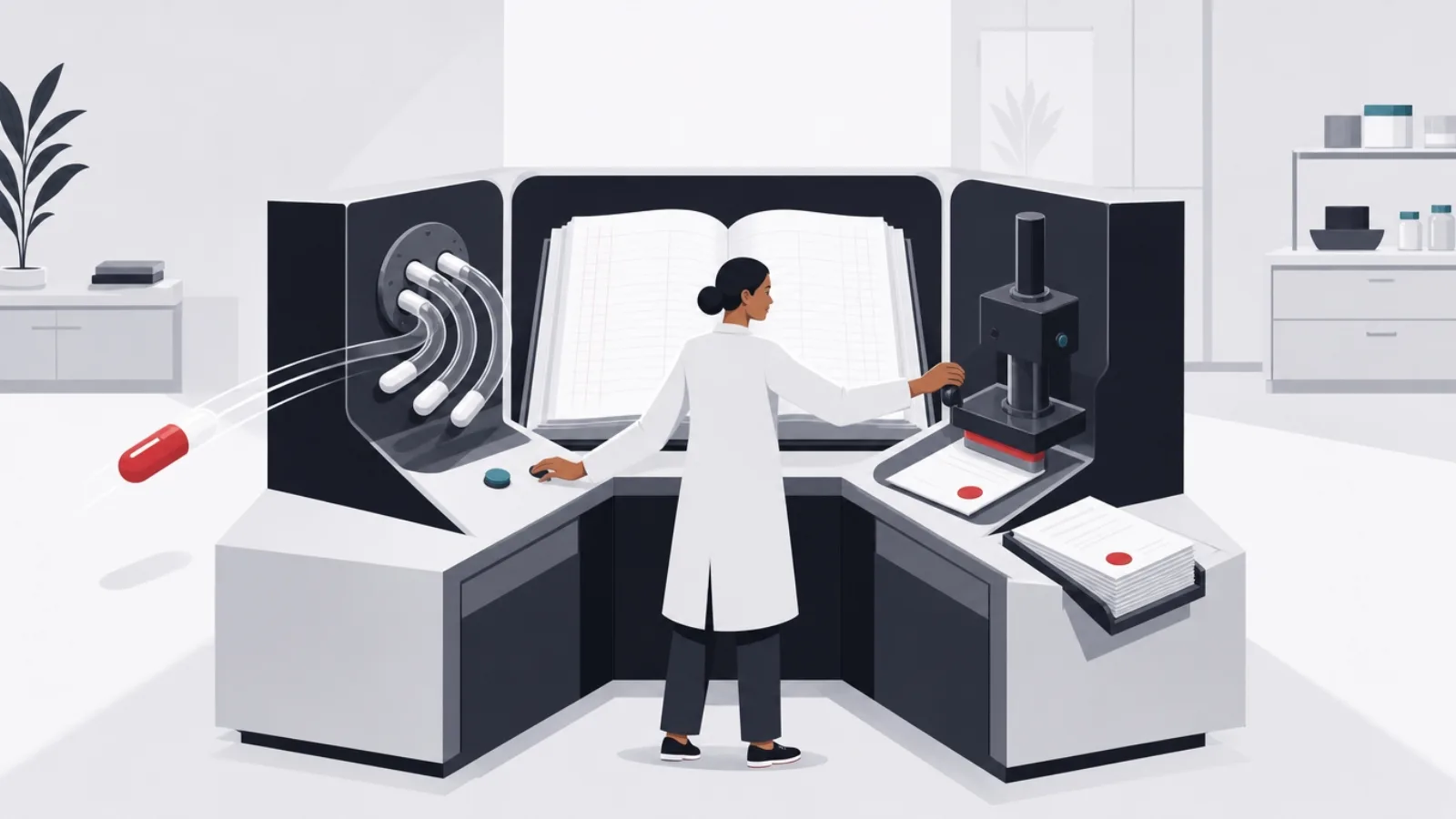
The EHR at the center owns the longitudinal record: problems, allergies, medications, histories, results, notes, the clinical truth about a patient that every other module reads and extends. The distinctions and mechanics of the record itself, EMR versus EHR versus eMAR, structured versus narrative documentation, are the records guide's territory; what matters at the federation level is the record's role as the shared state every workflow converges on. When lab results post, they post to the record. When pharmacy verifies an order, the verification lands in the record. A hospital in which any module holds clinical truth the record does not see is running a shadow chart, and shadow charts are where incidents live.
Orders are the federation's command channel. CPOE turned ordering from paper slips into structured transactions: a clinician orders a medication, a lab panel, an imaging study or a diet, decision support evaluates it at entry, allergies, interactions, duplicate therapy, renal dosing, and the order routes to the module that executes it. The design tension is alert quality: decision support that fires on everything trains clinicians to click through everything, the alert-fatigue problem that every serious implementation tunes for years, suppressing low-value alerts so the high-value ones retain their force. Order sets, pre-built bundles for common scenarios, admissions, post-op, sepsis, are where clinical standardization actually happens, and their governance, who maintains them, on what evidence cadence, is a permanent clinical-informatics function.
Clinical documentation is where the record meets the clock. Inpatient documentation spans admission notes, daily progress notes, procedure notes and discharge summaries, structured where data must be computable, flowsheets, vitals, scores, and narrative where clinical reasoning lives. The burden is real and measured: documentation consumes hours of clinician time daily, which is why ambient AI scribing and template ecosystems are the current battleground, and why nursing documentation, flowsheets, assessments, care plans, the eMAR loop, dominates by volume. The federation-level point: documentation quality downstream determines coding accuracy, quality reporting and revenue, so the revenue layer's health is decided at the bedside keyboard, a dependency hospitals learn expensively.
The core's hardest non-clinical job is identity and access. One patient, one record: the master patient index enforces it across registration desks, interfaces and facilities, with duplicate-detection algorithms and a human reconciliation queue, because a patient split across two records has half a history in each, and a merge done wrong is worse. Access control in a hospital is relationship-based and break-glass-capable: clinicians see patients under their care, emergencies override with audit, and every record touch logs immutably, the same compliance-as-architecture posture the rest of this cluster describes, at hospital scale. These are the invisible systems that make the visible ones safe.
The ancillary engines: lab, pharmacy, imaging
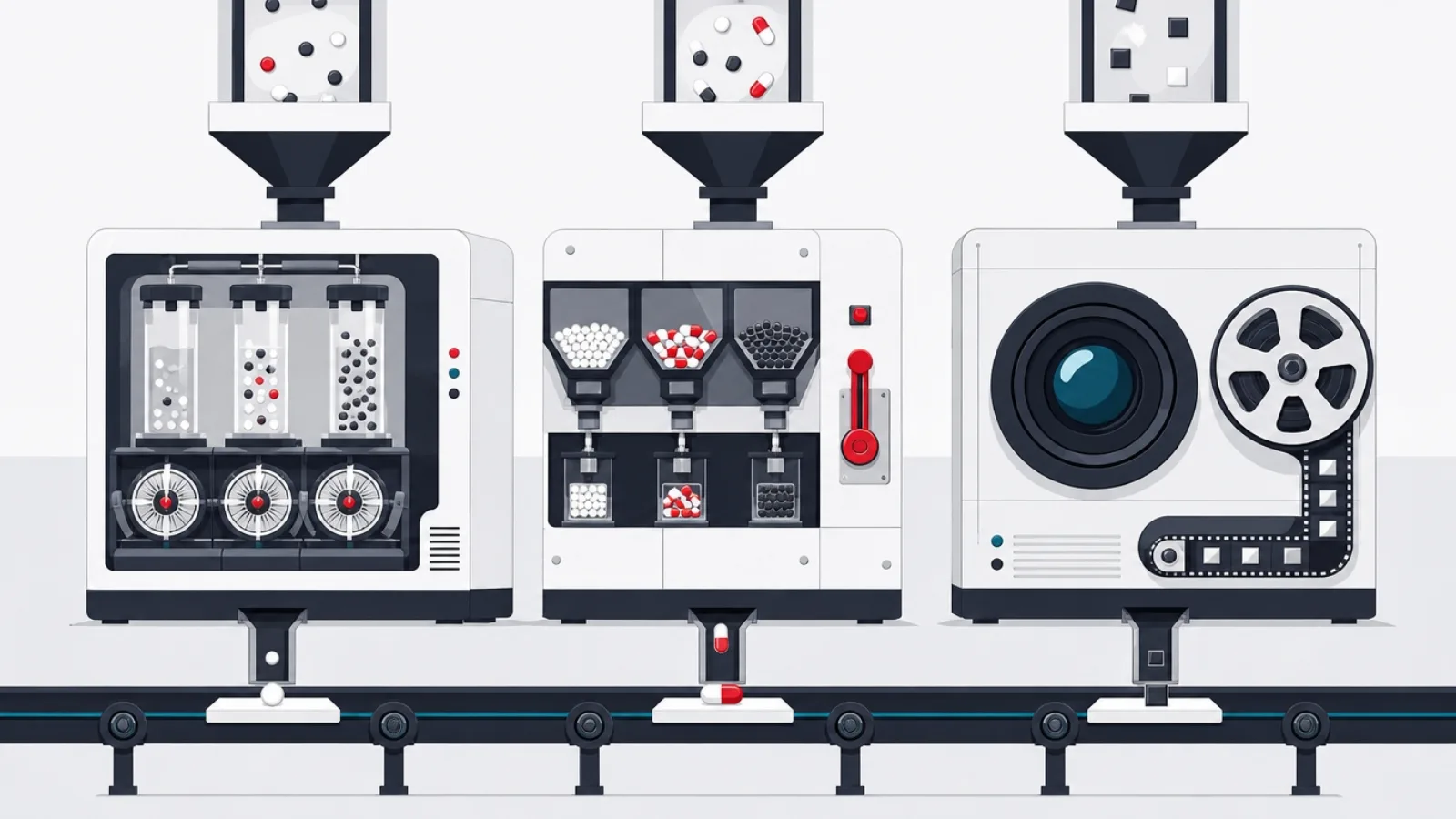
The laboratory information system is the highest-volume engine in the building: a mid-size hospital processes thousands of specimens daily, and the LIS orchestrates all of them. The loop runs from order to specimen, barcoded collection with positive patient identification, through accessioning, analyzer routing, the instrument interfaces that stream results back, auto-validation rules that release normal results untouched and hold abnormal ones for technologist review, to results delivery with critical-value alerting, a stat potassium calls the clinician, not just the chart. Microbiology, blood bank and pathology add their own sub-workflows, blood bank with the most unforgiving safety logic in the hospital. The LIS is the classic best-of-breed candidate precisely because this depth is hard for suite vendors to match.
The pharmacy chain closes the medication loop, the safety-critical path the eMAR guide traces bedside-down. An order from CPOE arrives for pharmacist verification, dose, interactions, renal function, formulary substitution; dispensing routes through automation, carousel cabinets centrally, automated dispensing cabinets on the wards, with sterile compounding as its own regulated workflow; and administration happens at the bedside under barcode verification, right patient, right drug, right dose, right route, right time, recorded on the eMAR. The engineering signature of the chain is its integration density: CPOE to pharmacy to cabinet to eMAR to the record, every hop a message, every gap a place where the loop's safety guarantees leak.
Imaging runs on the RIS/PACS pair, with the enterprise trend consolidating both. The RIS handles the workflow, scheduling, protocols, radiologist worklists, reporting; the PACS stores and serves the studies, multi-gigabyte objects delivered to diagnostic-grade displays over DICOM, the imaging world's own standard. Modern estates converge on a vendor-neutral archive holding all imaging, radiology, cardiology, dermatology photos, scope video, behind standard interfaces, with AI-assisted reading entering the radiologist's worklist as triage and second-read. Imaging's data mass shapes hospital infrastructure disproportionately: storage, network and disaster-recovery designs are sized by PACS before anything else.
The pattern across all three engines repeats and generalizes: each is a specialized workflow orchestrator wrapped around hardware, analyzers, dispensing cabinets, scanners, with its own regulatory context and its own results flowing back to the record. The same pattern extends to the smaller ancillaries, dietary, respiratory therapy, physical therapy, sterile processing, each a lighter engine on the same shape. For teams building or integrating hospital software, the design implication is constant: model the department's physical workflow first, hardware and handoffs included, because the software's job is to orchestrate a physical process, and the incidents happen where the digital model and the physical reality disagree.
The three big engines, side by side
| Engine | Orchestrates | Wraps | Signature challenge |
|---|---|---|---|
| LIS (laboratory) | Order to specimen to result, validation, critical values | Analyzers, barcode tracking | Volume plus auto-validation rule safety |
| Pharmacy + eMAR | Verification, dispensing, bedside administration | Cabinets, compounding, barcode scanners | Closing the loop across five systems |
| RIS / PACS | Scheduling, worklists, reading, reporting | Scanners, diagnostic displays | Data mass: storage, network, DR sizing |
The major ancillary systems as workflow orchestrators: what each runs, the hardware it wraps, and its signature engineering challenge.
The operational and revenue layers
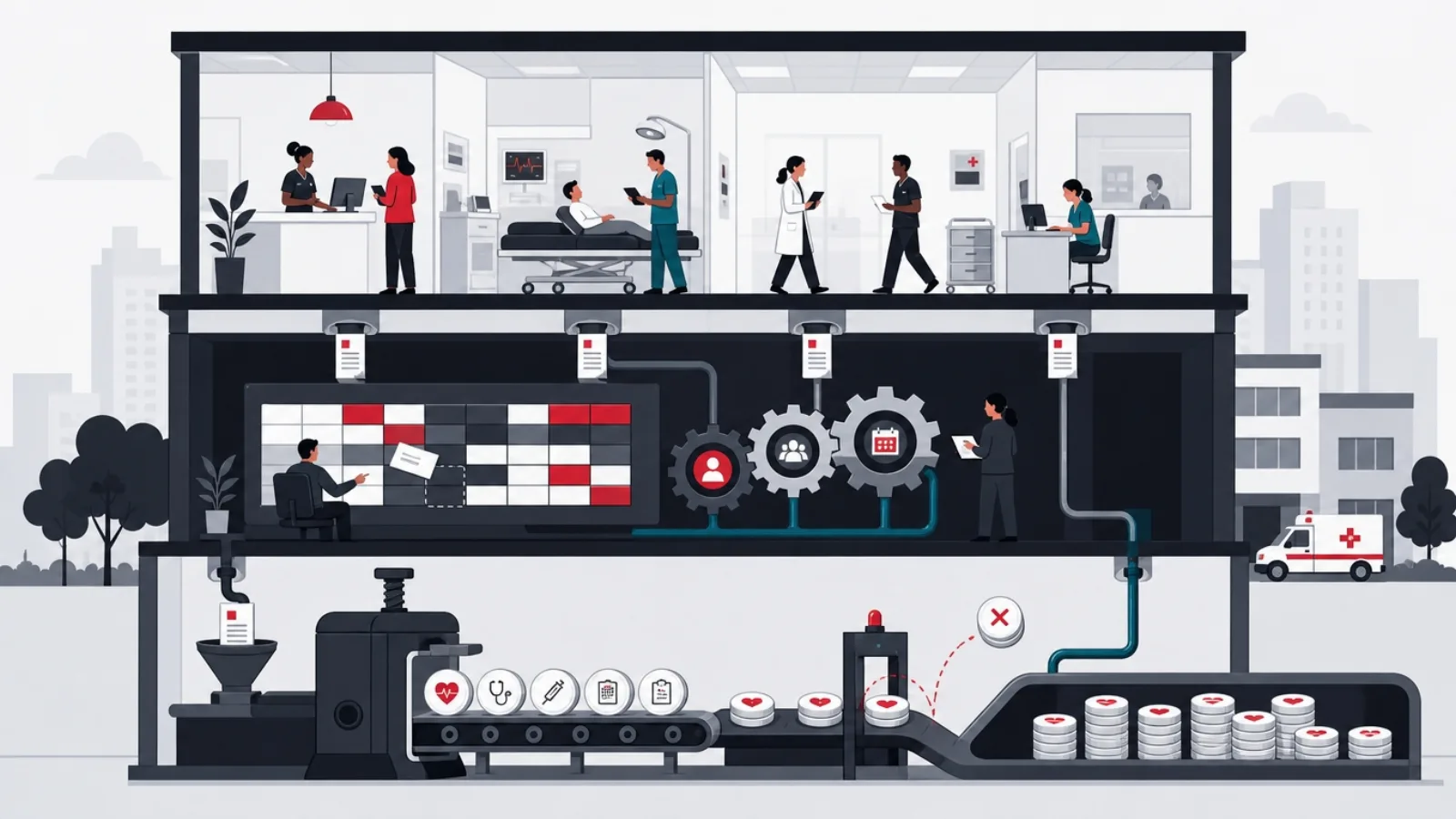
ADT is the operational heartbeat. Every admission, transfer and discharge is an event, and the event stream drives the federation: the bed board updates, dietary gets the new ward, the lab's pending draws re-route, pharmacy's cabinets re-profile, and billing opens or closes an account. Bed and capacity flow is the discipline built on top: real-time bed status, environmental services turnaround, the discharge-lounge and transfer-center logic that keeps a full hospital moving, with emergency-department boarding as the visible symptom when flow fails. Hospitals measure flow hourly, length of stay, boarding hours, discharge-before-noon rates, and the operational systems that improve these numbers pay for themselves faster than almost anything clinical, which is why capacity command centers are the decade's signature operational investment.
Scheduling spans three different problems wearing one name: outpatient appointment scheduling with visit-type and payer rules; procedural scheduling, operating rooms above all, where a schedule coordinates rooms, surgeons, anesthesia, equipment trays and sterile processing, and where an OR minute is the most expensive unit of time in the building; and workforce scheduling, nurse staffing against acuity and ratio rules, the domain where hospital operations meets labor reality. The three interlock: a surgical case books a room, a team, equipment and a bed downstream, and the systems that model those dependencies honestly are the ones that survive contact with a real OR board.
The revenue layer converts documented care into cash, and its architecture mirrors the clinical flow it shadows. Charge capture harvests billable events from clinical activity, orders, procedures, medications, time; coding translates documentation into the code sets payers adjudicate (ICD diagnoses, procedure codes, DRGs for inpatient episodes), increasingly with computer-assisted coding drafting from the documentation itself; claims generate, scrub against payer rules, transmit through clearinghouses, and return as payments and denials; and denial management works the exceptions, appealing, correcting, learning. The dependency this layer never escapes: coding quality is documentation quality, which is decided in the clinical core, which is why revenue-cycle projects so often become documentation projects in disguise.
Around these layers sits the analytics estate, the layer modernization keeps expanding: the data warehouse or lakehouse fed by every module, quality and regulatory reporting, infection surveillance, readmission and deterioration models, and the operational dashboards that turn ADT exhaust into capacity decisions. The architectural rule learned across the industry: analytics reads from the operational systems, it never becomes the integration path between them, and the hospitals that let reporting extracts become de facto interfaces spend years untangling the result. Analytics is the federation's memory and its instrument panel; the message fabric remains its nervous system.
The operational layer, in numbers
One admission, end to end: the federation in motion
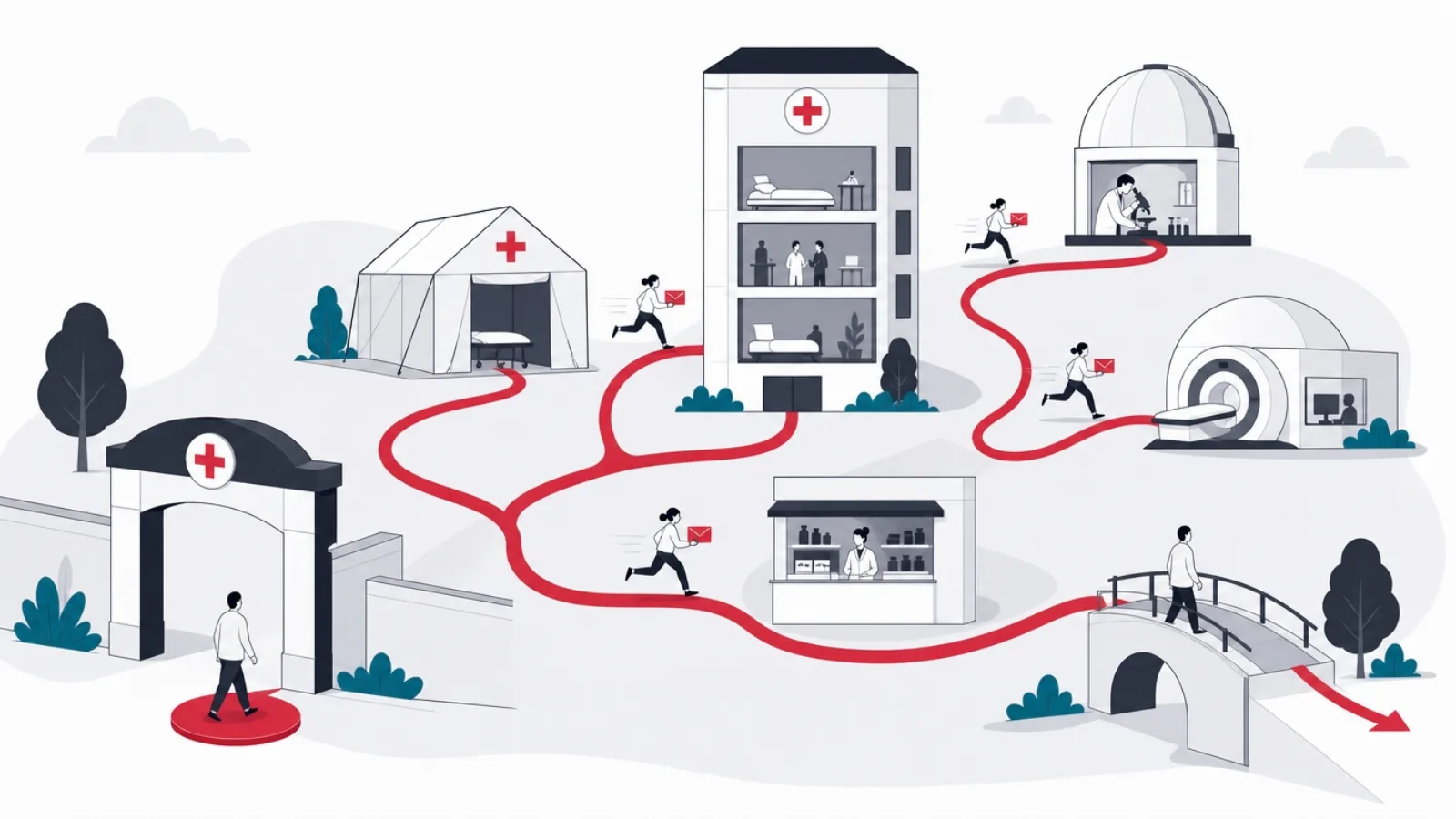
Follow a single emergency admission and the federation stops being abstract. A patient arrives in the ED; registration finds or creates their record, the master patient index doing its quiet duplicate-prevention work, and an ADT event announces the arrival. Triage documents onto flowsheets; the ED physician orders through CPOE, bloods, an ECG, a chest X-ray, and the orders fan out: the LIS prints specimen labels and the phlebotomy worklist updates, the RIS schedules the portable X-ray, and decision support has already checked the medication order against the allergy list. Within the first hour, five systems have transacted around one patient, and every transaction has landed back in the record.
Results drive the next moves. The analyzer streams the blood panel to the LIS, auto-validation releases most of it, and a critical value pages the physician directly. The radiologist reads the study from the PACS worklist and the report posts. The decision is admission: an ADT event converts the encounter, the bed system finds a ward bed against infection-control and acuity rules, environmental services confirms it clean, and transport moves the patient. Dietary, nursing assignment and the pharmacy cabinet profile all update from the same event stream, nobody phoned anybody, which is precisely the point. The admitting team's order set lands the standard bundle: medications to pharmacy verification, daily labs to the LIS, VTE prophylaxis prompted by decision support.
The inpatient days run the loops this guide has already traced: medication rounds under barcode verification onto the eMAR, morning draws through the lab loop, progress notes accumulating, the bed board and capacity center watching length of stay. Discharge is its own orchestrated workflow, and the industry's hardest-won lesson: reconciliation of medications, prescriptions to the patient's pharmacy over the eRx rails, the discharge summary to the primary-care physician over whatever interoperability path exists, follow-up appointments booked, and patient instructions delivered through the portal. The ADT discharge event releases the bed, closes the account, and hands the revenue layer a complete episode: charges captured along the way, documentation coded into a DRG, the claim scrubbed and gone.
Read as an engineering case, the admission makes the guide's argument better than any diagram. Every step was a message between specialized systems; the patient's safety depended on identity integrity and the record's completeness; the hospital's economics depended on events captured as they happened; and no single vendor's product performed even half of the steps. This is why hospital software work, whether implementing a suite, integrating a module, or building something new at the estate's edge, is systems engineering before it is application engineering, and why the teams that succeed in it are the ones that map the message flows before they write the first screen.
The integration fabric: HL7, FHIR, and the engine in the middle
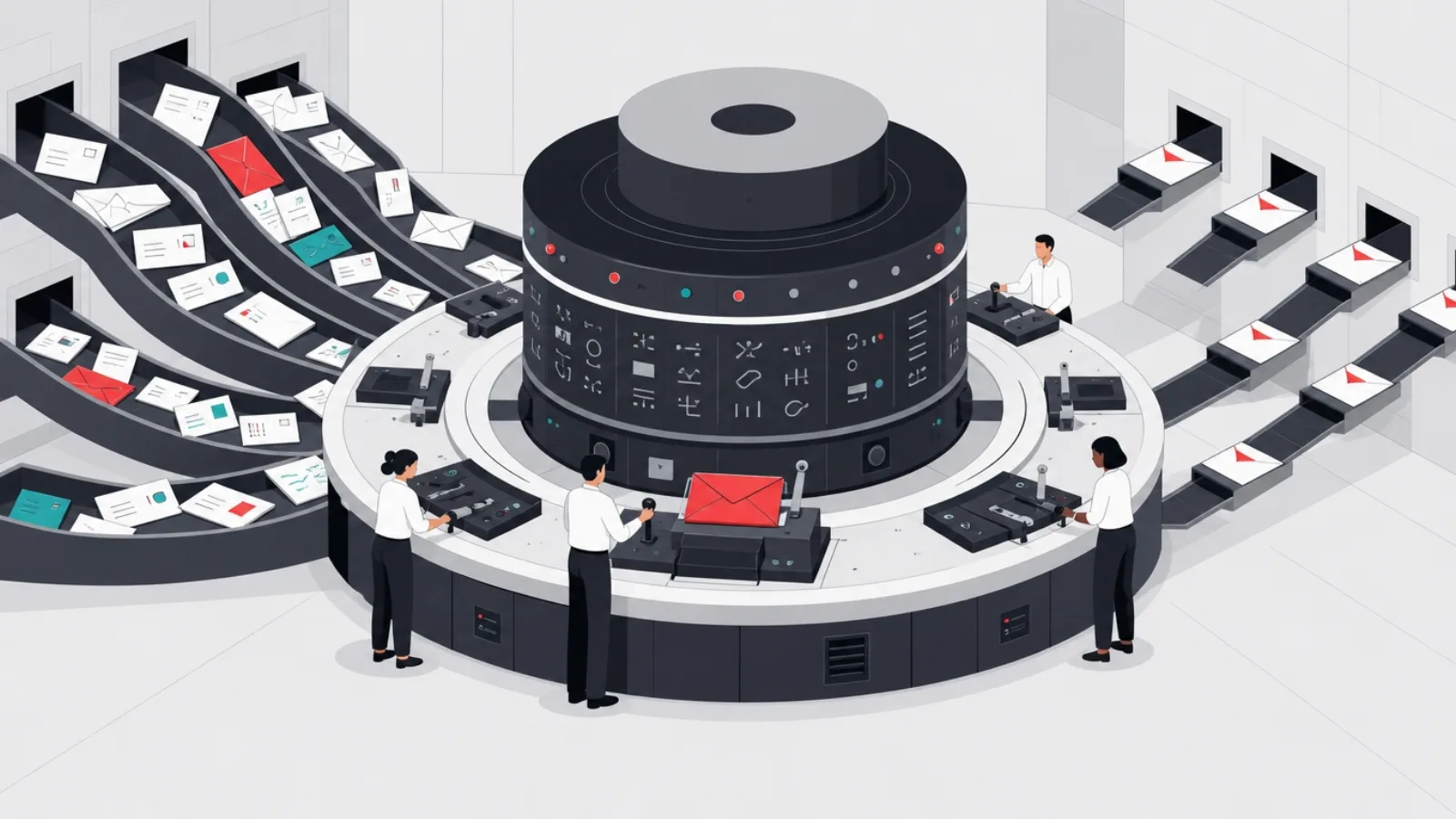
The fabric's workhorse remains HL7 v2: pipe-delimited event messages, ADT feeds, order messages, result messages, flowing point to point in their thousands per hour. Its virtues are ubiquity and forty years of installed base; its vice is dialect, every system implements the segments slightly differently, which is why the interface engine exists: the central hub that receives, transforms, routes and monitors the traffic, mapping one system's dialect to another's, queuing through outages, and alerting when a feed goes quiet. An interface engine with hundreds of active interfaces is normal for a mid-size hospital, and the engine team's run-book, which feeds exist, what each carries, who owns each end, is among the most valuable documents in the building.
FHIR is the modern edge, and its adoption pattern is precise: regulation forced EHR vendors to expose standardized FHIR APIs for patient access and data exchange, so FHIR now dominates the new surfaces, patient apps, provider-facing extensions, payer exchange, population analytics, while HL7 v2 continues to carry the interior traffic between the federation's installed modules. SMART on FHIR adds the app-platform layer: third-party applications launching inside the EHR with contextual access, which is the sanctioned path for extending the clinical core without forking it. The practical stance for builders, developed fully in the EMR integration guide: new products speak FHIR first, expect HL7 v2 at hospital boundaries for years yet, and treat DICOM, X12 and the eRx rails as the specialized lanes they are.
Identity stitches the fabric together, and deserves its named place: the master patient index reconciles the patient across modules and facilities, and its enterprise sibling reconciles clinicians, one physician across credentialing, ordering, scheduling and billing identities. Merge and unmerge machinery, probabilistic matching tuned against both false merges and false splits, and the governance queue of human-reviewed edge cases are permanent operations, not a project. Every integration failure mode worth fearing, results on the wrong chart, duplicate records diverging, orphaned orders, is an identity failure first, which is why identity work is the least glamorous and most consequential engineering in the estate.
Beyond the hospital's walls, the fabric extends into interoperability networks: national and regional exchange frameworks through which records follow patients between organizations, payer data exchange, public-health reporting feeds, and the e-prescribing and lab networks already threaded through this cluster. The direction of travel is steady, more FHIR, more network-mediated exchange, more regulatory teeth against information blocking, and the design consequence for anyone building at the estate's edge is optimistic: the interfaces are more open, better documented and more enforceable than they have ever been, and integration capability has shifted from a moat guarded by incumbents toward an engineering discipline a good team can genuinely own.
Integration discipline in the federation
Do this
- Put an engine in the middleRoute, transform, queue and monitor centrally. Point-to-point spaghetti is unmanageable past a dozen feeds.
- Speak FHIR first at new edgesPatient apps, extensions and analytics ride the regulated modern APIs; keep HL7 v2 fluency for the interior.
- Treat identity as an operationMPI matching, merge queues and governance run forever. Every scary failure mode is an identity failure first.
- Monitor feeds like clinical dutiesA quiet ADT or results feed is a patient-safety event in progress. Silence alerts, not just error alerts.
Not this
- Integrate through the warehouseAnalytics extracts as de facto interfaces create untraceable, lagging data paths. Reads only, never the fabric.
- Assume the standard is standardEvery HL7 v2 implementation is a dialect. Budget mapping and testing per feed, per counterparty.
- Let a module hoard truthClinical data that never reaches the record is a shadow chart. Integration capability outranks features in procurement.
- Skip the run-bookUndocumented interfaces become archaeology. The feed inventory, owners and payloads are estate-critical documents.
Implementation reality and the modernization playbook
Suite implementations are among the largest projects a hospital ever runs, and the numbers deserve sober statement: a full EHR-suite implementation at a mid-size hospital runs one to three years and tens of millions of dollars, with large health systems spending hundreds of millions, and the software license is routinely a third or less of the total, the rest being integration, data migration, configuration, training and the go-live surge staffing. The failure modes are equally well documented: configuration by committee producing thousand-click workflows, under-invested training surfacing as a productivity crater at go-live, and data migration treated as an afterthought until the legacy archive question, what happens to twenty years of records, blocks the cutover. Hospitals that succeed run implementations as clinical transformation programs with engineering inside them, not the reverse.
For most organizations, though, the realistic frame is not greenfield but modernization of a running estate, and the postures are recognizable. Replace: swap a module, or the whole suite, with a modern successor, the highest-risk, highest-ceiling move, sequenced module by module where the architecture allows. Wrap: leave the legacy system running and put modern APIs in front of it, an integration facade that lets new products build against clean interfaces while the old core ages in place, the pattern that dominates because it converts risk into optionality. Extend: build the new capability, the patient portal, the telemedicine channel this cluster's platform guide describes, the analytics layer, the RPM program, at the estate's edge over the wrapped interfaces, which is where most new hospital software engineering actually happens.
The sequencing rule that keeps modernization survivable: stabilize identity and integration first, the MPI and the interface engine are the foundations everything else assumes; then modernize at the edges where clinical risk is lowest and value is fastest, portals, scheduling, analytics; and only then, with the fabric proven and the team fluent, take on core replacements, one module at a time, each behind a rollback plan. Big-bang core replacements have their place, sometimes the legacy vendor forces the issue, but the graveyard of hospital IT is full of simultaneous everything-migrations, and the postures above exist precisely to avoid joining it. Every step's gate is clinical continuity: care delivery uninterrupted, safety loops intact, and the one-admission walkthrough passing before and after.
For the teams doing this work, the capability profile is consistent whether they sit inside the hospital or at a partner: healthcare integration fluency, HL7, FHIR, the identity discipline, security and compliance as reflexes, and the workflow humility to model the physical hospital before writing screens. That profile is scarce and expensive onshore, which is why hospital IT increasingly blends internal teams with specialized partners, under the same selection rule this cluster keeps repeating: regulated-domain portfolios and integration war stories outrank generic scale claims entirely. The estate is a federation; the teams that serve it well are federations too, stitched by exactly the disciplines this guide has mapped.
The modernization sequence
-
Stabilize the foundationsFirst
Master patient index health, interface engine coverage, feed run-books and monitoring. Everything else assumes these.
-
Wrap the legacy coreSecond
Modern APIs in front of aging modules: an integration facade that lets new work build against clean contracts.
-
Extend at the edgesThird
Portals, telemedicine, analytics, RPM: fast-value, lower-risk additions over the wrapped interfaces.
-
Replace, one module at a timeFourth
Core swaps with rollback plans, sequenced by risk. The one-admission walkthrough passes before and after each.
Frequently asked questions
What is a hospital information system (HIS)?
The umbrella term for the federation of software a hospital runs: a clinical core (the EHR with orders, documentation and decision support), ancillary engines for laboratory, pharmacy and imaging, an operational layer for admissions, beds and scheduling, and a revenue layer for coding and billing, all connected by an integration fabric of HL7 and FHIR traffic. It is a federation of specialized systems, not a single product, even when one vendor supplies most modules.
What modules does a hospital system include?
The clinical core: patient record, CPOE order entry, documentation, decision support. Ancillary engines: the LIS for laboratory, the pharmacy chain with eMAR for medications, RIS/PACS for imaging. Operations: ADT (admission, discharge, transfer), bed and capacity flow, outpatient, OR and workforce scheduling. Revenue: charge capture, coding, claims and denial management. Plus the invisible load-bearing pieces: the master patient index, the interface engine, and the audit and access-control machinery.
Should a hospital buy an integrated suite or best-of-breed modules?
The suite buys coherence: one identity, one experience, one vendor relationship, at the price of lock-in and weaker departmental fit where the suite is thin. Best-of-breed buys departmental depth, classically in lab and imaging, at the price of owning the integration and identity-reconciliation burden. The practical norm is hybrid: a suite core with best-of-breed ancillaries where stakes justify it, wired through an interface engine, which both postures need anyway.
How do hospital systems talk to each other?
Through an integration fabric with two main dialects: HL7 v2 event messages, ADT feeds, orders, results, still carry most interior traffic between installed modules, while FHIR APIs carry the modern edge, patient apps, extensions, analytics, payer exchange, under regulatory mandate. An interface engine in the middle routes, transforms, queues and monitors the traffic, and the master patient index keeps one patient one record across all of it. Imaging adds DICOM; billing adds X12; prescribing adds the eRx rails.
How much does implementing a hospital system cost?
A full suite implementation at a mid-size hospital runs one to three years and tens of millions of dollars, with large health systems spending hundreds of millions; the software license is typically a third or less of the total, with integration, data migration, configuration, training and go-live staffing carrying the rest. Modernization postures cost radically less: wrapping legacy modules behind modern APIs and extending at the edges delivers new capability in months without touching the core's risk.
How do hospitals modernize legacy systems without a risky big-bang replacement?
The proven sequence: stabilize identity and integration first (master patient index health, interface engine coverage, feed documentation); wrap legacy modules behind modern API facades so new work builds against clean contracts; extend at the edges where risk is low and value fast, portals, telemedicine, analytics, remote monitoring; and only then replace core modules one at a time behind rollback plans. The gate at every step is clinical continuity, tested by tracing a full admission end to end before and after.
If your organization is commissioning any part of this stack, AgileTech is a leading software development company in Vietnam that builds hospital systems with the interoperability work priced honestly.
Source: https://agiletech.vn/blog/hospital-system-guide/ · (c) AgileTech Vietnam. Printed from agiletech.vn.