 Nguyen Manh Thang
Chief Executive Officer, AgileTech Vietnam
Nguyen Manh Thang
Chief Executive Officer, AgileTech Vietnam
- Published
- Read time
- 14 min
Read the AI overview
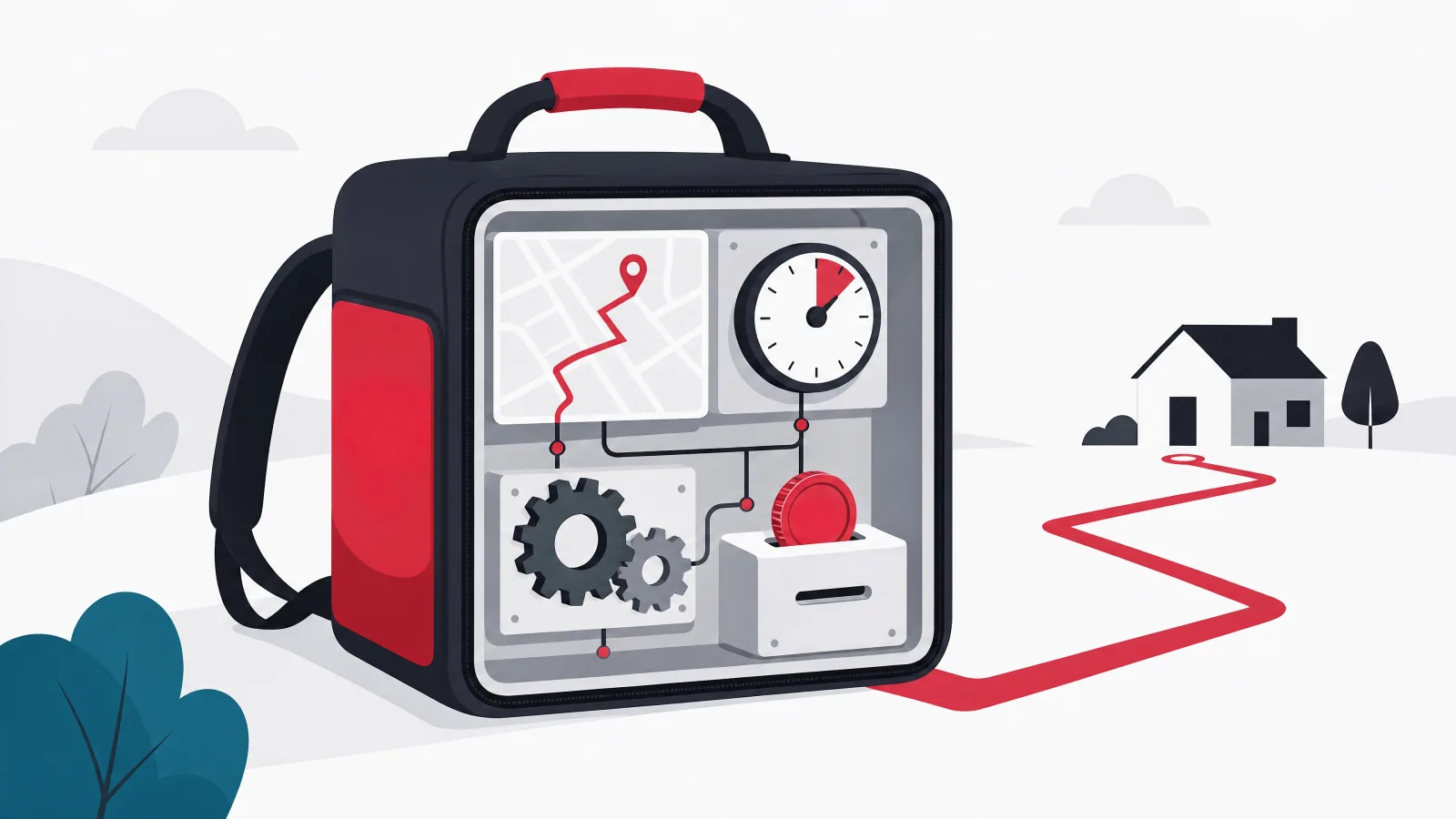
A food delivery app like Uber Eats is a three-sided marketplace connecting customers, restaurants, and couriers, and it is harder to build than a normal ecommerce app because inventory, preparation, dispatch, location, payments, and support must stay synchronized in real time. The visible customer app is one of at least four systems: a working platform also needs restaurant software, a courier app, an operations console, and a dispatch backend coordinating one consistent order state across all of them. A focused MVP for one city typically costs about USD 60,000 to 150,000 over four to nine months; a broader production platform runs USD 180,000 to 400,000 or more. The technology, however, is the smaller risk: most food delivery startups fail on unit economics, because contribution margin per completed order does not improve enough with growth. The responsible build starts narrow, one zone, one delivery model, a controlled restaurant group, and proves reliable, reconciled fulfillment before adding breadth.
A food delivery app like Uber Eats is a three-sided marketplace connecting customers, restaurants, and couriers. It is harder to build than a normal ecommerce app because inventory, preparation, dispatch, location, payments, and support must stay synchronized in real time, and any one of them drifting out of sync produces a customer standing at a door with no food and a support queue filling up.
The visible customer app is only one part of the product. A working platform also needs restaurant software, a courier app, operational tools, and a dispatch backend that coordinates the entire order lifecycle. This guide walks through all of it: the applications and features each participant needs, the architecture that keeps one order state consistent, the five genuinely hard technical problems, the unit economics that decide survival, and what an honest budget and timeline look like.
Two companion pieces frame this one. How to build an app like Grab covers the mobility-marketplace pattern this category grew from, and how DoorDash works for restaurants shows the merchant side of an operating platform in the wild. Here, the subject is building the delivery platform itself, from first pilot to production scale, with the mobile engineering realities kept in view throughout.
Key takeaways
- You are building three connected applications plus a marketplace operating system, and the dispatch backend and operational tooling are usually harder than the browsing and checkout screens everyone estimates first.
- The architecture should center on an explicit order state machine and an auditable financial ledger. Real-time features decorate those foundations; they cannot replace them.
- The hardest technical problems are dispatch timing, location tracking under real-world conditions, delivery estimates dominated by kitchen variance, financial reconciliation, and batching. None is a secondary enhancement.
- Unit economics kill more delivery startups than technology does. Model the completed order, not the download, and treat density as the variable that decides whether the model works.
- A focused MVP costs about USD 60,000 to 150,000 across four to nine months. Cutting the courier exception workflow, the ledger, or the operations console is false economy that surfaces with the first failed orders.
- Launch in one narrow zone with a controlled restaurant group and measure repeat behavior before expanding. A broad map looks impressive while producing slow deliveries and poor courier utilization.
What are you actually building?
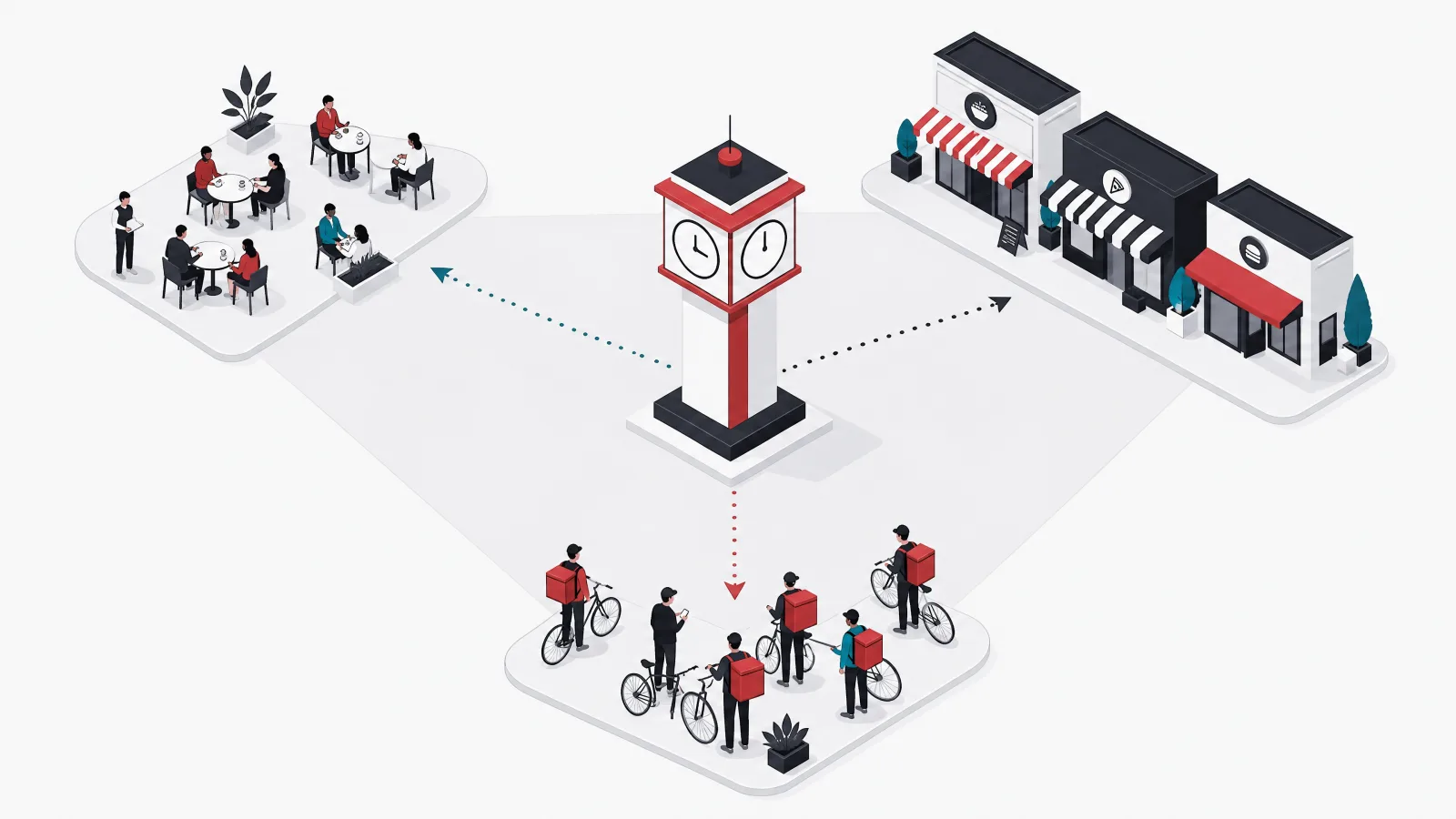
You are building three connected applications and a marketplace operating system. Each participant sees a different workflow, but every action must update one consistent order state, and that single sentence is the source of most of the engineering difficulty in this category. A customer expects accurate menus, reliable checkout, live status updates, and a predictable delivery time. A restaurant needs to control availability, accept orders, manage preparation, and resolve exceptions. A courier needs safe navigation, clear pickup instructions, earnings visibility, and fast support.
Behind those interfaces, the platform must validate service areas, calculate fees, route orders to restaurants, match couriers to deliveries, process payments, track preparation and travel, recalculate delivery estimates, handle cancellations and refunds, calculate restaurant and courier payouts, and give support agents a complete order history. Every one of those responsibilities exists whether or not it appears in the pitch deck, because the first real order that goes wrong exercises all of them at once.
A common planning mistake is estimating only the customer application. The dispatch backend and operational tooling are usually more difficult than the browsing and checkout screens, and they are invisible in competitor teardowns precisely because they are backend systems. Teams that discover this in month four have not discovered a scope change; they have discovered the actual product, and the budget conversation that follows is the one this article exists to have early.
- Customer app. Discovery, menus, checkout, live status. The visible tenth of the platform.
- Restaurant software. Order acceptance, preparation status, menu and availability control, built for a loud kitchen.
- Courier app. Job offers, navigation, proof of delivery, earnings, and predictable behavior on weak networks.
- Dispatch and operations. The order state machine, courier matching, and the console support agents live in. The hard part.
Which applications and features are required?
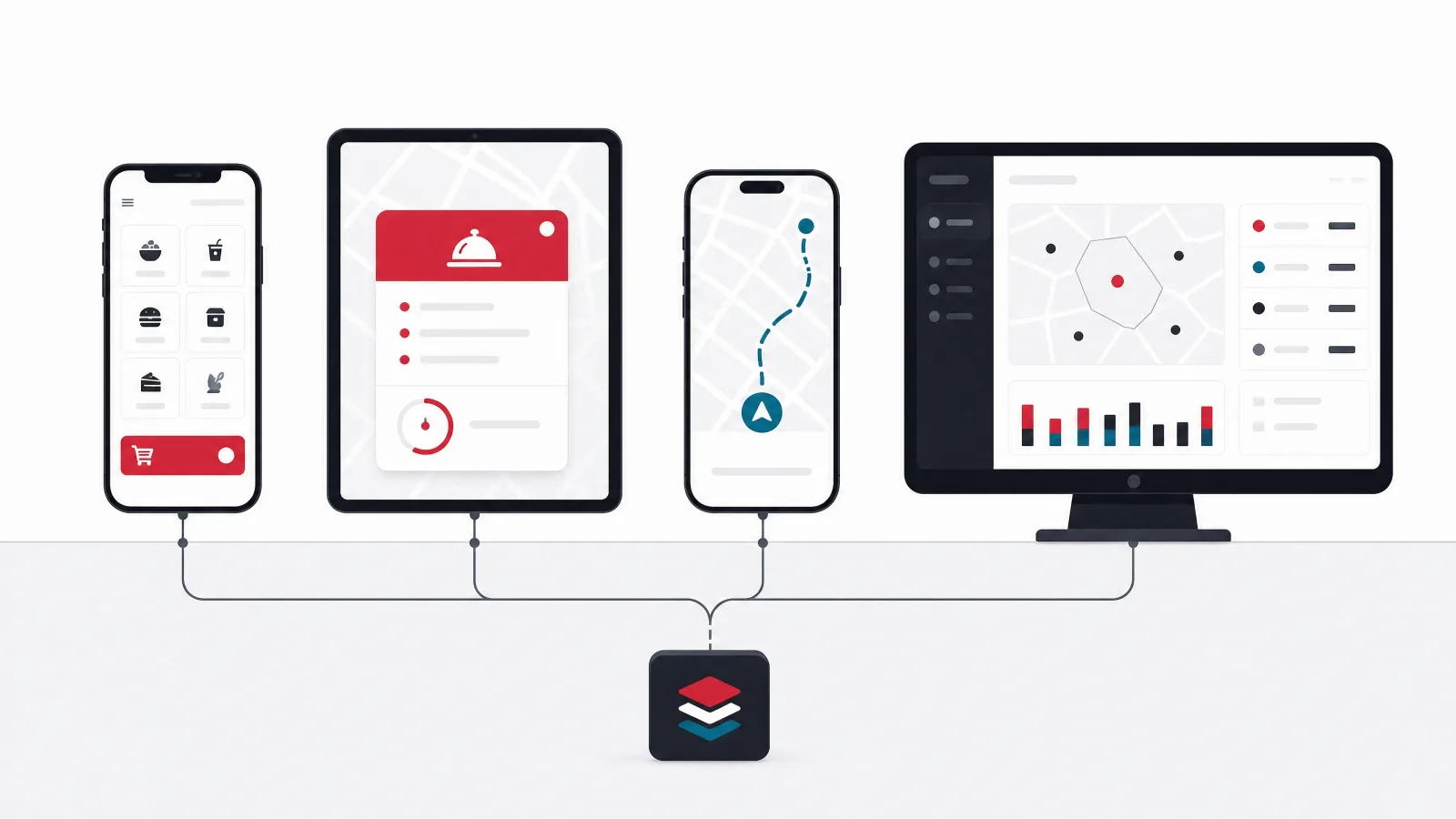
A usable platform needs customer, restaurant, and courier experiences, plus administration and dispatch services. Some interfaces can begin as responsive web applications, but none of the participant workflows can be ignored, because the marketplace only functions when all three sides can complete their part of an order without calling anyone.
The customer experience starts with location: the platform must determine which restaurants can serve the address, which menu is active, and whether the restaurant is accepting orders. The core flow runs from account or guest access through delivery address, restaurant discovery, menu and item customization, cart and fee calculation, payment, order confirmation, status tracking, delivery completion, and rating or support. Menu customization is the underestimated piece: a single item may have required choices, optional extras, quantity limits, dietary labels, and nested combinations, and poor menu modeling creates incorrect orders and restaurant support incidents at a rate that swamps every other defect category. The decision rule is to simplify discovery before simplifying order accuracy: a basic restaurant list is acceptable in an MVP, an ambiguous modifier system is not.
Restaurants need a fast interface designed for a busy operating environment, where new orders are difficult to miss and status changes are difficult to enter incorrectly. The minimum workflow covers accepting or rejecting an order, confirming preparation time, marking it ready, and reporting unavailable items, with menu, price, schedule, and availability controls for managers. A tablet application is useful, but a responsive web portal may reduce initial cost; the choice depends on whether reliable background alerts, dedicated hardware, and kitchen usage are essential from day one. The main failure mode is stale availability: if restaurants forget to pause sold-out items or close the store in the system, customers place orders that cannot be fulfilled, so product design must reduce the manual actions required during busy periods. Platforms in the online food ordering category live or die on this screen.
The courier app manages availability, job offers, pickup, navigation handoff, proof of delivery, and earnings information, and it must keep behaving predictably when the network is weak or the app is backgrounded. Location collection needs careful engineering: updating too slowly produces inaccurate tracking, updating too often burns battery, data, and infrastructure. Couriers also need a clear exception path for a closed restaurant, an incorrect address, an unreachable customer, an unsafe location, or a missing item, because a platform that handles only the successful flow will bury its support team within weeks. Operations, finally, needs a console showing current status, state history, payment and refund state, restaurant response, assigned courier, last reported location, communication history, cancellation reason, and manual intervention controls, with narrow, logged permissions around refunds, account changes, and manual payouts.
The six product areas, from MVP to later stages
| Product area | MVP features | Later-stage features | Primary complexity |
|---|---|---|---|
| Customer app | Registration, address, search, menu, cart, checkout, order status | Recommendations, scheduled orders, loyalty, group orders | Search, pricing, status accuracy |
| Restaurant app or portal | Menu management, availability, order acceptance, preparation status | Promotions, analytics, multiple branches, POS integration | Inventory and operational reliability |
| Courier app | Availability, job offers, pickup, navigation handoff, delivery confirmation | Batching, incentives, heat maps, earnings analytics | Location, battery use, background behavior |
| Dispatch backend | Order state, courier matching, service zones, notifications | Predictive assignment, batching, capacity management | Real-time coordination |
| Admin console | User management, refunds, manual dispatch, order timeline | Fraud controls, advanced permissions, marketplace analytics | Safe operational access |
| Financial operations | Customer charges, refunds, basic payout calculation | Split payments, tax workflows, automated reconciliation | Ledger accuracy and provider rules |
Every area ships something in the MVP column. The later-stage column is earned by operational stability, not by roadmap ambition.
How should the platform architecture work?
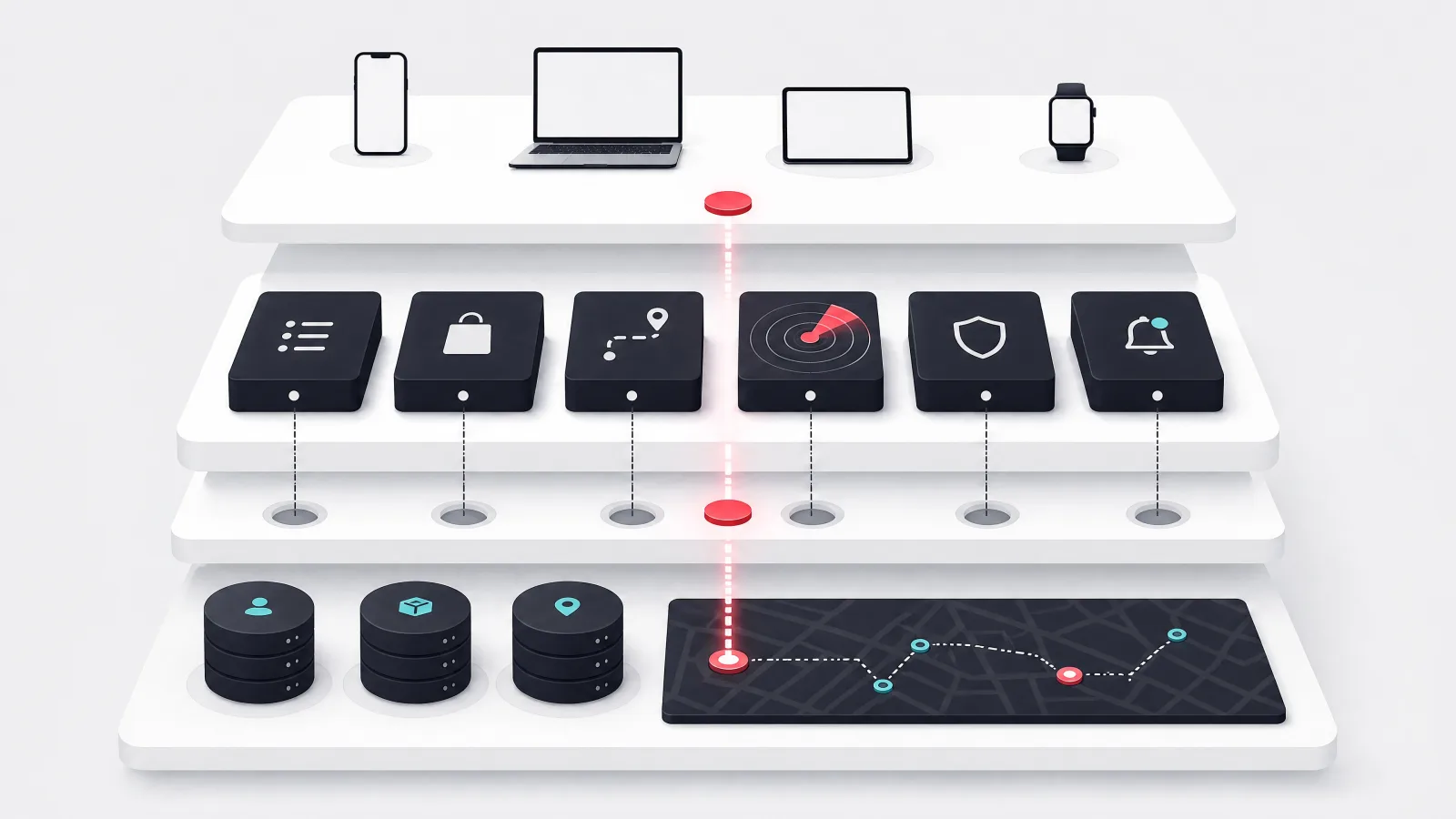
The architecture should center on an explicit order state machine and an auditable financial ledger. Real-time features can be added around those foundations, but they cannot replace them, and every architectural debate in this category resolves faster once that priority is agreed. A typical platform includes mobile or web clients, an API layer, identity services, restaurant and menu services, order management, dispatch, payments, notifications, location processing, and an administrative system.
At MVP scale, a modular monolith is often safer than many microservices. A small team can deploy and debug it more easily, and clear module boundaries allow high-load components, location ingestion and dispatch are the usual first candidates, to be separated later when real traffic justifies the operational cost of distribution. Choosing microservices first buys the failure modes of a distributed system before the platform has the traffic that excuses them.
The order state machine represents stages such as created, payment authorized, sent to restaurant, accepted, preparing, courier assigned, ready for pickup, picked up, delivered, and canceled or refunded. Not every transition should be allowed: an order marked delivered should not silently return to preparing, and corrections should create visible operational events rather than quiet field updates. This discipline is what makes the operations console trustworthy and the ledger reconcilable, because both read their truth from the state history.
The practitioner rule is to design failure and recovery states before optimizing infrastructure. Delivery systems fail in partial ways: a payment may succeed while the restaurant request times out, a courier may accept a job just as the restaurant cancels it, a status update may arrive out of order from a device that spent two minutes in a tunnel. A platform that models those partial failures as first-class states, with defined recovery paths, turns them into support workflows. A platform that does not turns them into engineering incidents.
The order state machine, and what each stage guards
Before the kitchen
- Created
- Cart validated against an active menu and a serviceable address. The last stage where cancellation is free of operational cost.
- Payment authorized
- Funds held, not captured. Guards the restaurant from cooking for a declined card.
- Sent to restaurant
- The acceptance timer starts. Timeout behavior here is a designed state, not an error.
In the kitchen
- Accepted, preparing
- Preparation estimate confirmed by the restaurant. Dispatch begins evaluating courier timing against it.
- Courier assigned, ready for pickup
- The two clocks, kitchen and courier, converge. Assigning too early wastes courier time; too late leaves food cooling.
On the road and after
- Picked up, delivered
- Location tracking runs; proof of delivery closes the loop. Delivered is terminal except through a visible correction event.
- Canceled or refunded
- Reachable from most states with a recorded reason, an actor, and a financial consequence the ledger reflects.
Transitions are the contract between every application on the platform. Corrections create events; they never silently rewrite history.
What are the hardest technical problems?
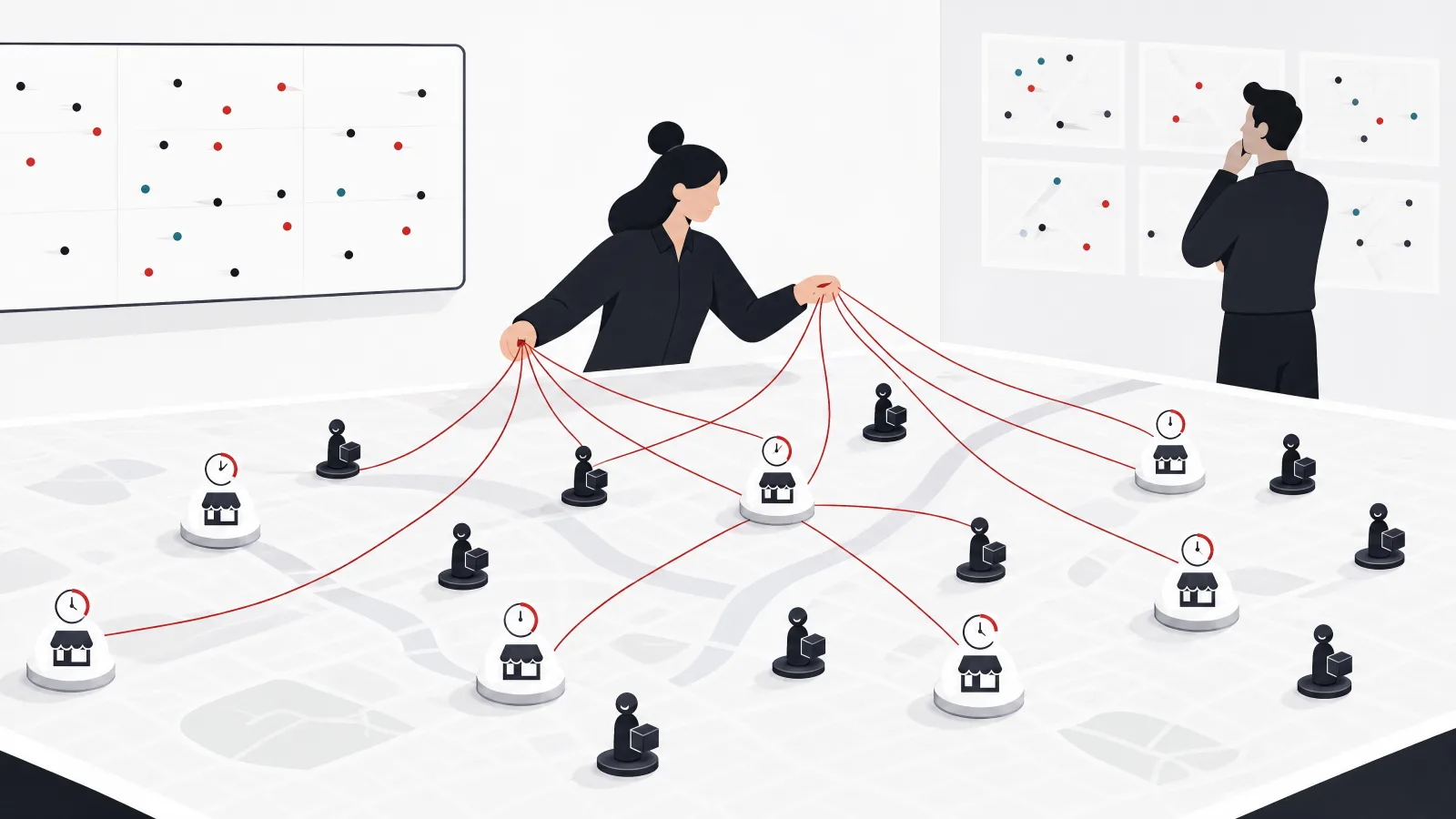
Dispatch, location, and delivery estimates determine whether the service works operationally. They are not secondary enhancements, and each rewards being started simple and instrumented heavily rather than being built clever and blind. Dispatch decides which courier should receive an order and when the assignment should happen, and the nearest courier is not always the best choice: the system may weigh courier distance from the restaurant, estimated preparation time, current workload, vehicle type, service zones, expected travel time, acceptance behavior, existing batched orders, delivery promises, and operational constraints. Assigning too early leaves couriers waiting at restaurants; assigning too late leaves completed food waiting for pickup. A practical MVP begins with rules and manual override, because machine learning is unnecessary until the platform has enough reliable operational data and a clear metric to optimize.
Real-time tracking sounds like a solved problem and is not. The courier device sends periodic location updates; the backend validates and stores relevant points, then pushes updated information to customer and operations interfaces. The system must account for delayed updates, inaccurate GPS readings, disabled permissions, background restrictions, and poor mobile networks, all of which are daily conditions rather than edge cases. Showing every raw coordinate is rarely useful: the product should communicate confidence and last update time instead of presenting an inaccurate moving marker as exact, because a marker that jumps backward across a river costs more trust than a marker that honestly says it last heard from the courier ninety seconds ago.
Delivery time estimation combines several uncertain durations: restaurant acceptance, preparation, courier assignment, travel to pickup, pickup delay, travel to the customer, and handoff. Map routing solves only part of the problem, because restaurant preparation variance can dominate the estimate, and no routing API knows that a kitchen is buried under a lunchtime rush. A rules-based model supports an early product honestly; historical preparation and delivery data improves it later. The mistake is offering precise promises before the system has evidence to support them, since a wrong precise promise costs more than a right vague one.
The dispatch and tracking rules that survive contact with real orders
Do this
- Start with rules and manual overrideDeterministic dispatch a human can inspect and correct. Optimization comes after data exists and a metric is chosen.
- Show tracking confidence honestlyLast update time and status beat a fake-precise marker. Trust survives vagueness; it does not survive being wrong.
- Treat kitchen variance as the ETA corePreparation time, not travel time, dominates most estimate errors. Model it first.
- Design the exception pathsClosed restaurant, wrong address, unreachable customer, missing item. Each needs a courier-facing flow, not a phone call.
Not this
- Machine learning before operational dataA model trained on nothing optimizes nothing. Rule-based dispatch with logging is the data collection program.
- Raw GPS as ground truthDevices lie: drift, tunnels, disabled permissions, background throttling. Validate before storing, smooth before showing.
- Precise ETAs on day oneA promise the system cannot keep converts an operations gap into a refund and a lost customer.
Payments, payouts, and the batching temptation
The customer payment is only the first financial event. The platform may need to account for restaurant revenue, commission, delivery fees, courier earnings, discounts, tips, refunds, adjustments, and taxes, and every one of those numbers must reconcile at payout time. The rule that saves months of cleanup is to use an internal ledger rather than calculating balances repeatedly from mutable order fields: each financial adjustment gets a reason, a timestamp, and a source, and balances are derived from the event history rather than stored as editable numbers.
Payment providers simplify collection and connected-account payouts, but the platform remains responsible for reconciliation and exception handling. Failed payouts, partial refunds, disputed charges, and adjustment reversals all require operational workflows with an audit trail, and they arrive in week one of real operations, not at scale. Building payment infrastructure correctly at MVP size is dramatically cheaper than retrofitting it under a backlog of unreconciled orders.
Batching, letting a courier carry more than one compatible order, is the perennial temptation, because it visibly improves courier utilization on a spreadsheet. It also increases route and timing risk: orders must align geographically and operationally, a second restaurant delay damages the first customer, and food type, delivery promises, courier capacity, and pickup sequence all constrain which combinations are safe. Batching should normally come after single-order dispatch is stable, and early teams that treat it as a straightforward efficiency feature consistently underestimate the support cost of bad combinations. The spreadsheet never shows the customer whose noodles toured a second restaurant.
Why do food delivery startups fail on unit economics?
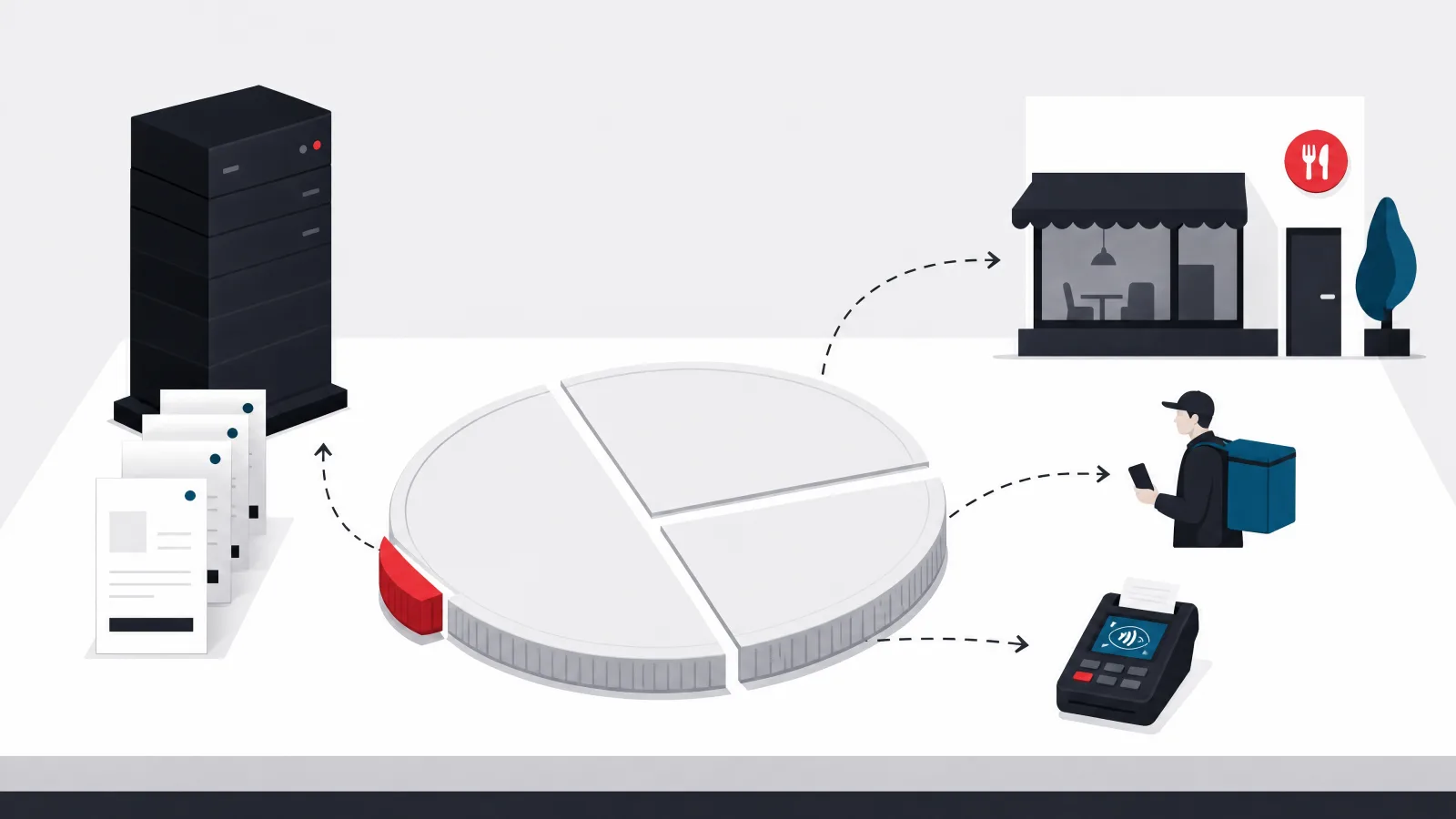
Many food delivery startups fail because contribution margin does not improve enough with growth. Technology can coordinate orders, but it cannot make an uneconomic delivery profitable, and no dispatch algorithm rescues a market where every completed order loses money structurally. The platform can earn from restaurant commissions, customer delivery fees, service fees, advertising, subscriptions, or merchant software, and each source has limits: restaurants operate under cost pressure and resist high commissions, customers compare the delivered price with direct pickup, couriers need compensation that makes the work worthwhile, and promotions can increase volume while making the losses worse.
The relevant unit is the completed order. Teams should model revenue collected per order against courier compensation, payment processing, customer support, refunds and credits, discounts, insurance or local operating costs, variable infrastructure, restaurant incentives, and failed delivery cost. That model, kept honest and updated weekly from real operations, is worth more than any growth chart, because it answers the only question that matters: does the next thousand orders make the business stronger or just bigger.
Density is the critical variable. A courier traveling a short distance between active restaurants and customers completes more work per hour than a courier covering a large, low-demand area, which is why the same product can be viable in one neighborhood and hopeless three suburbs over. The practitioner rule follows directly: launch in a narrow zone and measure repeat behavior before expanding. A broad map can look impressive while producing slow deliveries and poor courier utilization, and the economics of ride-hailing marketplaces teach the same lesson from the adjacent category: density is the moat, and subsidized breadth is rented share.
The three numbers that decide survival
What should the MVP include?
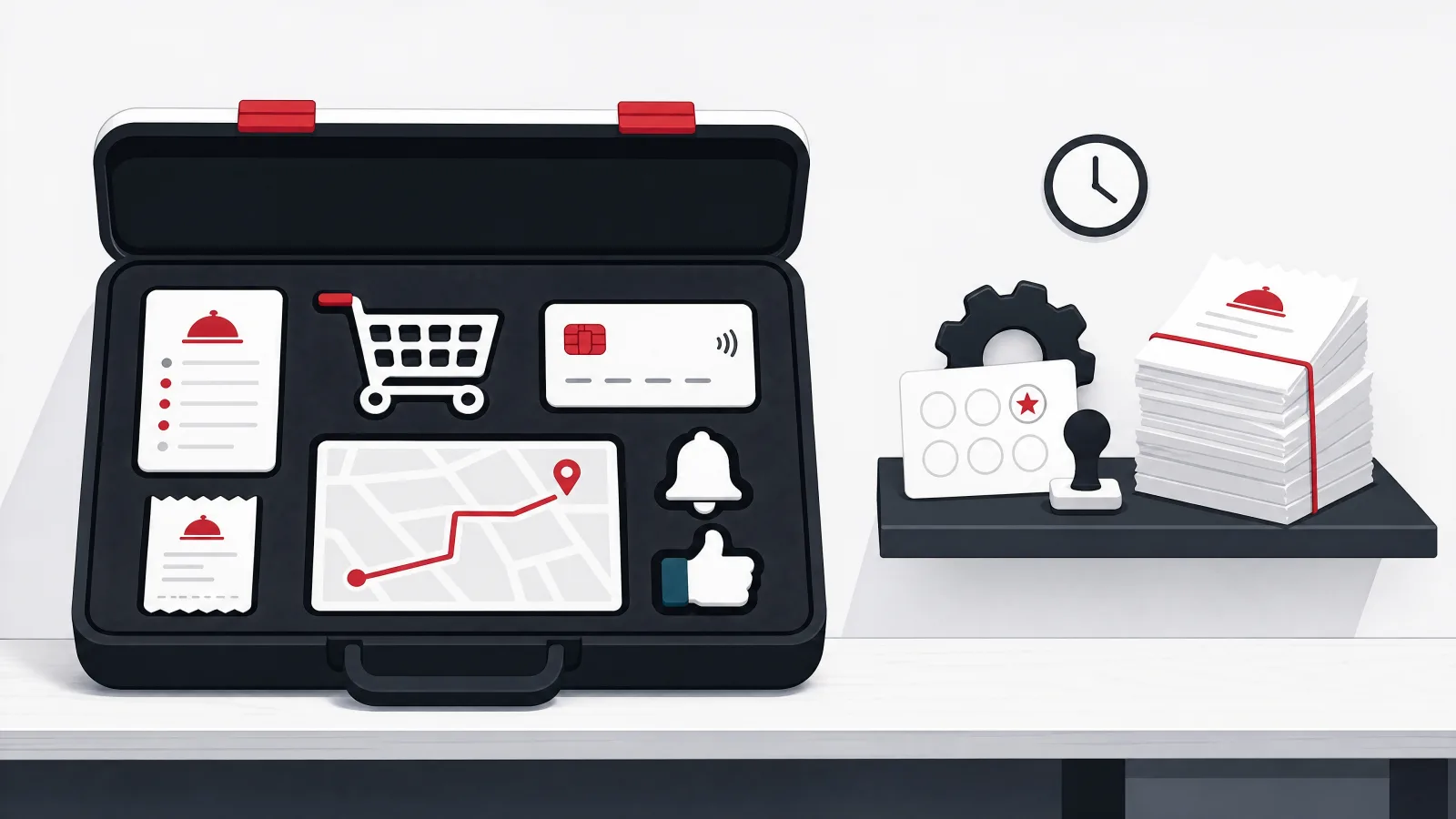
The MVP should support one city or operating zone, one delivery model, and a controlled restaurant group. It should prove reliable fulfillment before adding marketplace breadth, because breadth multiplies every unsolved operational problem by the number of new restaurants carrying it. The pilot should not include every restaurant category, advanced recommendations, gamified courier incentives, or complex loyalty: those features create surface area without proving the core operation.
Manual operations are acceptable during a pilot if they are deliberate and measured. A dispatcher manually assigning couriers for the first hundred orders is a research program; the same person doing it secretly in month eight is a scaling lie. Hidden manual work is dangerous precisely because founders may mistake an operations team for scalable automation, and the honest pilot instruments its manual steps so that automation targets are chosen from evidence.
The phasing that works runs from a controlled pilot proving complete real orders in one zone, through a market-ready stage improving repeat use and reducing intervention, to a scale stage adding POS integrations, batching, advanced dispatch, and multi-region support, and finally a platform stage diversifying revenue with merchant services, advertising, and subscriptions. Each phase is entered on operational evidence from the previous one, not on calendar pressure, and the discipline of refusing the next phase until the current one reconciles is what separates the platforms that survive from the well-funded maps of red zones that do not.
Four phases, each earned by the one before it
-
Phase 1, pilotMonths 1 to 6
Customer ordering, restaurant portal, courier app, rule-based dispatch, one payment method, manual support.
Done when Complete real orders in a controlled zone, reconciled end to end.
-
Phase 2, market-readyMonths 6 to 9
Better search, promotions, automated payouts, improved tracking, refund workflows, operational analytics.
Done when Repeat use improving and manual intervention rate falling.
-
Phase 3, scaleMonths 9 to 15
POS integrations, batching, advanced dispatch, multi-region support, fraud controls, loyalty.
Done when Density and courier utilization rising across more than one zone.
-
Phase 4, platformBeyond
Merchant services, advertising, subscriptions, enterprise reporting, deeper automation.
Done when Revenue diversified beyond the per-order margin.
Product scope grows only as operational goals are met. The pilot phase is part of development, not a launch afterparty.
How much does it cost, and how long does it take?
A focused food delivery MVP typically costs about USD 60,000 to 150,000. A broader production platform can cost USD 180,000 to 400,000 or more, depending on dispatch sophistication, integrations, operating markets, and application scope. These are planning ranges, not fixed quotes, and any partner offering a precise number before the delivery radius, courier supply, and restaurant process are defined is selling false precision. The largest cost drivers are the three participant applications, real-time location infrastructure, dispatch logic, payment and payout integration, menu and modifier complexity, mapping and routing, notification reliability, administrative tooling, restaurant POS integrations, multi-region tax and compliance requirements, and quality assurance across devices and failure states.
A team can reduce initial cost by using a web portal for restaurants, launching in one region, supporting one payment provider, and beginning with rule-based dispatch. What it cannot safely cut is the courier exception workflow, the financial ledger, or the operations console, because those systems become urgent as soon as real orders fail, and retrofitting them under live traffic costs multiples of building them first. Testing deserves the same protection: a platform whose failure states were never exercised by systematic QA discovers them through customers instead.
On timeline, a controlled pilot generally takes four to six months and a market-ready product six to nine, while a platform with advanced dispatch, batching, merchant integrations, and multi-region support can take a year or longer. A reasonable sequence runs through discovery and operational modeling, UX design and technical foundation, the customer and restaurant ordering flow, the courier and dispatch workflow, payments, notifications and administration, pilot testing with real participants, reliability improvements, and a controlled launch. The pilot period is part of development, because real restaurants and couriers reveal workflow issues internal testing cannot reproduce. The schedule also depends on business readiness: menu onboarding, restaurant contracts, courier operations, support policies, payment accounts, and local requirements can delay launch even when the code is ready.
Planning ranges by scope
| Scope | Typical range | Timeline | Team |
|---|---|---|---|
| Controlled pilot | USD 60,000 to 100,000 | 4 to 6 months | Product lead, designer, 3 to 5 engineers, QA |
| Market-ready MVP | USD 100,000 to 180,000 | 6 to 9 months | Product lead, designer, 5 to 8 engineers, QA, DevOps |
| Scalable platform | USD 180,000 to 400,000 or more | 9 to 15 months | Multiple engineering roles, QA, DevOps, data and operations support |
Ranges assume an experienced product team and one initial market. Multi-region compliance and POS integration push toward and past the upper bounds.
What does it take to build one responsibly?
A responsible build starts with marketplace operations, not screen design. The product team should define service zones, restaurant procedures, courier policies, cancellation rules, payout logic, and support ownership before finalizing architecture, because each of those decisions constrains the software more than any framework choice does. An architecture designed before the cancellation policy exists will be redesigned when it arrives.
A typical core team includes a product manager, a UX and UI designer, mobile or cross-platform engineers, backend engineers, a QA engineer, a DevOps engineer, a part-time data or dispatch specialist, and an operations representative. The last role is the one startups skip and regret: an operations voice in sprint planning is the difference between building for the demo and building for the Tuesday lunch rush. The engineering partner, in turn, should challenge the business model as well as estimate features; if the delivery radius, courier supply, or restaurant process is undefined, a detailed technical quote creates false precision, and a partner who provides one anyway is optimizing for the signature rather than the outcome.
The best first milestone is not an app store release. It is a small number of repeatable, accurately reconciled deliveries completed with acceptable customer, restaurant, and courier effort: orders placed, cooked, carried, paid, and accounted for, with every exception that occurred handled inside the product rather than around it. A team that reaches that milestone has a platform. A team that reaches launch day without it has three apps and an incident queue.
Before the first sprint: the operations questions that shape the software
- Service zone and delivery modelOne zone, one model. The map defines dispatch, ETAs, courier economics, and the pilot restaurant group.
- Restaurant operating procedureHow orders are received, confirmed, and marked ready during a rush, and who pauses the menu when items sell out.
- Courier policies and exception pathsCompensation, closed-restaurant procedure, unreachable-customer procedure, and where support ownership sits.
- Cancellation and refund rulesWho can cancel at which state, who absorbs the cost, and what the ledger records for each case.
- Payout logicCommission structure, courier earnings composition, tip handling, and the reconciliation calendar.
- Support ownershipWho answers the customer, the restaurant, and the courier, with what tools and what authority.
If three or more of these are undefined, run a discovery phase first. Every undefined answer becomes a mid-build redesign.
Frequently asked questions
How much does it cost to build an app like Uber Eats?
A focused MVP typically costs about USD 60,000 to 150,000, covering the customer app, a restaurant portal, a courier app, rule-based dispatch, and one payment integration in a single market. A broader platform with sophisticated dispatch, batching, POS integrations, multiple regions, and advanced operations can cost USD 180,000 to 400,000 or more. The largest drivers are the three participant applications, real-time location infrastructure, dispatch logic, and financial integration.
How long does it take to build a food delivery app?
A controlled pilot commonly takes four to six months, and a market-ready platform usually takes six to nine. A complex multi-region service with batching, POS integrations, and advanced dispatch can take a year or longer. The pilot period with real restaurants and couriers is part of development rather than after it, because live participants reveal workflow issues internal testing cannot reproduce, and business readiness, contracts, onboarding, payment accounts, often gates launch as much as code does.
How does an app like Uber Eats work?
The platform accepts a customer order, sends it to the restaurant, assigns a courier, tracks preparation and travel, processes payment, and records the final financial allocation between restaurant, courier, and platform. Customer, restaurant, courier, and operations systems all read and write one shared order state, managed as an explicit state machine, which is what keeps four different interfaces telling the same story about the same order.
What features does a food delivery app need?
The minimum scope includes restaurant discovery, menus with accurate modifier handling, checkout, restaurant order acceptance and preparation status, courier assignment, delivery tracking, payments, notifications, refunds, and an administration console. Reliable exception handling, closed restaurants, wrong addresses, unreachable customers, missing items, is as important as the successful order flow, because the support burden of unhandled exceptions grows faster than order volume.
Can I build a food delivery app with one mobile application?
One codebase may support several branded builds or user roles, and cross-platform frameworks reduce duplication, but the workflows are still different products. Customers, restaurants, and couriers require separate interfaces, permissions, testing, and operational logic: a kitchen tablet during a rush, a courier phone on a weak network, and a browsing customer have almost nothing in common as design problems, whatever they share as code.
Should a food delivery MVP use automated dispatch?
It should use basic automated rules with manual override. Rule-based dispatch that a human can inspect and correct completes real orders while generating the operational data that any later optimization needs. Machine learning and predictive assignment are better added after the platform has reliable preparation, acceptance, and travel data plus a clear metric to optimize, because a model trained on no history optimizes nothing.
If a delivery marketplace is on your roadmap, AgileTech is an AI native software development company in Vietnam with dispatch, tracking and marketplace ledger systems already in production for this region.
Source: https://agiletech.vn/blog/food-delivery-app-like-uber-eats/ · (c) AgileTech Vietnam. Printed from agiletech.vn.