 Nguyen Manh Thang
Chief Executive Officer, AgileTech Vietnam
Nguyen Manh Thang
Chief Executive Officer, AgileTech Vietnam
- Published
- Last updated
- Read time
- 15 min
- Views
- 85
Read the AI overview
There is no best front-end framework, and every ranking that names one is answering a different question than yours. The choice decomposes into three decisions made in order: what you are shipping and to where, which decides the rendering model before any framework name enters the room; which framework fits that model and your team, where the honest differences between React, Svelte and Vue are ecosystem size, hiring pool and update philosophy rather than the benchmark charts; and whether one codebase must serve web and mobile together, which is where Flutter and React Native change the conversation entirely. Team experience with the tool predicts project success better than any property of the tool itself.
Ask which front-end framework is best and the internet will answer with a ranking. The ranking will be sincere, current and useless, because it cannot know the one thing the choice depends on: what you are building, who is building it, and for how long it has to live. A content site that must load instantly on a weak phone, a dashboard that behaves like a desktop application, and a startup that needs one team shipping to web and both app stores are three different problems, and the best answer for each is a poor answer for the other two.
This guide replaces the ranking with the three decisions that actually decide the outcome, in the order they should be made. First the rendering model, which is chosen by the product rather than by taste and constrains everything downstream. Then the framework, where the real differences between React, Svelte and Vue are worth naming honestly, and where they matter far less than the criteria teams usually skip. Then the cross-platform question, which changes the answer entirely when it applies and should be ignored when it does not.
It is written from the delivery seat rather than the conference stage. Our teams run a frontend development practice that ships in most of the stacks this article names, which is precisely why it recommends none of them universally: the stack that wins is the one that fits the product, the team and the decade, and the sections below are the method we use to find it.
Key takeaways
- The rendering decision comes first and is bigger than the framework decision. Server-rendered, client-rendered and hybrid are different products with different costs, and most framework arguments are actually rendering arguments in disguise.
- React, Svelte and Vue differ far less in capability than in ecosystem: how many solved problems you inherit, how many developers you can hire, and how the framework treats its own past decisions.
- Benchmarks measure the framework alone. Your product’s speed is decided by images, data fetching, third-party scripts and rendering strategy, which is why benchmark deltas rarely survive contact with a real page.
- Flutter and React Native answer a business question, one team shipping to web and mobile together, not a technical one. Judge them on how native the result must feel, not on language preference.
- Team experience with a tool is the strongest single predictor of delivery success, and it is the criterion most selection processes weight at zero.
- The language question underneath is largely settled: the browser runs JavaScript, teams write TypeScript on top of it for the type safety, and the interesting language choices have moved to the backend.
- Write the choice down. A one-page decision record with the criteria and the runners-up turns the year-two conversation from an argument about taste into a review of assumptions.
Framework, language, or stack: what is actually being chosen
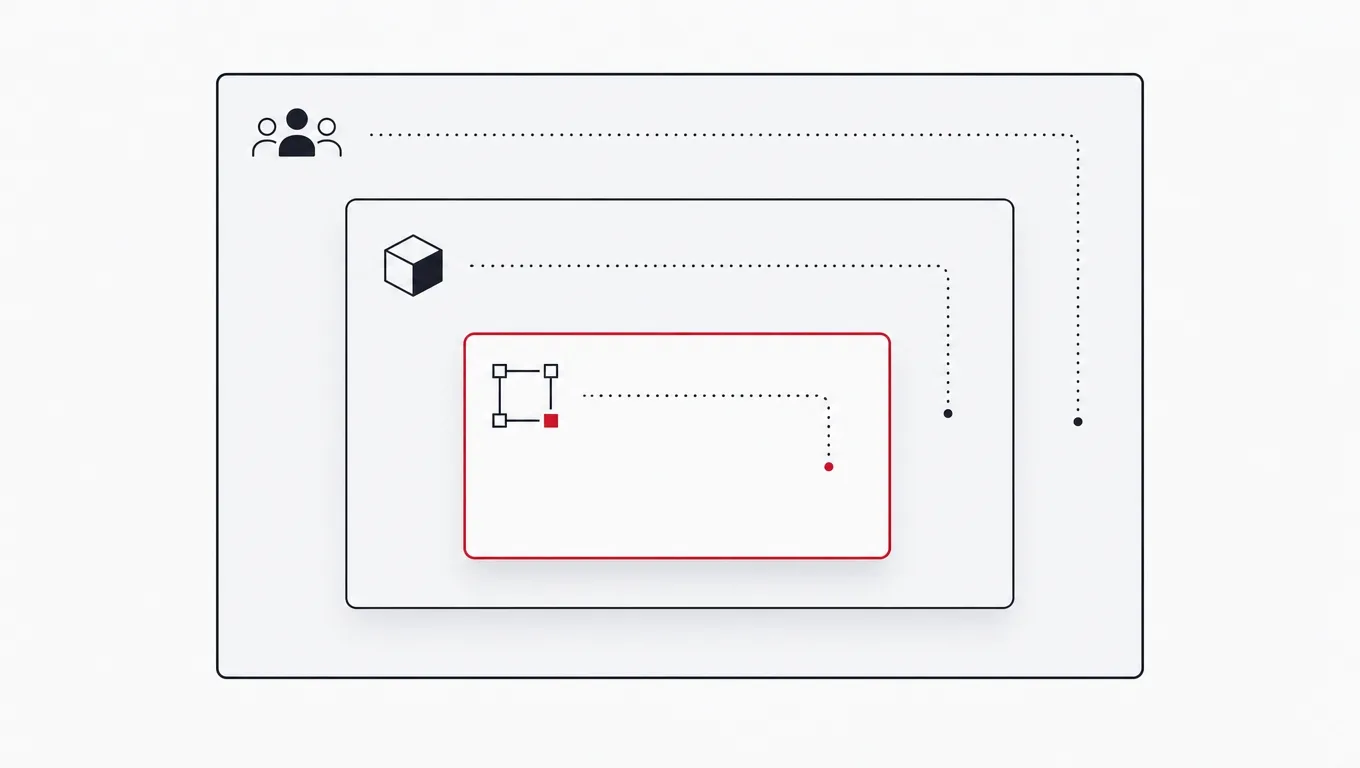
The vocabulary confuses buyers before the options do, because three different decisions travel under one question. A programming language is what the code is written in: for the browser that is JavaScript, almost always written as TypeScript now, and the choice is close to settled. A framework is a set of decisions someone else made about how interfaces get built: how the screen updates when data changes, how pieces compose, how state is shared. A stack is the whole arrangement, framework plus rendering strategy plus build tooling plus the hosting model, and it is the stack, not the framework, that your users experience.
The settledness of the language layer is worth stating plainly, because a whole genre of articles implies otherwise. The browser executes JavaScript; every framework in this article compiles to it; TypeScript adds compile-time types on top and has become the default for teams above a handful of developers because it converts a class of runtime surprises into editor warnings. The interesting language diversity lives on the server, where the API behind your front end might reasonably be written in several languages, and that choice is about your backend team and your infrastructure rather than about the front end at all.
Naming this untangles a common trap: language-first questions produce framework-shaped answers. Someone asking which language to build a website in is really asking which stack to choose, and someone asking which language a ride-hailing app should use is really asking about the cross-platform decision covered later, since the driver app, the rider app and the dispatcher dashboard may reasonably ship from different stacks that share a backend. Answer the real question and the language largely answers itself.
One more distinction pays for itself in vendor conversations: the difference between a framework and its ecosystem. The framework is the core library; the ecosystem is everything around it, the routing solutions, the component libraries, the form handling, the testing tools, the tutorials, the people on the job market who already know it. Frameworks are compared on features; projects succeed or stall on ecosystems. That asymmetry runs through every section that follows.
Six terms this decision is conducted in
- Rendering
- Where and when HTML gets produced: on the server per request, in the browser from a JavaScript bundle, or a hybrid of both. Decided by the product before any framework is named.
- SPA
- Single-page application. The browser loads one JavaScript application that redraws itself as the user navigates. Powerful for app-like products, costly for content.
- Hydration
- The step where server-rendered HTML becomes interactive in the browser. The tax every hybrid approach pays, and a place frameworks genuinely differ.
- Component
- The unit every modern framework composes interfaces from: a piece of screen with its own markup, logic and state.
- Ecosystem
- Everything around the core library: packages, tools, tutorials, and the hiring pool. Where framework choices are actually won and lost.
- Cross-platform
- One codebase shipping to more than one target, typically web plus the two mobile app stores. A business decision wearing a technical costume.
The rendering decision comes before the framework decision

Before any framework is named, a bigger choice has usually been made by accident: where HTML gets made. Server rendering produces the page on each request and sends finished HTML, which is fast to first content, friendly to search engines by construction, and light on the visitor’s device. Client rendering ships a JavaScript application that builds the page in the browser, which makes rich interactivity natural and navigation instant once loaded, at the price of a heavier first load and more work for weak devices. Hybrid approaches render the first view on the server and hand off to the client afterward, buying both benefits and paying both complexity costs.
The product chooses among these more than taste should. A content-led site, marketing pages, documentation, a publication, wants server rendering: its value is readable text delivered fast to unknown devices, and it gains almost nothing from an application framework running in the browser. A genuinely app-like product, a dashboard, an editor, a planning tool, wants client rendering: its users arrive once, stay long, and experience navigation speed rather than first-load speed. Products that are both, a storefront with a rich checkout, a portal with a public face, are why the hybrid category exists and why it now dominates framework marketing.
This is the place to say what the search-engine argument is actually about, because it drives more framework anxiety than any other single topic. Crawlers have become competent at executing JavaScript, but competence is not equivalence: rendering budgets, timing and third-party scripts still make client-only rendering the riskier posture for pages that live on organic search. The practical rule is unromantic: pages that need to be found should be served as HTML, pages behind a login can render however the team likes, and the deeper trade-offs between single-page and multi-page architectures are covered in our PWA versus native guide, which treats the same decision from the mobile side.
The reason to settle rendering first is that it filters the framework list for you. Every major framework can technically do every rendering model, but each has a grain: some ecosystems grew up around client-rendered applications and bolt on server rendering with visible seams, others were built server-first. Choosing the framework first and the rendering model second is how teams end up fighting their own tools, and it is the single most common structural mistake we see in rescue projects.
React, Svelte and Vue: the honest differences
The capability gap between the major frameworks has closed to the point where feature comparisons mislead. All three build component-based interfaces, all three handle state and routing through their ecosystems, all three support every rendering model, and a competent team ships a good product in any of them. What still differs, and differs enough to decide projects, is everything around the core: the size of the ecosystem, the depth of the hiring pool, the philosophy of change, and the way each tool spends your attention.
React’s decisive property is gravity. It has the largest ecosystem, the deepest hiring pool, the most answered questions, and a component library for nearly everything, which means a React team spends unusual amounts of time assembling solved problems rather than solving them. The costs are real but different than the criticism suggests: the ecosystem’s size means several competing ways to do everything, the framework has accumulated concepts across its history that newcomers must layer together, and keeping a large React codebase current is a standing workstream rather than an event. Teams choose React for the gravity, and the gravity is a legitimate reason.
Svelte’s decisive property is economy. It moves work from the browser to the compile step, producing smaller bundles and code that reads closer to plain HTML and JavaScript, and teams consistently report it is the most pleasant of the three to write. The costs mirror the benefits: the ecosystem is a fraction of React’s, the hiring pool likewise, and a team choosing Svelte accepts building some things themselves that a React team would install. For content-led products and small teams that value directness over gravity, that trade is often correct, which is why the comparison query this article answers deserves a real answer: Svelte when the product is light and the team is small and senior, React when the product is large and the roadmap needs the ecosystem.
Vue sits deliberately between: more approachable than React, a larger ecosystem than Svelte, strong adoption in some regions and sectors, and a design that scales from a script tag on one page to a full application framework. It is frequently the right answer for teams inheriting server-rendered applications that need islands of interactivity rather than a rewrite. The honest summary of all three is that the framework is rarely the risk. The risk is the match between the framework and the team, which is the subject of the criteria section below.
What actually differs, stated without benchmarks
| Property | React | Svelte | Vue |
|---|---|---|---|
| Ecosystem depth | Largest by far; a package for nearly everything | Small; expect to build some solved problems yourself | Substantial; strongest in some regions and sectors |
| Hiring pool | Deepest; the default skill on the market | Thin but enthusiastic; often senior self-selectors | Solid; strong in teams that grew from server stacks |
| Learning curve | Concepts accumulate; the ecosystem is the real curriculum | Shortest; reads closest to plain HTML and JavaScript | Gentle start, deep water available when needed |
| Update philosophy | Frequent movement; staying current is a workstream | Fewer, larger shifts; a small surface to keep current | Measured cadence with long transition windows |
| Where it shines | Large products, long roadmaps, big teams | Content-led products, small senior teams | Incremental adoption inside existing systems |
Capability rows are deliberately absent, because all three pass. The rows that remain are the ones that decide projects in practice, and none of them fits on a benchmark chart.
Flutter, React Native, and the cross-platform question

Flutter belongs in this article because buyers put it here, but it answers a different question than the web frameworks do. Flutter is a UI toolkit that draws its own interface, pixel by pixel, on iOS, Android, web and desktop from one codebase written in Dart. React Native takes the other route to the same goal: it drives each platform’s real native controls from JavaScript, which is why the two feel different in hand even when the screens look the same. Both exist for the same business reason, one team shipping one product to several platforms at once.
The decision between them is more honest at the level of texture than of features. Flutter’s self-drawn interface is identical everywhere, which is a strength for brand-heavy consumer products and design systems that must not drift, and a weakness where users expect the platform’s own feel, because an almost-native control is more noticeable than a clearly custom one. React Native inherits the real controls and therefore the real feel, along with the seams that come from bridging two worlds. Teams already deep in React usually find React Native the shorter road; teams starting fresh with strict design control often prefer Flutter. Our cross-platform practice ships both, and the choice between them is a project decision, not a house rule.
Flutter on the web deserves a specific caution, because the query traffic behind this article asks about it. Flutter renders the web the way it renders everything, as its own drawn surface, which means the result is an application in a canvas rather than a document made of HTML. For an app moved to the browser, a planning tool, a configurator, an internal system, that is acceptable and sometimes excellent. For anything that must be read, indexed, linked deeply or loaded fast on weak connections, it is the wrong tool, and the earlier rendering section explains why: content wants to be HTML.
The trap in all cross-platform reasoning is counting only the code sharing and not the new seams. One codebase does not mean one platform: the app store review processes, the push notification systems, the payment integrations and the platform-specific bugs all remain two of everything, and a cross-platform team needs at least a working familiarity with both native worlds for the day the abstraction leaks. The saving is real, commonly a third to half of the effort of two native builds, but it is a discount, not a merger, and business plans that treat it as a merger discover the difference during integration weeks.
Reasoning about cross-platform honestly
Do this
- Start from the product’s feel requirementIf users must feel the platform’s own controls, weight React Native. If the design system must be identical everywhere, weight Flutter.
- Count the team you haveA React shop reaching for React Native reuses real skills. The same shop adopting Dart is funding a second learning curve.
- Keep content pages in HTMLShip the marketing site and anything indexable as a normal web stack beside the app, whatever the app is built in.
Not this
- Promise one codebase means half the costStore review, notifications, payments and platform bugs stay doubled. The discount is real; the merger is not.
- Take Flutter to the web for documentsA drawn canvas is the wrong shape for content that must be read, linked and indexed.
- Decide by language preferenceDart versus JavaScript is the least consequential difference between these tools. Texture, team and ecosystem decide it.
The criteria that actually predict success

Selection processes for front-end stacks reliably weight the wrong things, and the pattern is consistent enough to name. The criteria that get spreadsheet columns are the measurable-from-outside ones: benchmark scores, popularity rankings, release cadence, the feature matrix. The criteria that decide outcomes are the ones that require looking inward: what the team already knows, who the company can realistically hire, how long the product must live, and how much custom work the ecosystem will save or create. The chart in this section is an illustrative weighting of that gap, and the argument for it occupies the rest of the section.
Team experience is the strongest single predictor, and it is not close. A team six months deep in a framework knows where its bodies are buried: which patterns scale, which library combinations fight, what the error messages actually mean. Moving that team to a better framework it has never used trades away certain knowledge for hoped-for properties, and the trade usually loses on delivery speed for a year or more. This does not make experience a veto, teams do need to move eventually, but it makes "our team knows it" a first-class engineering argument rather than an admission of laziness, and selection processes that score it at zero select against their own delivery dates.
Hiring pool is the second criterion, and it is the one that compounds. Every framework choice is also a decision about the next five hires: their availability in your market, their cost, and how long they take to become productive in your codebase. A framework the local market barely knows converts every future vacancy into a search for a unicorn or a training project, and that cost recurs for the life of the product. This cuts in both directions: a hard-to-hire framework staffed by senior self-selectors can outbuild a commodity-skill team, but that is a bet a company should make knowingly, not discover in its second year.
The remaining criteria earn their order. Ecosystem depth decides how much of your roadmap is assembly versus construction, which is why it outranks performance for most products. Performance ceilings matter at the extremes, genuinely low-end devices, genuinely enormous interfaces, and are rarely the binding constraint between major frameworks in the middle. Popularity rankings change yearly and mean little beyond a floor of viability. And longevity, the odds the framework is maintained and hireable in eight years, is best judged not by star counts but by who depends on it: a framework load-bearing inside large companies does not disappear, it ages, and aging is a manageable condition.
A selection process that takes a week, not a quarter
-
Write the product sentenceDay 1
One sentence: what is being shipped, to which devices, for how long. This decides the rendering model before any framework is named.
-
Inventory the team honestlyDay 1
What does the current team know deeply, not what would it like to learn. List the local hiring market’s real depth for each candidate stack.
-
Cut to two candidates on hard factsDay 2
Rendering fit, team knowledge, hiring pool. Benchmarks and rankings do not get a column.
-
Build the same thin slice twiceDays 3 to 5
One real screen with real data in each candidate, built by the people who will do the work. Two or three days that surface what no comparison article can.
-
Write the decision recordDay 5
One page: the choice, the criteria, the runner-up and why it lost. The year-two review reads this instead of relitigating taste.
The stack underneath: languages, tools, and what not to relitigate
A cluster of adjacent questions travels with the framework choice, and most of them have shorter answers than their search volume suggests. The language question is the shortest: the browser runs JavaScript, TypeScript is the professional default on top of it, and no framework choice changes either fact. The interesting language decisions live behind the API boundary, where the backend team’s existing depth should dominate, and where the front end genuinely does not care what answers its HTTP requests.
The build tooling question has also largely settled, which is worth knowing because articles about it outnumber the remaining decisions. Modern frameworks ship with working toolchains: a bundler, a dev server, a test runner, sensible defaults. The era when a project began with a week of build configuration is over, and a team still spending that week is fighting a solved problem. What remains genuinely open is the hosting model, whether the product renders on traditional servers, serverless functions or an edge network, and that choice follows from the rendering decision made earlier rather than adding a new degree of freedom.
On tools more broadly, the honest guidance is to spend the selection budget where the options still differ. Component libraries differ enormously in quality and accessibility, and choosing one well saves months. Testing approaches differ in where they catch failures, and a thin layer of end-to-end tests over a product’s critical paths outperforms elaborate unit coverage of its trivia. Code editors, formatters and linters are commodities: pick the defaults, enforce them mechanically, and never hold a meeting about them again. The scarce resource in a front-end project is attention, and every hour spent relitigating settled tooling is an hour taken from the product.
The last question underneath the stack is organizational: who owns the choice going forward. Frameworks age on a schedule set by their maintainers, browsers move, and a stack unowned by anyone drifts until an upgrade becomes a rescue. The teams that age well treat the stack as operated infrastructure, a named owner, a quarterly hour reviewing what moved, small continuous upgrades instead of deferred large ones. That habit costs almost nothing and is the difference between a framework version being a fact about your codebase and a crisis in it. It is also, not coincidentally, the habit this article’s decision record makes possible.
The adjacent questions, answered at their real length
Settled by default
- Browser language
- TypeScript over JavaScript, for any team larger than a couple of developers. Revisit never.
- Build tooling
- Whatever the chosen framework ships with. Revisit only when a measured build problem appears.
- Formatting and linting
- Defaults, enforced mechanically, never discussed in meetings again.
Worth real selection effort
- Component library
- Quality and accessibility vary enormously. Evaluate against your design system before committing.
- Testing shape
- Thin end-to-end coverage of critical paths first; unit depth where logic is genuinely complex.
- Hosting model
- Follows the rendering decision. Server, serverless or edge changes cost shape and operational skills needed.
Ongoing, not one-off
- Stack ownership
- A named owner and a quarterly review hour. Small continuous upgrades beat deferred large ones.
- Dependency hygiene
- The ecosystem that saves you construction time is also a supply chain. Audit what you adopt.
Each of these has a content industry attached to it. The middle column is the answer most teams should take; the groups separate what is settled from what still deserves selection effort.
Choosing for the decade, not the demo

Every framework demonstrates beautifully. The demo is the tool’s best case: a fresh project, a small surface, the framework’s own patterns, none of your legacy. The decade is where the choice is actually lived: three team generations, two major migrations, a design refresh, an acquisition’s worth of integration, and a thousand Tuesday afternoons of ordinary maintenance. The properties that decide the decade are barely visible in the demo, and the comparison below names the gap directly.
What the decade rewards is boringness in the load-bearing places. A framework with a large ecosystem, a deep hiring pool and a maintainer with institutional weight can be upgraded, staffed and extended for years after its novelty is gone. What the decade punishes is coupling to cleverness: the exotic state library that lost its maintainer, the build customization nobody remembers the reason for, the framework fork that seemed harmless. None of this argues against choosing newer tools like Svelte, whose core trade is genuinely attractive; it argues for making that choice with the decade’s costs priced in, senior self-selecting hires, some built-instead-of-installed components, and a written record of why the trade was taken.
The migration question deserves one honest paragraph, because every long-lived product eventually faces it. Well-run migrations are boring: they happen screen by screen behind a routing boundary, old and new stacks coexisting for months, each release shippable. Badly run migrations are rewrites wearing a migration’s name, and the rewrite’s failure mode is well documented: the new stack chases the old one’s feature set for a year while the product stands still. The structural defense is the same routing-boundary architecture that enables hybrid rendering, which is one more reason the rendering decision from the second section outranks the framework decision in consequence.
The closing advice compresses to three sentences. Decide the rendering model from the product, and let it filter the frameworks. Weight team experience and hiring reality above everything measurable from outside, and write the decision down. And when the choice is between two defensible options, take the one your team can be productive in this quarter, because the compound interest on shipped product outruns the compound interest on theoretical framework advantages every time it has been measured honestly.
Signals the choice will age well
- The rendering model was chosen firstFrom the product’s shape, not the framework’s marketing. The framework then had to fit it.
- The team’s existing depth got a real weightNot a veto, but a first-class criterion with a column of its own.
- The next five hires were pricedSomeone checked the local market’s actual depth in the chosen stack before committing.
- A thin slice was built, twiceThe final two candidates each built one real screen with real data before the decision.
- The decision record existsOne page, criteria and runners-up, findable by the people who will inherit the choice.
- The stack has a named ownerUpgrades happen continuously in small pieces, reviewed quarterly, never deferred into a crisis.
Frequently asked questions
Which frontend framework is the best?
The question is malformed the same way "which car is best" is, which is why this guide replaces the ranking with a method. React, Svelte and Vue are all mature, all fast enough for the overwhelming majority of products, and all capable of carrying an application for a decade. What separates outcomes is fit: your team’s experience, your hiring market, the ecosystem your features need, and the rendering strategy your product calls for. Score those four for your situation and the "best" framework names itself.
Should we choose Svelte or React?
Choose React when you are hiring frequently, when your features lean on a deep ecosystem of existing libraries, or when your team already knows it, which is most teams. Choose Svelte when bundle size and runtime overhead genuinely matter for your users, when the team is small and stable enough that a thinner hiring pool is not a risk, or when the developers who will live in the codebase prefer its compile-time model. Both are production-grade; the difference is which risks your organization is better placed to absorb.
What programming language should a website be built in?
For the frontend, the browser decides for you: HTML, CSS and JavaScript, with TypeScript as the widely adopted typed layer on top of the JavaScript you write. The real choice is not the language but everything around it, the rendering strategy, the framework, and the backend language behind the API, where you genuinely have options. A team asking "which language" is usually asking "which stack," and the criteria in this guide answer that better than any language ranking can.
Is Flutter a good choice for the web?
Flutter is strongest where it was aimed: shipping one codebase to iOS and Android with an interface drawn by its own rendering engine. On the web that same engine works, but it produces a canvas-driven page rather than conventional HTML, which carries costs in initial load, accessibility tooling and search indexing that content-led sites feel immediately. If your product is an app that happens to also need a web build, Flutter web can be a reasonable third target. If the web is your primary surface, a web-native framework is the safer default.
What should a ride-hailing or delivery app be built with?
The pattern behind that question is an app that must exist on two phone platforms at once, in real time, from day one. That points to a cross-platform framework, Flutter or React Native, for the rider and driver apps, chosen mainly by which your team can hire for, sitting on a shared backend that owns the hard parts: live location, dispatch, pricing and payments. The frontend framework matters less here than the architecture; the same backend also serves the web dashboard your operations team will inevitably need.
How do we future-proof a framework choice?
You cannot pick a framework that will never age, so future-proofing is about the shape of the codebase, not the name on the package. Keep business logic out of framework components and behind plain interfaces, so the framework owns rendering and nothing else. Prefer boring, widely used patterns over each framework’s cleverest features, because the clever ones are what break in major version migrations. And write the decision down, criteria, scores and losers, so the inevitable year-five revisit starts from evidence instead of from whoever speaks loudest.
Do framework performance benchmarks matter?
Less than the attention they receive suggests. Benchmarks measure the framework alone under synthetic load; your users experience the framework plus your data layer, your images, your third-party scripts and your team’s discipline, and those terms usually dominate. The performance questions worth asking are product-shaped instead: how fast is first load on a mid-range phone over a real network, and does the interface stay responsive at your actual data volumes. Every framework in this guide can pass both tests when the team building on it cares.
And if the honest end of your evaluation is that the framework matters less than the people wielding it, AgileTech is an AI native software development company in Vietnam with production teams across every stack this guide names, from server-rendered web to Flutter and React Native, and a habit of putting the scoring in writing.
Source: https://agiletech.vn/blog/frontend-framework-choice/ · (c) AgileTech Vietnam. Printed from agiletech.vn.