 Nguyen Manh Thang
Chief Executive Officer, AgileTech Vietnam
Nguyen Manh Thang
Chief Executive Officer, AgileTech Vietnam
- Published
- Read time
- 10 min
Read the AI overview
Fuel management software reconciles every liter a fleet buys against every liter its vehicles verifiably burned, and works the difference. It joins four data sources, fuel card transactions, tank level sensors, engine bus fuel-rate data and GPS context, into one ledger per vehicle, then runs detections against it: fills exceeding tank capacity (card fraud), tank drops without engine burn (siphoning), purchases far from the vehicle's location (card misuse), idle hours priced in currency, and burn-per-route outliers that surface mechanical problems and driving habits. Fleets running the full loop typically recover 3 to 10 percent of total fuel spend. Most fleets should buy the fuel module of a fleet platform and wire in their card feeds; building is justified for fuel-intensive operations with unusual infrastructure, private tanks, bunkering, mixed equipment, or for software companies serving them.
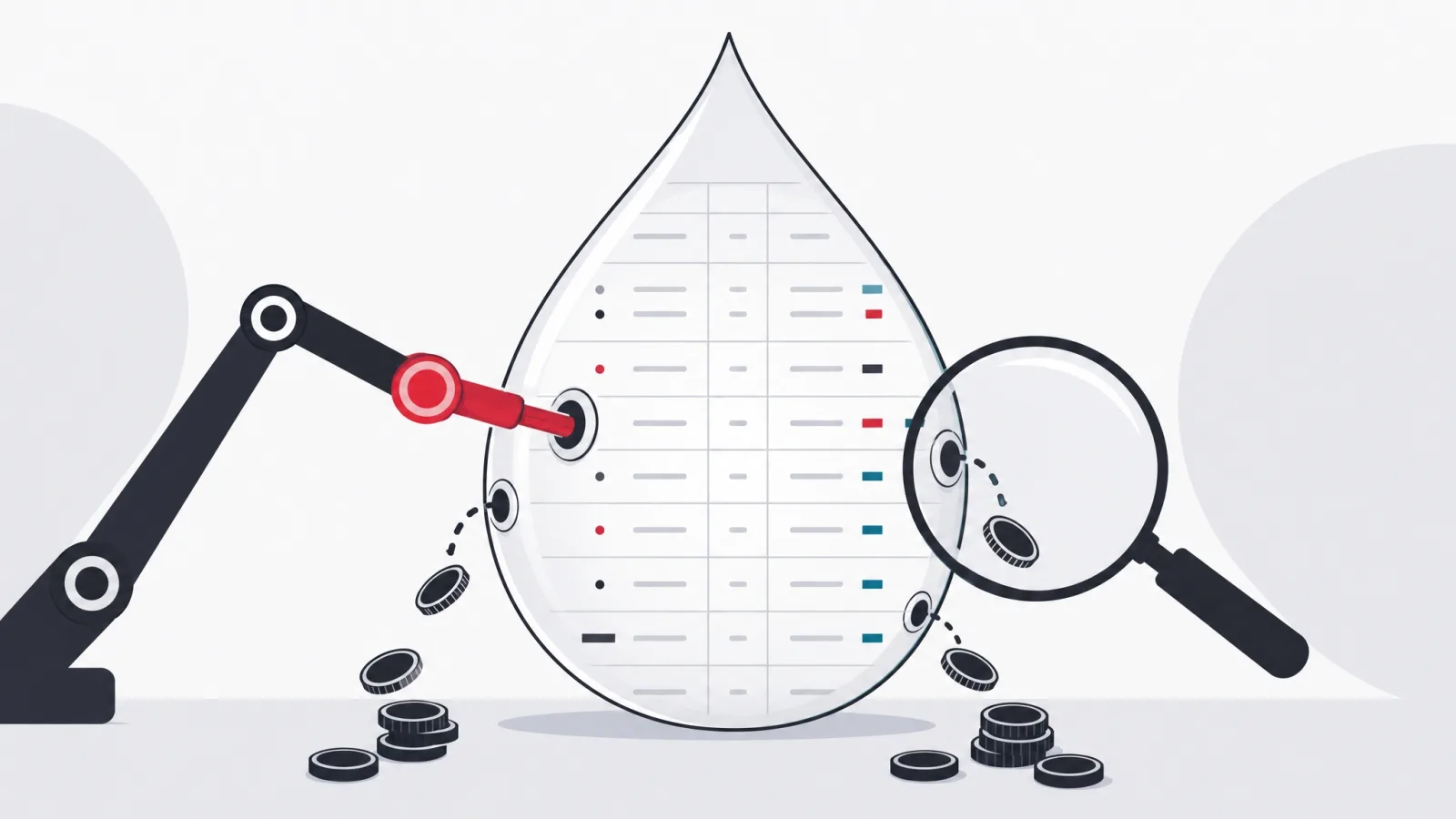
Fuel is the second largest line in most fleet budgets after wages, and it is the line with the strangest property: a meaningful slice of it, industry experience says 3 to 10 percent, is not buying motion at all. It leaks: siphoned from tanks at night, charged to cards by people filling private cars, burned by engines idling through lunch breaks, and wasted by vehicles whose degrading injectors nobody noticed. Fuel management software exists to find those leaks, name them, and give someone a queue to work.
This guide builds the topic from the loss ledger up: the four ways fuel money actually leaves, the data sources that make the leaks visible, the detection logic that catches each one, the honest buy-versus-build boundary, and the rollout discipline that separates fleets that keep the savings from fleets whose dashboard enthusiasm faded by the second quarter. The perspective throughout is operational: every detection is described with the exception it raises and the person who should work it.
It sits inside a cluster: the fleet software buyer's guide covers the platforms whose fuel modules this article evaluates, the sensor guide covers the tank and engine instrumentation feeding it, and the build guide covers constructing the platform around it.
Key takeaways
- Start from the loss ledger, not the feature list: theft, card fraud, idling and inefficiency leak in different ways and are caught by different detections.
- The system is a reconciliation engine: liters bought versus liters verifiably burned, per vehicle, per day, with every gap explained or flagged.
- Four data sources make it work: card transactions, tank level sensors, engine fuel-rate data and GPS context. Any three leave a blind spot the leak will find.
- The classic detections are simple and devastating: fills over tank capacity, drops without burn, purchases away from the vehicle, and idle time priced in money.
- Buy the platform module and wire in card feeds for standard fleets; build only for fuel-intensive operations with private tanks and unusual equipment, or as a product.
- Savings decay without process: the fleets that keep the 3 to 10 percent run weekly exception queues with named owners, not dashboards.
The loss ledger: four ways fuel money leaves
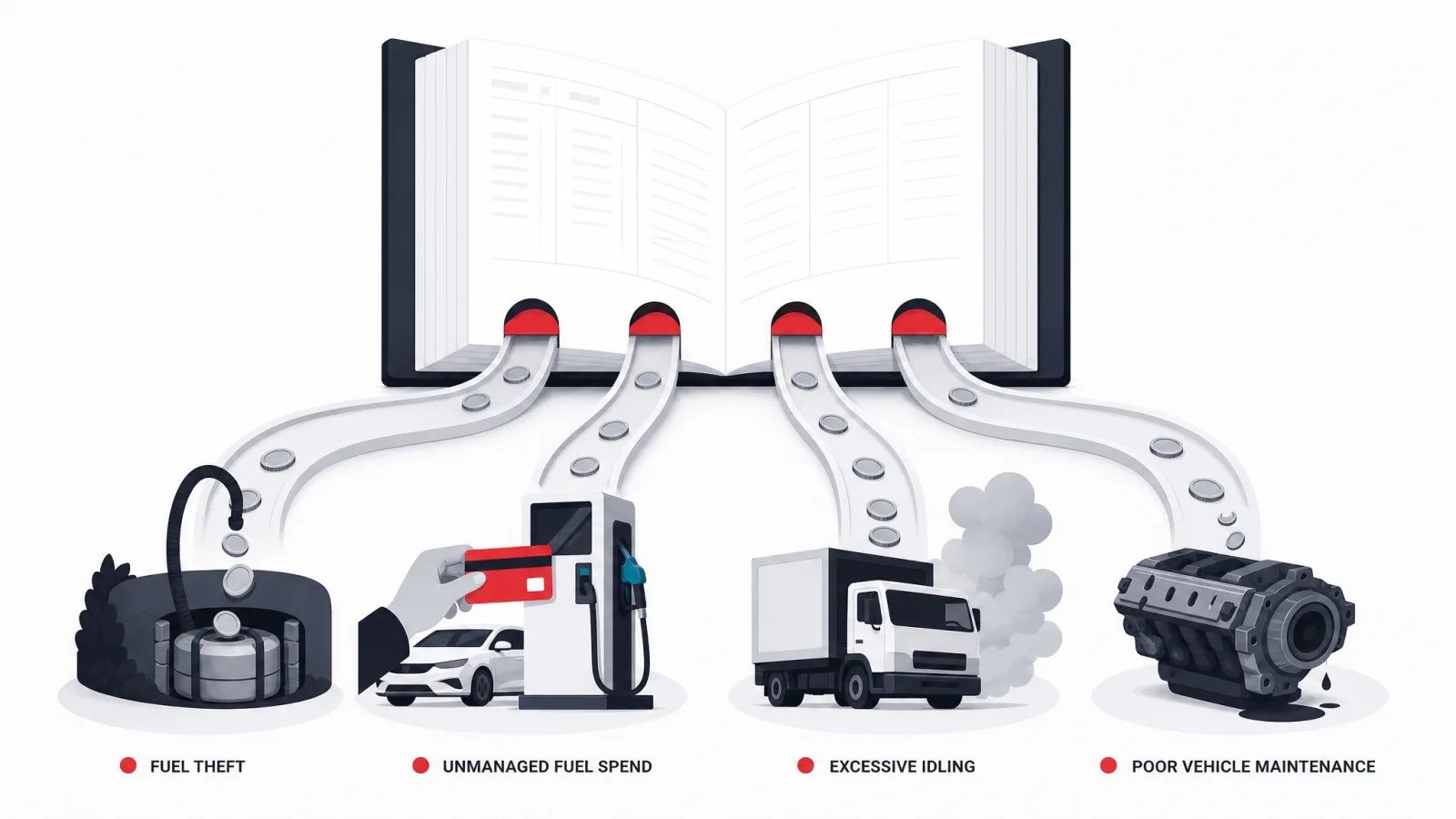
Theft is the loss everyone imagines and the one operators most often misjudge in both directions. Siphoning from parked vehicles, skimming during fills (the driver pumps 80 liters, pockets a receipt for 100, and the attendant splits the difference), and outright tank draining at yard level are real, endemic in some markets and rare in others, and their signature is physical: fuel that was verifiably in a tank is later verifiably absent without corresponding engine burn. Fleets in high-risk corridors report theft alone reaching several percent of fuel spend; fleets in low-risk markets sometimes instrument for theft and find their actual leak was always the next three categories.
Card fraud is the loss with the cleanest paper trail and the easiest detections. Fleet fuel cards get used for private vehicles, lent to friends, or charged for phantom fills by colluding stations; the tells are geometric and arithmetic: a purchase logged while the assigned vehicle's GPS places it forty kilometers away, a fill of 95 liters into a tank that holds 70, two fills in three hours with no plausible burn between them, weekend purchases on a Monday-to-Friday route profile. Card fraud is where fuel programs usually score their first documented win, because the evidence is a join between two datasets the fleet already owns.
Idling is the loss that is nobody's crime and everybody's habit. An idling heavy truck burns roughly 2 to 4 liters an hour to accomplish nothing, and across a fleet the hours accumulate invisibly: warming cabs, running air conditioning through breaks, queuing at depots with engines on. Idle loss is not detected so much as priced: the engine bus already reports it, and the software's job is converting idle hours into currency per vehicle per month and putting the number in front of the people who set behavior, with the operational nuance that some idle is legitimate (refrigeration units, power takeoff equipment) and the system must classify before it accuses.
Inefficiency is the quietest and often the largest loss: fuel burned moving, but burned badly. Degrading injectors and clogged filters that raise burn per kilometer a few percent for months before any fault code, underinflated tires paying their fuel penalty on every trip, route choices that trade tolls for traffic, and driving styles whose harsh acceleration profiles show up directly in the burn data. Inefficiency does not produce dramatic exceptions; it produces drift, and the software catches it by baselining each vehicle's burn against its own history and its cohort's, then flagging deviations that persist. This is the category where the fuel module quietly becomes a maintenance early-warning system.
The four losses and their signatures
| Loss | Typical share of leak | Signature in the data | Who works the exception |
|---|---|---|---|
| Theft | Market dependent | Tank drop without engine burn | Security or operations manager |
| Card fraud | Steady, universal | Fill-location mismatch, over-capacity fills | Fleet administrator |
| Idling | Habitual, behavioral | Idle hours priced per vehicle | Line managers, coaching |
| Inefficiency | Largest over time | Burn drift versus baseline and cohort | Maintenance planner |
Each loss leaks differently and is caught differently. A program that only chases theft misses the drift that usually costs more.
The four data sources, and why any three leave a blind spot

Fuel card feeds are the purchase side of the ledger and the easiest source to wire: every major card provider offers transaction exports or APIs carrying station, timestamp, volume, price and card identity. Their weakness is that they record what was charged, not what entered a tank, which is precisely the gap fraud lives in. A fuel program running on card data alone can detect geometric impossibilities (wrong place, over capacity) but cannot see siphoning at all, because siphoned fuel was legitimately purchased.
Tank level sensors are the physical truth of the tank, covered on the hardware side in the fleet sensor guide. Calibrated float or capacitive probes report level continuously, which turns fills and drains into events with timestamps and locations: a fill event of 68 liters against a card transaction of 95 is a skim; a 40-liter drop at 2 a.m. in a parking lot is a siphon; a slow overnight decline might be a leak worth a bay inspection. Their weaknesses are calibration drift, slosh noise that the ingestion layer must smooth, and installation cost, which is why many fleets deploy them selectively on the routes and vehicles where the theft hypothesis is live.
Engine bus fuel-rate data is the consumption side: the vehicle's own computer reporting fuel flow, which integrated over a trip gives liters actually burned, the number every reconciliation needs. It also carries the efficiency signals, burn per kilometer, idle fuel consumption, and the fault codes that explain drift. Its weakness is coverage and fidelity variance across vehicle makes and ages: older vehicles and mixed fleets report unevenly, and the software must handle vehicles whose burn is estimated from distance and duty cycle rather than measured, without silently treating estimates as measurements.
GPS context is the source that makes the other three mean something. A card transaction is innocent or damning depending on where the vehicle was; a tank drop is a siphon or a long grade depending on the route; idle hours are waste or a refrigerated delivery depending on the stop. Position, trip and geofence context, the backbone the telematics pipeline guide describes, is what converts raw fuel events into classified exceptions. This is also the architectural argument for fuel living inside the fleet platform rather than beside it: the joins are the product, and joins across vendor silos are batch jobs pretending to be answers.
What each source can and cannot see
| Card feed | Tank sensor | Engine bus | GPS context | |
|---|---|---|---|---|
| Card fraud | Partial | Yes | Partial | Yes |
| Siphoning | No | Yes | Partial | Yes |
| Skimmed fills | Partial | Yes | No | Partial |
| Idle waste | No | No | Yes | Yes |
| Burn drift | Partial | No | Yes | Yes |
The blind spots are the point: each loss category needs a specific pair of sources to become visible.
The detection logic, rule by rule

The reconciliation core runs per vehicle per day: opening tank level plus purchases minus measured burn should equal closing level, within a tolerance band that absorbs sensor noise and temperature expansion. Every day that balances needs no attention; every day that does not becomes an exception carrying its own evidence: the events, their locations, the trip context. This framing matters operationally because it inverts the workload: instead of someone reviewing all fuel activity, someone reviews only the days the arithmetic rejected, which for a healthy fleet is a short queue.
The geometric rules catch fraud with joins rather than judgment. Fill-location mismatch: the card transaction's station coordinates against the vehicle's GPS position at the timestamp, flagging beyond a radius. Over-capacity fill: transaction volume against the vehicle's registered tank size, an impossibility that needs no tuning. Implausible frequency: consecutive fills whose interval could not have burned the first fill's volume. Off-profile purchases: transactions outside the vehicle's operating hours or geography. Each rule is trivial alone; their power is running continuously against every transaction with the evidence pre-assembled when a human looks.
The physical rules catch theft with the tank sensor's event stream. Drain detection: level drops above a threshold rate while the engine is off, filtered against slosh and grade noise, escalated immediately rather than batched, because a siphoning event in progress is actionable and a report about last Tuesday is not. Skim detection: fill events whose sensor-measured volume falls short of the card-charged volume beyond tolerance, which is the rule that pays for tank sensors in high-risk markets. Leak inference: slow persistent decline across parked periods, routed to maintenance rather than security, an example of why exception classification matters as much as detection.
The behavioral and efficiency rules run on longer windows. Idle pricing: engine-on stationary hours classified against legitimate-idle contexts (PTO equipment, refrigeration, regulated rest), priced at the vehicle's measured idle burn rate, and reported per driver and per site, because idle concentrates at places as much as people. Burn drift: each vehicle's fuel per kilometer trended against its own seasonal baseline and its cohort, with persistent deviation opening a maintenance exception before any fault code appears. Driver profiling: burn correlated with harsh-event rates from the telematics stream, feeding coaching programs rather than automated accusation, because the goal is the fleet's burn curve, not a leaderboard of shame.
Buy the module, or build the system

For most fleets the answer is unambiguous: buy the fuel module of the fleet platform you run, wire in the card feeds, and instrument tanks selectively where the theft hypothesis justifies hardware. Every serious platform in the buyer's guide ships fuel reconciliation, card integrations for the major providers, idle reporting and burn analytics; the marginal cost is a per-vehicle uplift and some integration configuration, and time-to-first-savings is weeks. The evaluation questions that separate good modules from checkbox features: which card providers integrate natively, whether tank sensor events join the reconciliation or live in a separate report, whether exceptions carry assembled evidence or just flags, and whether legitimate-idle classification is configurable.
Building becomes rational in three situations. First, fuel-intensive operations whose infrastructure the platforms do not model: private fuel depots and yard tanks with their own dispensing records, bunkering operations, construction and mining fleets mixing road vehicles with equipment measured in engine hours, agricultural operations with seasonal patterns that defeat generic baselines. Second, enterprises whose fuel programs span systems, procurement contracts, hedging, tax reclaim across jurisdictions, where fuel is a finance function with a fleet attached and the software must serve both. Third, software companies building fleet products, for whom the fuel module is a differentiator precisely because most implementations are shallow.
A fuel-specific build inherits the architecture of the platform build guide with the weight shifted toward ingestion quality and the reconciliation engine. The scope that experience says gets underestimated: card feed normalization (every provider's export differs, and multi-provider fleets need them unified), tank sensor calibration workflows (per-vehicle curves, drift detection, recalibration scheduling), the legitimate-idle classification model, and the exception workflow itself, queues, assignment, resolution codes, and the audit trail that turns a suspicion into a defensible personnel or vendor action. A credible fuel-focused build runs 60,000 to 150,000 dollars at offshore rates depending on how much of the fleet platform substrate already exists.
There is also a scoped middle path worth naming: fleets on a platform whose fuel module is weak sometimes build only the analytical layer, exporting the platform's events into their own reconciliation and exception queue while leaving tracking and dispatch alone. It is cheaper than a platform build, avoids ripping out a working system, and its risk is the one every side-system carries: the export is a dependency, and platform API changes land on your roadmap uninvited. It fits organizations with data engineering capacity and a fuel leak large enough to name in board meetings, which, at several percent of a large fleet's fuel line, it often is.
The fuel software decision
What does your operation actually need?
-
Standard fleet on cards and stations
Buy the platform module
Reconciliation, card feeds and idle pricing are solved problems; weeks to first savings.
-
Private tanks, bunkering, mixed equipment
Build, or extend heavily
Platforms do not model your infrastructure; the reconciliation must match how fuel actually moves.
-
Platform is fine, fuel module is shallow
Build the analytical layer beside it
Export events, own the reconciliation and exception queue, leave dispatch alone.
The rollout: from baseline to a worked queue

Begin with a baseline month that touches nothing. Wire the card feeds, connect the engine bus data the trackers already report, and let the system watch: total spend per vehicle, burn per kilometer distributions, idle hours, and the exception rules running in shadow mode to calibrate tolerances. The baseline serves two purposes beyond calibration: it is the denominator every future savings claim divides by, and it usually contains the program's first discovery, because a month of joined data on a fleet that never had it almost always surfaces something, an over-capacity fill pattern, a vehicle whose burn is twenty percent off its twins, that makes the program concrete to leadership.
Deploy hardware where the baseline points, not everywhere. If the reconciliation gaps concentrate on particular routes, vehicles or yards, those are the tank sensor candidates; if card geometry looks clean and the leak is idle and drift, tank sensors may never be needed. This is the capital discipline that keeps fuel programs paying: instrumentation follows evidence, and the sensor budget lands where the baseline says the physical truth is worth having. The rollout of sensors follows the provisioning rules any vehicle sensor deployment does: paired, calibrated and verified reporting before the installer leaves.
Then stand up the exception operation, which is where programs live or die. Every detection routes to a named owner: card geometry to the fleet administrator, drain alerts to operations in real time, drift to the maintenance planner, idle summaries to line managers monthly. Every exception gets a resolution code, confirmed loss, explained, sensor fault, policy gap, because the codes are what tune the rules and what turn twelve months of queue-working into an audited account of where the money went. The weekly rhythm matters more than the software: a thirty-minute exception review with the queue on screen beats any dashboard nobody opens.
Handle the human dimension deliberately, because fuel programs touch livelihoods and accusations. Announce the program before it detects anything, framed accurately: most exceptions resolve as sensor noise, process gaps or legitimate operations, and the program's first documented wins are usually fraud by outsiders and mechanical drift, not driver theft. Where driver behavior is involved, route findings through coaching before discipline, and let the idle and efficiency data reward as visibly as it flags: several fleets publish most-improved burn rankings alongside the exception queue, and the cultural difference between surveillance and shared savings shows up directly in how long the savings last.
The rollout, in order
-
Baseline month, shadow modeMonth one
Card feeds and engine data joined, rules running silently, tolerances calibrated per vehicle.
-
Read the baseline with leadershipWeek five
Spend per vehicle, burn distributions, the first discoveries. The denominator for every future claim.
-
Instrument where evidence pointsMonths two to three
Tank sensors on the routes and vehicles the reconciliation gaps name, not fleetwide by default.
-
Stand up the exception queuesMonth two
Named owners per detection type, resolution codes, real-time routing for drains.
-
Run the weekly reviewOngoing
Thirty minutes, queue on screen, codes recorded. The rhythm is the program.
-
Report savings quarterly against baselineQuarterly
Recovered fraud, converted idle, drift repairs, priced honestly with confounders named.
What it costs and what it returns
The cost side is modest against the fuel line it watches. Platform fuel modules typically add 3 to 8 dollars per vehicle per month to the base subscription; card feed integration is usually configuration rather than a project for the major providers. Tank sensors run 150 to 400 dollars installed per vehicle, deployed selectively. A dedicated analytical build, where justified, runs 60,000 to 150,000 dollars at offshore rates. The recurring human cost is the exception operation: a few administrator hours weekly for a mid-size fleet, more where theft is live, and the coaching time line managers spend on the behavioral findings.
The return side scales with the leak, and honest expectation setting beats vendor decks. Fleets with live theft and fraud exposure recover the most and fastest: geometry rules alone commonly claw back one to several percent of fuel spend in the first quarter, and the deterrence effect, drivers and vendors learning the fleet reconciles, is real and unmeasurable. Fleets whose exposure was already low find their money in idle and drift: one to three percent, arriving slower, through coaching cycles and maintenance interventions. Across the industry, the sustained band for programs run with the weekly rhythm is 3 to 10 percent of total fuel spend, and the fleets at the top of the band are the ones whose exception codes feed rule tuning quarter after quarter.
Two secondary returns deserve their line items. The maintenance early-warning effect: burn drift flags injector, filter and tire problems months before fault codes, and each roadside failure converted to a scheduled bay visit avoids tow, delay and cascade costs that the fuel program gets no credit for unless someone counts them. And the audit effect: a fleet that reconciles fuel has, as a byproduct, the per-vehicle consumption records that tax reclaim schemes, emissions reporting and cost-per-delivery pricing all want, records that fleets without the system reconstruct annually at consulting prices.
The failure mode to budget against is decay. Fuel programs produce their savings through attention, and attention wanders: the queue stops being worked, thresholds drift out of calibration, a card provider changes its export and the feed silently halves, and eighteen months later the dashboard still renders while the leak has quietly returned. The defenses are structural: the weekly review as standing rhythm, data-contract alerts on every feed (a day without card transactions is an alert, not a quiet Tuesday), and quarterly savings reporting that keeps the program's budget line honest. Fuel money leaks toward whatever nobody is watching; the software's job is to make watching cheap, and the organization's job is to keep doing it.
The fuel program, priced and returned
The special case: private tanks and yard fueling
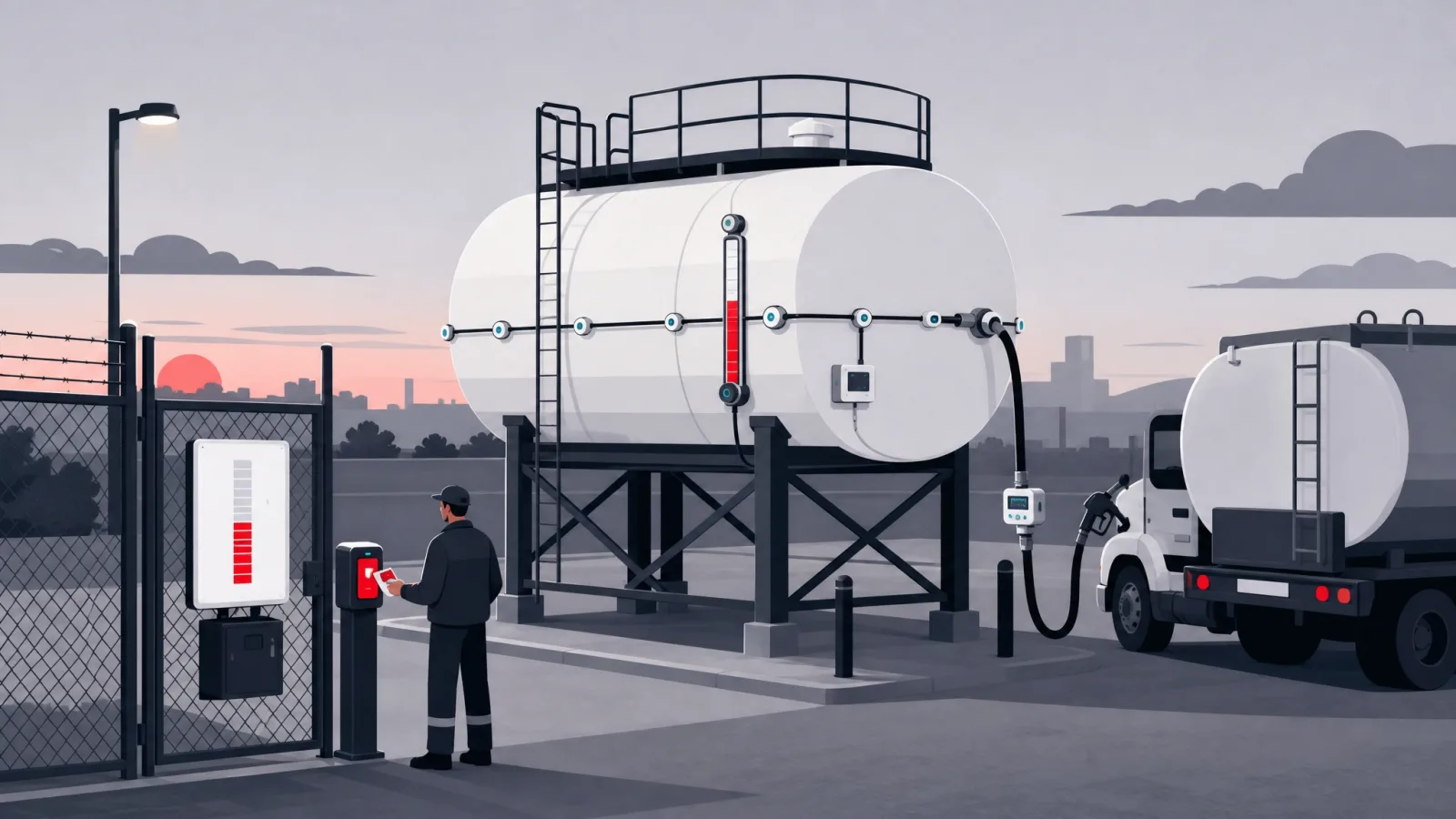
Fleets that fuel from their own tanks, depots with bulk storage, construction sites with bowsers, agricultural operations, mining camps, run a different reconciliation with an extra tier: the yard tank itself is now a ledger entry, receiving bulk deliveries and dispensing to vehicles, and both sides of it leak. Bulk deliveries can be short (the invoice says 20,000 liters, the tank gauge says 19,400), dispensing can be unrecorded (a fill with no vehicle attribution), and the tank can leak or be stolen from directly. The software model extends naturally: the tank gets its own level sensor and its ledger reconciles deliveries against dispensed volume, while each dispense event needs vehicle attribution, which is where the hardware decision lives.
Attribution technology at the pump is the crux. The spectrum runs from driver-entered codes on the dispenser (cheap, error-prone, gameable) through RFID tags on vehicles read at the nozzle (the workhorse: the dispense event binds to the physical vehicle automatically) to fully automated systems where the nozzle reads the vehicle and the dispenser refuses unregistered tanks. The RFID tier is where most operations should land: it converts every yard fill into an attributed event that flows into the same per-vehicle reconciliation as card purchases, and it removes the attribution honesty problem entirely, because the tag is on the truck, not in the driver's memory.
Delivery verification closes the top of the ledger. The tank's level sensor measures each bulk delivery independently of the supplier's invoice, temperature-compensated because bulk volumes shift meaningfully with temperature, and the reconciliation flags short deliveries automatically. Operations that installed this verification report the finding pattern is bimodal: most suppliers reconcile clean, and the ones that do not were not making errors. The same sensor watches the tank between events for the slow declines that mean leaks (an environmental liability before a financial one) and the fast ones that mean theft.
The scale argument for this special case is worth stating because yard operations often assume they are too small for the software. A single yard tank cycling 50,000 liters a month at typical diesel prices moves over half a million dollars of fuel a year through infrastructure with, in the unmanaged case, no reconciliation at all, a leak profile limited only by the honesty of everyone with yard access. The instrumented version, tank sensor, RFID dispensing, delivery verification, costs a few thousand dollars per yard plus software, and pays back on the first short delivery or unattributed-dispense pattern it catches. For multi-yard operations, this is routinely the fuel program's highest-return component.
Yard fueling vocabulary
- Bulk delivery verification
- Measuring each supplier delivery with the tank's own sensor, temperature-compensated, against the invoice.
- Dispense attribution
- Binding every yard fill to a specific vehicle, ideally by RFID at the nozzle rather than driver-entered codes.
- Tank ledger
- The yard tank's own reconciliation: deliveries in, attributed dispenses out, level changes explained.
- Temperature compensation
- Correcting volumes for thermal expansion; bulk quantities shift meaningfully between delivery and measurement.
- Bowser
- A mobile fuel tank or trailer used for on-site fueling; carries the same attribution problem as a fixed tank, plus mobility.
Frequently asked questions
What is fuel management software?
A reconciliation system that joins fuel card transactions, tank level sensors, engine fuel-rate data and GPS context into one ledger per vehicle, then verifies that every liter bought is explained by liters verifiably burned. The gaps become classified exceptions, card fraud, siphoning, skimmed fills, idle waste, efficiency drift, each routed with assembled evidence to a named owner. Fleets running the full loop typically recover 3 to 10 percent of total fuel spend.
How does fuel monitoring detect theft and fraud?
With joins and physics. Fraud rules are geometric: purchases logged far from the vehicle's GPS position, fills exceeding registered tank capacity, refill intervals that could not have burned the previous fill. Theft rules are physical: tank level drops while the engine is off (siphoning, alerted in real time), and fills whose sensor-measured volume falls short of the card-charged volume (skimming). Each rule is simple; the power is running them continuously with evidence pre-assembled.
Do we need fuel tank sensors on every vehicle?
No. Run a baseline month first on card feeds and engine data alone, then instrument where the reconciliation gaps point: specific routes, vehicles or yards. Fleets with clean card geometry and a leak concentrated in idle and drift may never need tank sensors. Installed selectively at 150 to 400 dollars per vehicle, they pay for themselves fastest in high-theft corridors and on yard tanks, where a single caught pattern covers the hardware.
Should we buy fuel management software or build it?
Buy the fuel module of your fleet platform for standard operations: reconciliation, card integrations and idle pricing are solved problems, and first savings arrive in weeks for 3 to 8 dollars per vehicle per month. Build, at roughly 60,000 to 150,000 dollars offshore, when the platforms do not model your infrastructure, private tanks, bunkering, mixed equipment fleets, or when fuel analytics is itself your product. A middle path builds only the analytical layer on the platform's exported events.
How much fuel money can a fleet actually recover?
The sustained industry band is 3 to 10 percent of total fuel spend. Fleets with live fraud exposure recover fastest: geometry rules alone commonly return one to several percent in the first quarter. Mature-market fleets find their money in idle and drift, one to three percent arriving through coaching and maintenance cycles. The top of the band belongs to fleets that run a weekly exception review with resolution codes; programs that stop working the queue decay back toward baseline within a year.
How does fuel management work with private yard tanks?
The yard tank becomes its own ledger tier: a level sensor verifies every bulk delivery against the supplier invoice (temperature-compensated), RFID at the nozzle attributes every dispense to a specific vehicle, and the tank's balance reconciles continuously. A single tank cycling 50,000 liters monthly moves over half a million dollars of fuel a year, and the instrumentation, a few thousand dollars per yard, routinely pays back on the first short delivery or unattributed-dispense pattern it catches.
When the fuel program needs engineering behind it, AgileTech is a trusted software house in Vietnam with fleet platforms and their fuel analytics in production.
Source: https://agiletech.vn/blog/fuel-management-software/ · (c) AgileTech Vietnam. Printed from agiletech.vn.