 Nguyen Manh Thang
Chief Executive Officer, AgileTech Vietnam
Nguyen Manh Thang
Chief Executive Officer, AgileTech Vietnam
- Published
- Read time
- 10 min

Read the AI overview
A customer training LMS is a learning platform pointed outward, at the people who pay you rather than the people you pay. That single change of audience rewrites the requirements: enrollment must be self-serve, the experience must carry your brand rather than the vendor's, completion must connect to product adoption and renewal data rather than compliance records, and the platform must scale to thousands of learners who owe you nothing and will leave at the first friction. Most software companies should buy a customer education specialist platform and integrate it with their CRM and product analytics; building a custom academy is justified when training IS the product, when the content is deeply interactive with the product itself, or when licensing costs at your learner volume overtake a build.
Every software company above a certain size eventually notices the same pattern: the accounts that learned the product deeply renew, expand and refer, and the accounts that never got past the first screen churn quietly at the end of the contract. Customer training is the deliberate response to that pattern, and a customer training LMS is the system that delivers it: a branded academy where your users enroll themselves, learn at their own pace, earn certificates they show off on their profiles, and generate the data that tells you which accounts are healthy and which are drifting toward cancellation.
The mistake most buyers make is treating this as a variant of the employee training problem they already know. It is not. An employee can be told to complete a course by Friday; a customer cannot be told anything. An internal LMS can look like the intranet it lives on; a customer academy is a public extension of your brand and your product. A compliance report satisfies an internal audit; a customer education program has to satisfy a CFO asking what it did for net revenue retention. The platforms that serve one problem well are routinely mediocre at the other, which is why this guide exists separately from our general guide to choosing an LMS and its internal-facing sibling on employee training platforms.
This guide walks the decision in the order a buying team actually meets it: what makes the customer problem different, the feature set that matters and the features that are noise, how to connect training to the revenue metrics that fund it, the vendor landscape as it actually segments, when building a custom academy beats buying, the integration architecture either way, and the launch sequence that separates academies people use from academies that become expensive content graveyards. Costs are covered where they shape the decision; for platform pricing in depth, the corporate LMS comparison and our LMS development cost breakdown go deeper.
Key takeaways
- Customer training and employee training share three letters and almost nothing else: voluntary learners, brand-facing surfaces and revenue metrics replace mandates, intranets and compliance reports.
- The feature set that matters is specific: self-serve enrollment, customer SSO, certification with public credentials, white-label theming, optional paid courses, and analytics that join training to product usage.
- An academy earns its budget in four places: faster onboarding to first value, fewer support tickets, higher feature adoption, and measurably better renewal in trained accounts.
- The vendor landscape splits into customer education specialists, corporate LMS products with bolt-on external portals, and custom academies; the bolt-on portal is the most common regret.
- Buy a specialist platform first; build when training is the product, when content must live inside your product, or when per-learner licensing at scale overtakes the cost of owning the stack.
- The integration loop is the difference between a content library and a revenue tool: identity from your product, events to your analytics, completions to your CRM, and renewal data back to the curriculum.
Why training customers is a different problem from training employees

Start with the learner, because everything else follows from them. An employee learner is a captive audience: HR enrolls them, a manager chases them, a deadline compels them, and the LMS can afford to be as charmless as the expense system because completion is mandatory. A customer learner is a volunteer. Nobody assigned them the course. They arrived because onboarding email number three linked it, or because a support agent suggested it, or because they searched for how to do something and your academy outranked a YouTube tutorial of unknown quality. They will leave the moment the experience asks more of them than the value it returns, and they will not file a complaint on the way out. They will simply not learn your product, and eighteen months later a renewal conversation will go badly for reasons nobody traces back to a clunky login page.
That voluntariness rewrites the platform requirements from the first screen. Enrollment must be self-serve and instant: a customer who has to email someone to get an account is a customer who closed the tab. Authentication must reuse the identity they already have, ideally the same login as your product, because a second password is a second reason to leave. The catalog must be browsable before login, because learners decide whether to commit by looking at what is inside. And the content must be structured for the impatient: short modules that answer one question each, searchable, skippable, consumable in the gaps of a working day, because your customer's employer is paying them to do their job, not to study yours.
The second difference is whose brand is on the wall. An internal LMS is furniture; if it looks like the vendor's template, nobody minds. A customer academy is a public room in your house. It carries your logo, your typography, your tone, and your URL, because customers who are learning your product are forming their opinion of your company at the same time. This is why white-label depth matters far more in customer training than the checkbox on the vendor's comparison chart suggests: some platforms let you swap a logo and a color while the layout, the emails and the certificate template still shout someone else's product. Ask to see a live customer academy the vendor hosts, not a screenshot.
The third difference is what success means. Internal training reports to HR metrics: completion rates, compliance coverage, audit readiness. Customer training reports to revenue metrics: time to first value for new accounts, support ticket volume per trained versus untrained user, feature adoption depth, and ultimately renewal and expansion rates in accounts that engaged with the academy against accounts that did not. A customer training LMS that cannot export learner events to the systems where those metrics live, your product analytics and your CRM, can only ever prove that people watched videos. That is a content library with a quiz engine, and it will lose its budget in the second year.
The same word, two different problems
| Dimension | Employee training LMS | Customer training LMS |
|---|---|---|
| Learner | Captive, assigned, chased by a manager | Voluntary, self-enrolled, gone at first friction |
| Identity | Corporate directory, HR system of record | Product login, self-registration, customer SSO |
| Brand | Internal furniture, template is fine | Public brand surface, white-label depth matters |
| Success metric | Completion, compliance, audit coverage | Onboarding speed, ticket deflection, renewal |
| Reporting line | HR and L&D | Customer success, marketing, revenue |
| Scale pattern | Headcount, predictable | Customer base, spiky, grows with sales |
The feature set that matters, and the features that are noise

Customer education platforms compete on feature lists a hundred rows long, and most of those rows are irrelevant to whether your academy works. The features that decide outcomes cluster in five groups. First, frictionless entry: public catalog pages that search engines can index, self-serve registration, SSO against the identity provider your product already uses, and enrollment links that drop a learner directly into a course from an onboarding email or an in-app prompt. Every step between curiosity and content costs you a measurable slice of learners, and the platforms that treat entry as a funnel, with analytics on where people drop, are the ones built by teams who understand the problem.
Second, certification that customers actually want. A certificate for completing an internal compliance course is a formality; a certificate for mastering a professional tool is a career asset, and the platforms that understand this issue verifiable, publicly shareable credentials, badge integrations for professional networks, expiry and renewal mechanics for versioned products, and public verification pages an employer can check. Certification is also the single strongest engagement lever an academy has: learners finish courses they would otherwise abandon because a credential waits at the end, and certified users become visible advocates who market the product inside their own organizations.
Third, commerce, even if you never charge. Serious customer education platforms support paid courses, coupons, subscriptions and tax handling, because many companies eventually monetize advanced training or bundle it into premium tiers. But the commerce machinery matters even for free academies: entitlement logic, which customer tier sees which content, is the same machinery, and platforms without it force you to fake tiering with duplicate catalogs. Fourth, content flexibility: native video hosting with speed controls and transcripts, embedded quizzes and hands-on assignments, SCORM or xAPI import for content you already own, and an authoring experience your customer education team can use without a developer on call.
Fifth, and least visible in demos: the data surface. Webhooks or an event stream for enrollments, progress and completions; a real REST API, not a nightly CSV; native or well-documented connectors for the CRM you run; and learner-level export that joins on the same identity your product uses. This group is where bolt-on external portals sold by corporate LMS vendors fail quietly: the portal renders courses to outsiders acceptably, but the data model still assumes learners are employees, and joining academy activity to account health becomes a permanent ETL project. If the vendor cannot show you a live integration pushing completion events into a CRM, assume it does not meaningfully exist.
The demo script: what to make every vendor show live
- Register as a strangerFrom the public catalog to inside a course, timed. Count the steps and the fields; every one is a drop-off point.
- Log in with your product identitySSO against the identity provider your product uses, not the vendor's demo directory.
- Issue and verify a certificateComplete a short course, receive the credential, open its public verification page, share it to a professional profile.
- Push a completion into a CRMA live event landing on a contact record, not a slide about integrations.
- Restyle the academyLogo, palette, typography, email templates and certificate design, changed in front of you, on the learner-facing surface.
- Show a real customer academyA live reference academy at your intended scale, and permission to talk to the team that runs it.
Tying the academy to revenue: the four metrics that fund it

A customer academy survives budget season by proving movement on four metrics, and the platform choice determines whether that proof is possible. The first is time to first value: how long a new account takes to reach the activation milestone your product defines, first report published, first campaign sent, first integration live. Academies compress this by replacing exploratory fumbling with a guided path, and the measurement is a straightforward cohort comparison: median days to activation for accounts where at least one user engaged the academy in the first month, against accounts where none did. Instrument it from launch day, because the baseline you fail to capture now is the improvement you cannot prove later.
The second is support deflection. Every support ticket has a cost, and a visible fraction of ticket volume in any mature product is how-do-I questions the academy could answer at zero marginal cost. The mechanics matter more than the aspiration: deflection happens when support agents link courses in answers, when the help center search surfaces academy lessons beside documentation, and when in-app prompts route stuck users to the relevant module rather than the contact form. Measure tickets per active user, trained versus untrained, and tag inbound tickets whose answer exists in the academy; that tag rate is your remaining deflection headroom.
The third is adoption depth, because customers who use three features churn at a different rate from customers who use ten, in every product analytics dataset ever examined. Training is the cheapest lever on adoption depth: a feature nobody discovers organically gets discovered in a course, and completion events give the customer success team a precise signal of which accounts have been shown which capabilities. This is where the LMS-to-product-analytics integration earns its setup cost: completion joined to subsequent feature usage answers the only question that matters, did the training change behavior, at per-feature resolution.
The fourth is the renewal correlation itself, and honesty matters here: correlation is what you will get, not proof of causation, because motivated accounts both train more and renew more. The defensible claim is narrower and still valuable: trained accounts renew at a higher rate, trained accounts expand more often, and the academy engagement score is one of the strongest early-warning signals your customer success team has. Feed engagement into the account health model in your CRM, and the academy stops being a cost center with a completion dashboard and becomes part of the revenue machinery, which is the position from which budgets get approved.
The vendor landscape: three ways to get an academy
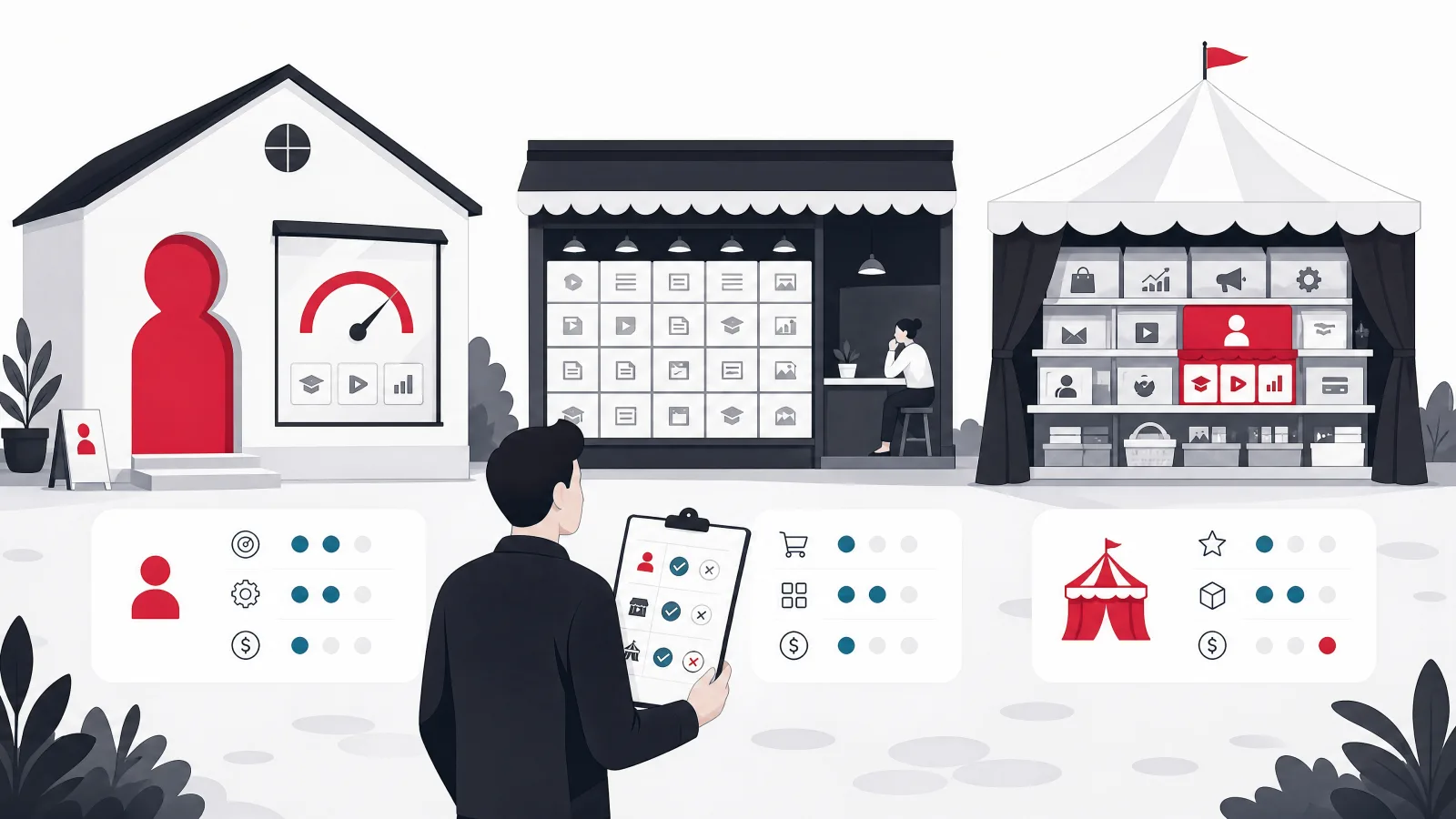
The market sorts into three families, and knowing which family a vendor belongs to predicts its behavior better than any feature chart. The first family is the customer education specialists: platforms designed from the first line of code for external learners, with the funnel, certification, commerce and CRM machinery described above as the core product rather than an add-on. They are the default answer for software companies, they price per active learner or by tier, and their weakness is the mirror of their strength: if you also need internal compliance training, their HR-side features are thin, and running one platform for both audiences usually means compromising one of them.
The second family is corporate LMS products with an external portal bolted on. The pitch is seductive, one platform for employees and customers, one contract, one admin team, and it is the most common source of regret in this market. The tell is in the data model and the seams: learner records shaped like employee records, self-registration that exists but feels like a visitor badge, theming that stops at the logo, per-seat pricing built for headcount that becomes absurd at customer scale, and reporting that answers HR questions about an audience that has revenue questions. There are exceptions, platforms whose external mode is genuinely mature, but the burden of proof is on the vendor, and the demo script above is how you apply it.
The third family is the custom academy: courses and progress tracked in a system you build, or a headless LMS backend with your own frontend over it. This is the smallest family by count and the right answer for a specific minority, which the next section maps precisely. What it buys you is total control of the experience, native integration with your product down to embedding lessons beside the features they teach, entitlement logic exactly matching your packaging, and freedom from per-learner pricing that punishes success. What it costs you is everything platforms amortize across their customer base: authoring tools, video pipelines, certificate infrastructure, accessibility, translations, and the unglamorous maintenance that never ends.
Whichever family you shortlist, negotiate on the pricing axis that matches customer scale. Per-registered-learner pricing is dangerous for a growing academy, because registrations accumulate forever while active learners do not; insist on active-learner definitions with a monthly window, caps with overage rates you can model, and contract language that lets the catalog be public without every browser counting as a learner. The pricing conversation is also where the families reveal themselves: specialists have answers ready because their customers all asked, and bolt-on vendors quote seat mathematics that made sense for employees.
The three families, compared where they differ
| Customer education specialist | Corporate LMS with portal | Custom academy | |
|---|---|---|---|
| Learner experience | Built for volunteers, funnel-aware | Employee UX shown to outsiders | Exactly what you design and fund |
| Brand control | Deep white-label as standard | Often stops at logo and palette | Total, it is your frontend |
| Revenue data loop | CRM and analytics connectors native | HR-shaped data, ETL project | Native if you build it, absent if you defer it |
| Internal training too | Thin HR features | Its home ground | Out of scope, run a second system |
| Cost shape | Per active learner, tiers | Per seat, headcount logic | Build plus permanent maintenance |
| Time to launch | Weeks | Weeks, longer to de-employee the UX | Months |
Buy a platform or build the academy: the honest split

The default is buy, and it is worth saying plainly why before mapping the exceptions. A specialist platform puts a working academy in front of customers in weeks, carries solved problems you should not want to own, video infrastructure, quiz engines, certificate verification, accessibility compliance, and its per-learner cost at typical B2B scale is a rounding error against the customer success payroll it supports. The build conversation begins only when one of three conditions holds, and pretending otherwise burns quarters.
The first condition: training is the product, or a product. If customers pay for certification programs, if partners must certify to sell your product, if the academy is a revenue line with its own P&L, then the entitlement logic, the commerce edge cases and the brand experience justify ownership, and platform licensing at that scale often crosses the build cost anyway. The second condition: the content must live inside the product. If the teaching that works is interactive, sandboxed environments, guided walkthroughs against real data, lessons embedded beside the features they explain, then a hosted academy on a separate domain is the wrong shape, and what you are really building is a product surface with learning semantics, not an LMS.
The third condition is arithmetic: learner volume. Per-active-learner pricing that is trivial at five hundred learners becomes a real line at fifty thousand, and consumer-scale or PLG products with training for every user eventually find the platform invoice funding a build. Run the numbers honestly, including the maintenance engineers the build permanently employs, and including the platform features you will quietly not rebuild; most teams doing this exercise discover the crossover is further out than the invoice made it feel. Our LMS development cost guide prices the build side of this comparison in detail.
There is also a hybrid worth naming, because it fits more companies than either pure answer: a specialist platform as the system of record, with a thin custom layer where the platform is weakest. The academy runs on the platform; your product embeds specific lessons through the platform's APIs; your data team joins learner events to product analytics in the warehouse; and the platform's theming carries the brand as far as it goes. This captures most of the custom academy's value at a fraction of its cost, and it keeps the exit door open: if you outgrow the platform, the content and the data model already speak your product's language.
The academy sourcing decision
Which of these describes your training program?
-
Training supports the product, B2B scale
Buy a customer education specialist
Weeks to launch, solved infrastructure, per-learner cost is trivial against the retention it protects.
-
Training IS a product, or certifies partners
Build, or buy headless and own the surface
Commerce, entitlements and brand experience become core product concerns worth owning.
-
Teaching must live inside the product
Build a learning surface, skip the standalone academy
Guided in-product learning is a product feature; a separate domain is the wrong shape.
-
Massive learner volume, platform invoice climbing
Model the crossover honestly, then decide
Include permanent maintenance and the features you will not rebuild; the crossover is usually further than it feels.
The integration architecture: how the academy joins the stack
Whether you buy or build, the academy creates the same four integration seams, and drawing them before the contract is signed prevents the most expensive category of surprise. The first seam is identity. The academy should accept your product's identity, so a logged-in user reaches a course without a second registration, and enrollments join to accounts without name-matching heuristics. In practice this means SSO from your identity provider for B2B, or token handoff from your product session for PLG, and it is the integration to validate first because retrofitting identity after launch invalidates every learner record created before it.
The second seam is the event stream outbound: enrollments, progress, completions and certifications flowing from the academy into the systems that act on them. The CRM gets completion milestones on the contact and account, so customer success sees training posture in the account view they already work. The product analytics warehouse gets the full event stream keyed on product identity, so analysts can join training to behavior. The marketing automation platform gets enrollment and completion triggers, so the onboarding sequences can branch on actual learning rather than elapsed days.
The third seam is inbound context: the academy is smarter when it knows who the learner is. Account tier drives entitlement, which courses this customer's plan includes; product usage drives recommendation, a user who never touched the reporting module gets the reporting course surfaced; lifecycle stage drives sequencing, week-one accounts see onboarding paths while year-two accounts see advanced certification. Platforms expose this as custom attributes and API-driven enrollment rules; builds implement it directly. Either way, the inbound seam is what separates an academy that feels curated from a catalog that feels like a filing cabinet.
The fourth seam is surfacing: where learners encounter the academy. The strongest academies are ambient, an in-app help panel that offers the relevant lesson beside the feature, support macros that link courses, onboarding emails that deep-link into enrollment, a help center whose search indexes lessons beside documentation. Each surface is a small integration, and collectively they are the distribution strategy; an academy reachable only through a link in the footer is a library nobody visits, however good the content. Teams that treat surfacing as a launch-week afterthought reliably produce the content graveyard this guide keeps warning about.
What a customer academy costs, both ways
Platform costs cluster by family and scale. Customer education specialists typically start in the low five figures annually for a serious B2B program and climb with active learners and features; the commerce, SSO and API tiers that this guide argues are essential are often gated above entry pricing, so quote the tier you will actually run, not the one on the pricing page. Corporate LMS external portals price by seat mathematics that varies too widely to summarize honestly; the number to extract is cost at your customer scale in year three, not at the pilot size the first invoice covers.
The custom academy, at offshore engineering rates, follows the arc our cost guide details: a credible first version, catalog, video lessons, quizzes, certificates, SSO and the CRM event stream, lands in the same band as other focused platform builds, with the warehouse joins and in-product surfacing as incremental projects after it. The number that surprises teams is not the build; it is the run rate. An academy is a product: it needs an owner, content refresh with every release, platform maintenance, and the analytics work that keeps it tied to revenue. Budget the team before the build, because an unstaffed academy decays into wrong screenshots and stale UI within two release cycles, and wrong training is worse than no training.
Content is the cost both paths share and both paths underestimate. Instructional design, screen recording, editing, transcripts, translations if you sell globally, and the refresh cycle above: for a product of any depth, content routinely costs more than the platform in year one and always costs more by year three. It is also the spend that determines whether any of this works, which suggests an allocation principle: when the budget forces a choice, buy the cheaper adequate platform and spend the difference on content and the person who owns it. Nobody ever churned because the academy's quiz engine lacked question pooling; plenty have churned because the course taught last year's interface.
Against these costs, the return math from the revenue section: onboarding compression, ticket deflection at known cost per ticket, adoption depth, and the renewal delta in trained accounts. Teams that instrument the baseline before launch can usually state the academy's payback in quarters, not years, and the programs that die are almost never killed by cost; they are killed by the absence of the measurement this guide has been insisting on since the third section.
The cost shape, both paths
The launch playbook: from empty platform to working academy

Academies fail at launch in a predictable way: six months of content production in private, a big reveal, a spike of curiosity, then silence, because the courses answered the questions the team imagined rather than the questions customers ask. The working sequence inverts this. Start from evidence: the support ticket taxonomy, the onboarding drop-off points in product analytics, and the questions customer success answers every week. The first ten courses are the top ten of that list, nothing else. Short, specific, titled in the customer's own words, because the academy's search box and the search engines are how most learners will arrive.
Launch narrow and instrumented. One audience, new users in their first month is the usual right answer, one path of five to eight short courses, every event flowing to the warehouse from day one, and the four revenue metrics baselined before the first learner arrives. Wire the ambient surfaces in launch week, not later: the onboarding email sequence links course one, the in-app help panel offers the path, support macros reference specific lessons. Distribution is not a phase after launch; it is the launch.
Then run it like a product. Weekly: which searches returned nothing, where learners drop inside courses, which support tickets now have an academy answer that was not linked. Monthly: cohort movement on activation time and deflection. Quarterly: the renewal and expansion comparison, presented to whoever funds the program. The content roadmap comes from this loop, not from a curriculum committee: the null search results are literally customers typing what they want to be taught. Certification comes second, after the core path proves engagement, because a credential on a weak curriculum devalues both.
Staff it honestly from the start. The minimum viable team is one owner who treats the academy as their product, with borrowed hours from instructional design or a content agency, an engineer for the integration seams at setup and quarterly thereafter, and executive sponsorship that survives the first flat quarter. Programs with a named owner and instrumented metrics compound; programs run as a side project by whoever had slack that quarter produce the graveyard. The pattern holds with such regularity across the industry that ownership, not platform choice, is the best single predictor of whether the academy you are about to fund will exist in three years.
Launch judgment calls
Do this
- Source the curriculum from ticketsThe support taxonomy and the null search log are customers stating their learning needs verbatim; the first courses answer the top of that list.
- Wire distribution in launch weekOnboarding emails, in-app prompts and support macros are the academy's arteries; a footer link is not a distribution strategy.
- Baseline the metrics firstNinety days of activation, ticket and renewal data before launch is the business case for year two.
Not this
- Produce a full curriculum in privateSix months of imagined-need content meets reality badly; ship ten evidence-sourced courses and iterate on the search log.
- Lead with certificationA credential on an unproven curriculum devalues both; earn engagement first, then formalize it.
- Run it as a side projectAn unowned academy decays within two release cycles; ownership predicts survival better than platform choice.
Frequently asked questions
What is a customer training LMS?
A customer training LMS, also called a customer education platform or external LMS, is a learning system aimed at a company's customers, partners and users rather than its employees. It hosts product courses, onboarding paths and certification programs under the company's own brand, lets learners enroll themselves, and connects learning activity to the CRM and product analytics so the business can measure training's effect on onboarding speed, support volume and renewal.
Can I use my employee LMS for customer training?
Technically often, advisably rarely. Employee platforms assume captive learners, directory-based identity and compliance reporting. Customers are volunteers who self-enroll with product identity, judge your brand by the experience, and matter through revenue metrics the HR data model does not carry. Some corporate LMS vendors sell external portals that bridge the gap; test them against a specialist with a live demo of registration, SSO, theming depth and a CRM event push before believing the one-platform pitch.
How does a customer academy improve retention?
Through four mechanisms: trained users reach first value faster, so fewer accounts stall in onboarding; they file fewer how-do-I support tickets; they adopt more features, and adoption depth correlates with renewal in essentially every product dataset; and academy engagement gives customer success an early-warning signal for drifting accounts. The honest claim is strong correlation plus a leading indicator, not laboratory causation, and it is enough to fund the program when the baseline was captured before launch.
Should customer training be free or paid?
Core product training should almost always be free, because its return arrives through retention and deflection, and any paywall between a struggling user and competence costs more than it earns. Paid training makes sense above that core: advanced certifications with career value, partner enablement programs, and instructor-led offerings. Many companies also bundle premium training into higher product tiers, which is why entitlement machinery matters in platform selection even for academies with no current commerce.
When should a company build a custom academy instead of buying a platform?
In three cases: when training is itself a product or a partner certification requirement, so commerce and brand experience justify ownership; when effective teaching must live inside the product as interactive embedded content, which makes a standalone academy the wrong shape; or when learner volume makes per-learner platform pricing exceed the honest cost of building and permanently maintaining the stack. Most B2B software companies fit none of these and should buy a specialist platform, sometimes with a thin custom layer at the integration seams.
What integrations does a customer training LMS need?
Four seams: identity inbound, so learners use their product login and records join to accounts; events outbound, enrollments and completions flowing to the CRM, the analytics warehouse and marketing automation; context inbound, account tier, usage and lifecycle driving entitlement and recommendation; and surfacing, the in-app prompts, onboarding emails, support macros and help center search that put courses where customers already are. Validate identity first, because retrofitting it invalidates every record created before it.
When the academy needs custom engineering behind it, AgileTech is a software house in Vietnam with learning platforms and their integration stacks in production.
Source: https://agiletech.vn/blog/customer-training-lms/ · (c) AgileTech Vietnam. Printed from agiletech.vn.