 Nguyen Manh Thang
Chief Executive Officer, AgileTech Vietnam
Nguyen Manh Thang
Chief Executive Officer, AgileTech Vietnam
- Published
- Read time
- 11 min
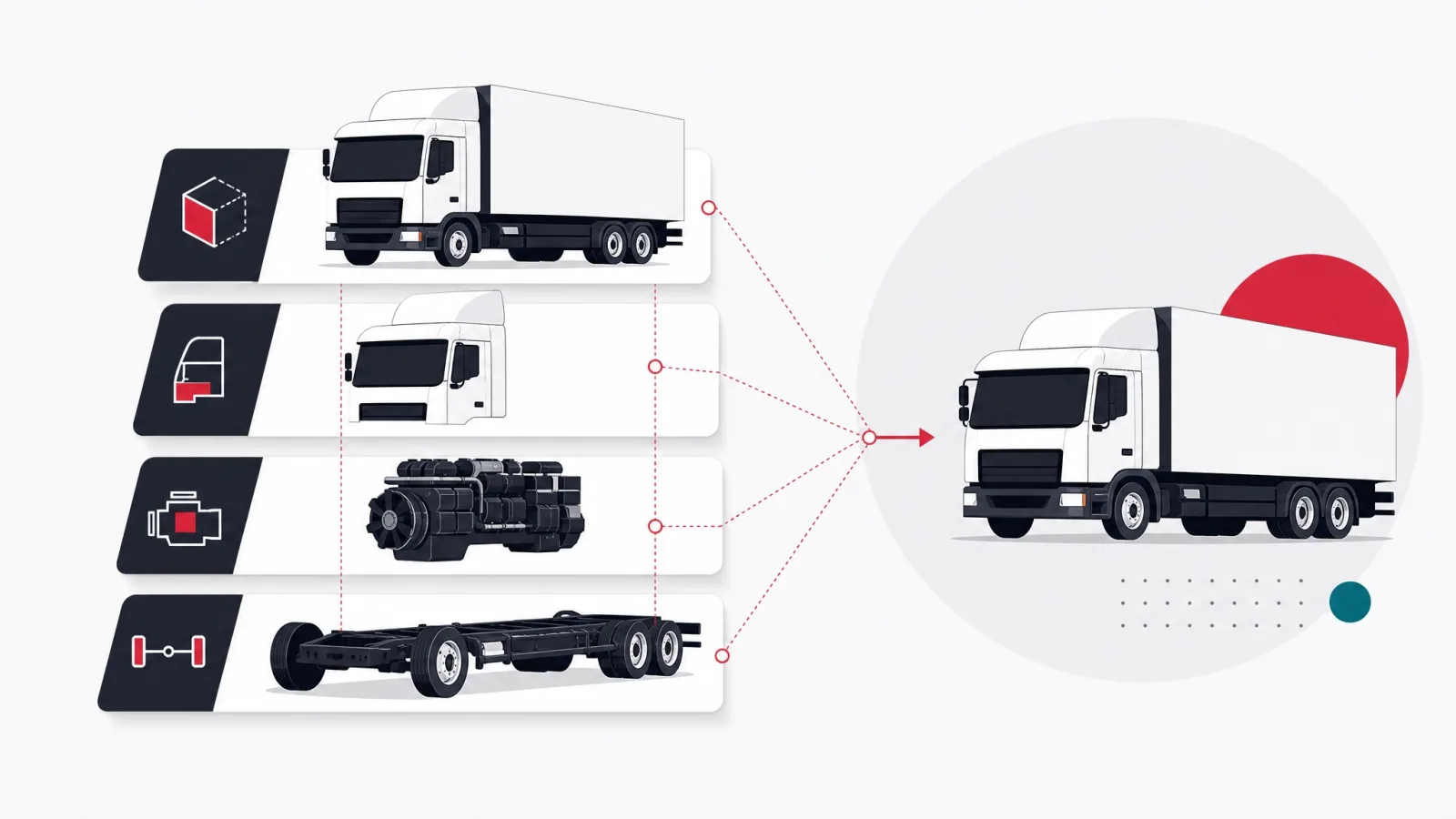
Read the AI overview
Building fleet management software means shipping four module families in a deliberate order: live tracking and telematics ingestion first, because everything else consumes its data; then operations modules (dispatch, routing, driver management) that turn positions into decisions; then asset modules (maintenance scheduling, fuel monitoring, inspections) that turn history into savings; and finally analytics and integrations that make the platform sticky. The architecture underneath is event-driven, a device gateway feeding a stream that fans out to live state, storage and rules, because fleet data arrives as a relentless stream and request-response designs buckle under it. A credible MVP for a single fleet segment runs 4 to 7 months with a team of 5 to 7 and roughly 120,000 to 250,000 dollars at offshore rates; a multi-tenant commercial platform is a multi-year product investment.
Fleet management software looks deceptively simple from the demo: a map with moving dots, some reports, a maintenance calendar. Underneath sits one of the harder product engineering problems in operations software: a relentless stream of telemetry from unreliable devices on moving vehicles, consumed by dispatchers who need the truth in seconds, feeding economics modules where a wrong number costs real money. Teams that start from the map build a toy; teams that start from the data stream build a platform.
This guide is the build-side manual: the module map and the order to ship it, the event-driven architecture that survives real fleets, the device strategy decision that shapes everything downstream, the team and timeline, and a budget honest enough to plan against. It deliberately does not repeat what its siblings own: the buyer's guide covers choosing an existing platform and whether to build at all, and the telematics pipeline guide goes deep on the data engineering from device to dashboard. This article sits between them: the whole product, module by module.
The market context matters for scoping. Fleet software serves segments with different physics: last-mile delivery vans, long-haul trucking, field service fleets, construction equipment, and each segment weights the modules differently. The single most important scoping decision, made before any code, is which segment the first release serves, because a platform for everyone is a platform for no one at MVP budgets.
Key takeaways
- Build in dependency order: telematics ingestion and live tracking first, operations modules second, asset economics third, analytics and integrations last. Every reversal of this order rebuilds something.
- The architecture is event-driven or it is wrong: positions and sensor events arrive as a stream measured in messages per second per vehicle, and the ingestion layer is the foundation everything else stands on.
- Device strategy is a product decision, not a detail: supporting installed trackers, OBD dongles and driver phones covers different fleet segments at very different data quality.
- The modules that close renewals are maintenance and fuel, not the map: operators buy the map but stay for the money the asset modules save them.
- An MVP for one fleet segment is 4 to 7 months and 120,000 to 250,000 dollars offshore; multi-tenant SaaS with billing, white-label and an integration catalog is a different, multi-year commitment.
- Decide early whether you are building an internal tool for one fleet or a product for many: the single-tenant shortcut is rational for the first and fatal for the second.
Scope first: one segment, one buyer, one workflow
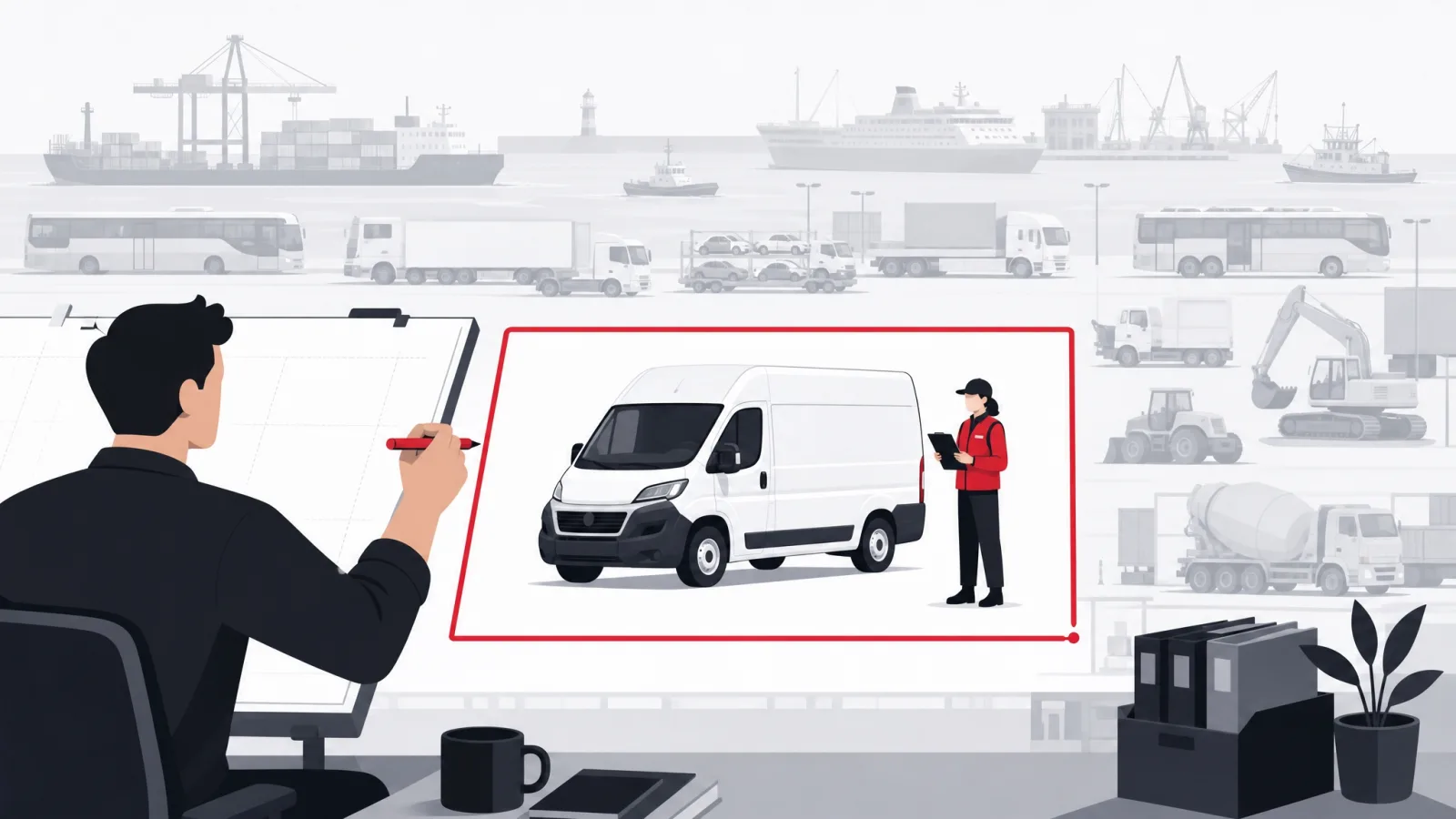
Fleet management software is a category, not a product, and the categories inside it barely overlap. A last-mile delivery operator lives in route optimization and proof of delivery; a long-haul trucking company lives in compliance hours, fuel economics and preventive maintenance; a field service business lives in job scheduling and technician utilization; a construction company lives in equipment hours, idle detection and site geofences. The modules share a data layer, positions, ignition, engine data, but the workflows above it are different products. The first scoping act is choosing one segment and interviewing its dispatchers, not its executives, because dispatchers own the workflow the software must win.
The second scoping act is deciding what the software is for its owner. An internal platform for your own fleet optimizes for your workflow and integrates with your systems; the single-tenant shortcut, no billing, no tenant isolation, no white-label, is rational and saves months. A commercial product for many fleets must be multi-tenant from the first schema, with organization-scoped data, per-tenant configuration and a billing model, because retrofitting tenancy into a single-tenant codebase is a rewrite wearing a refactor's name. Teams that are honestly unsure should build single-tenant for a design partner fleet and accept the rewrite cost if the product thesis proves out.
The third scoping act is the device question, covered fully in its own section below, but it belongs in scope because it constrains the buyer. Fleets with installed hardware trackers are a different sales motion and data quality tier than fleets that will only run a driver app. If the first segment is owner-operators and small fleets, phone-based tracking gets to market faster with worse data; if the first segment is contracted logistics with compliance requirements, installed hardware is non-negotiable and the platform inherits device provisioning and management as scope.
What a defensible first release contains, for almost any segment: live tracking with a fleet map and vehicle detail, trip history with replay, geofences with entry and exit alerts, basic driver assignment, ignition and idle reporting, and one segment-specific workflow module chosen from the interviews, routes for delivery, inspections for trucking, job dispatch for field service. What it deliberately defers: the full maintenance suite, fuel card integrations, advanced routing, driver scorecards, and the analytics warehouse. That first list is 4 to 7 months of work; the second list is the roadmap that keeps the product alive after launch.
Fleet segments and the modules they buy first
| Segment | Lives in | First workflow module | Deferred until later |
|---|---|---|---|
| Last-mile delivery | Routes and stops | Route planning, proof of delivery | Maintenance depth, fuel cards |
| Long-haul trucking | Compliance and fuel | Hours logging, inspections | Route optimization |
| Field service | Jobs and technicians | Job dispatch and scheduling | Advanced telematics |
| Construction equipment | Asset hours and sites | Geofences, utilization, idle | Driver scorecards |
The same data layer, different products. The first release serves one column, not the header row.
The module map, in build order

The foundation family is telematics: device ingestion, vehicle and driver registry, live state, and trip building. Ingestion receives raw messages from trackers, dongles or phones, normalizes protocol dialects into a canonical event, and orders them by device time rather than arrival time, because cellular networks deliver late and out of order. The registry maps devices to vehicles to drivers with effective dates, a mapping that sounds trivial and decides whether every downstream report attributes the right trip to the right person. Live state answers the dispatcher's only urgent question, where is everything now, and trip building segments the raw stream into ignition-to-ignition journeys with distance, duration, stops and idle, which is the unit every other module consumes.
The operations family turns state into decisions. Dispatch assigns vehicles and drivers to work; routing plans stop sequences and estimates arrival times; the driver app closes the loop with navigation, status updates and proof of delivery or job completion; and alerting watches the stream for the events a human must know about now: geofence breaches, harsh braking, unauthorized use, offline devices. This family is where segment specificity lives, and where the workflow interviews pay off: the difference between a dispatch board dispatchers love and one they work around is a dozen small decisions about how their day actually runs.
The asset family turns history into money, and it is the renewal engine. Maintenance scheduling watches odometer, engine hours and calendar rules to generate work orders before failures rather than after; service history per vehicle accumulates the record that resale and warranty claims need; fuel monitoring reconciles fill events against fuel card feeds and tank sensors to surface theft and waste; and inspections digitize the walk-around checklists that regulations or insurers require. Operators buy fleet software for the map and renew it for these modules, because this is where the software pays its own subscription: a single avoided engine failure or a detected fuel fraud pattern funds the year.
The platform family makes the product durable: reporting and analytics over the accumulated history, from utilization summaries to driver scorecards; the integration layer, fuel cards, maintenance shops, ERP and accounting exports, and an API for customers who treat the fleet data as an input to their own systems; and administration, roles and permissions, tenant management for commercial products, audit logs and data retention. This family is last in build order not because it matters least but because it consumes everything before it: analytics without deep history is empty, and integrations before the core model stabilizes are rework contracts with external parties attached.
The build, phased
-
FoundationMonths 1 to 3
Ingestion, registry, live map, trip building, geofences
Done when A pilot fleet's dispatcher uses the live map daily
-
OperationsMonths 3 to 5
Dispatch, driver app, alerting, the segment workflow module
Done when The segment workflow runs end to end in production
-
Asset economicsMonths 5 to 8
Maintenance scheduling, fuel monitoring, inspections
Done when The platform surfaces its first documented savings
-
PlatformMonths 8 and on
Analytics, integrations, API, multi-tenant administration
Done when A second customer onboards without engineering work
The architecture: an event stream with products attached
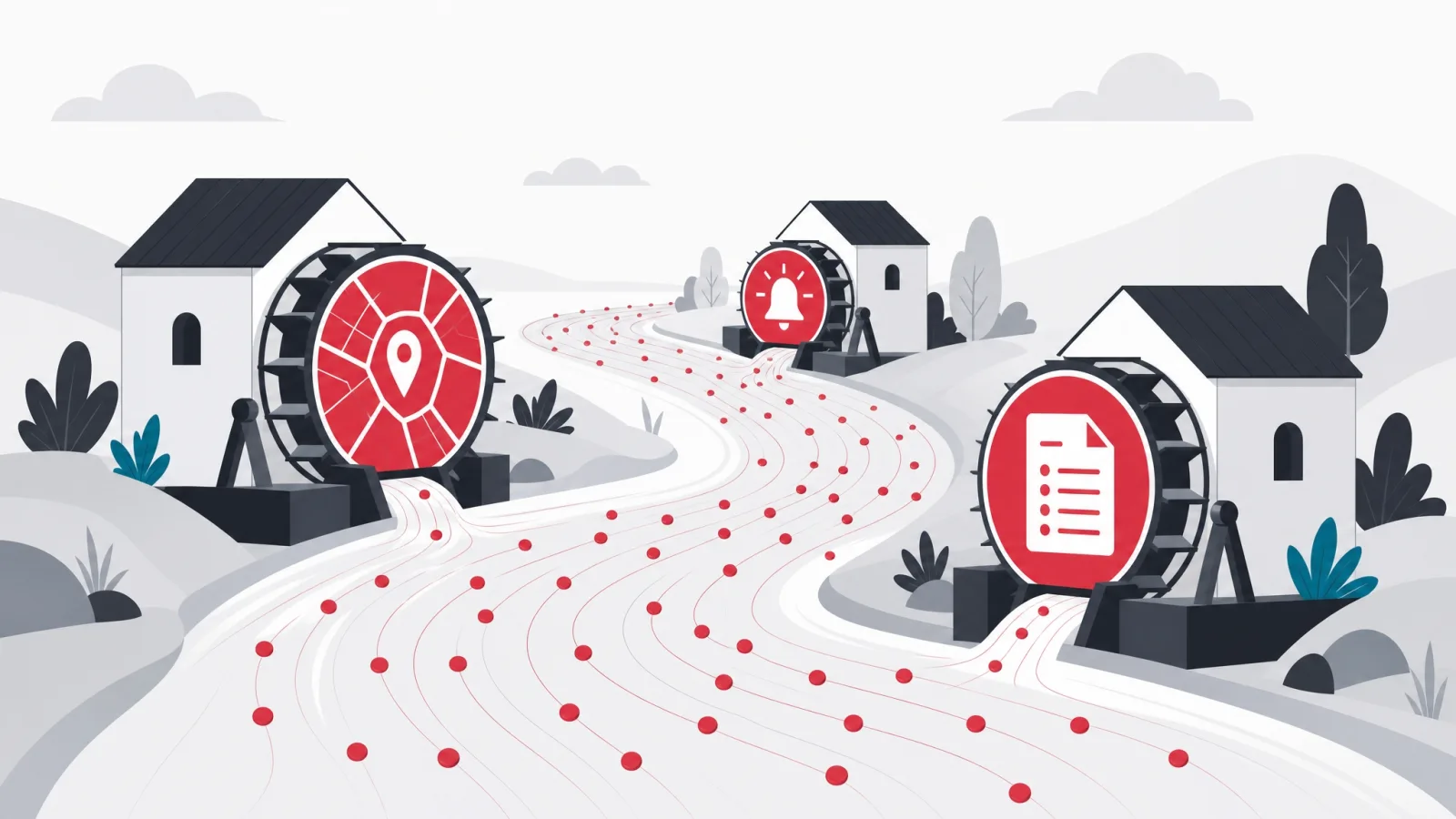
Fleet data is a stream, and the architecture must be shaped like one. A mid-size fleet of 500 vehicles reporting every 10 seconds generates over four million position events a day before sensor data, and the platform must ingest that flow while devices misbehave: duplicate messages, out-of-order delivery after cellular dead zones, clock drift, and firmware dialects that violate their own protocol documentation. The load-bearing design decision is a device gateway that terminates device protocols and publishes canonical events onto a stream, with everything else, live state, storage, rules, trip building, consuming that stream independently. Request-response designs where the API writes positions straight into a relational table demo well at ten vehicles and collapse at a thousand.
Storage divides by access pattern. Live state, the current position and status of every vehicle, lives in memory or a fast key-value store, updated by a stream consumer and read by the map at interactive latency. History lives in storage built for time-range queries, a time-series database or partitioned columnar tables, because every report is a time-range scan and relational indexes over billions of position rows die exactly the death the telematics pipeline guide prices out in storage math. Derived entities, trips, alerts, work orders, are relational and modest in volume: the stream is huge, but the business objects extracted from it are ordinary.
The rules engine deserves early architectural respect because every module wants it. Geofence alerts, idle thresholds, harsh driving detection, maintenance triggers and offline device detection are all the same shape: a condition evaluated against the event stream or a schedule, producing an alert or a task with routing and acknowledgment. Building each module's rules ad hoc produces five inconsistent notification systems; building one evaluation engine with per-module conditions produces a platform. The same argument applies to the notification layer itself: one delivery system with per-user channel preferences, quiet hours and escalation, shared by every module that needs to interrupt a human.
Two cross-cutting choices round out the architecture. Multi-tenancy, for commercial products, belongs in the schema from day one: every table carries the organization, every query is scoped, and the test suite asserts isolation, because a cross-tenant data leak in fleet software exposes one customer's operations to another and ends the company. And the driver app should be treated as a first-class product, not a viewport: it works offline in loading docks and rural dead zones, queues its events for reconciliation, and respects the battery, because an app that drains a phone by lunchtime gets uninstalled by drivers whose cooperation the entire data layer depends on.
The device strategy: hardware, dongles or phones
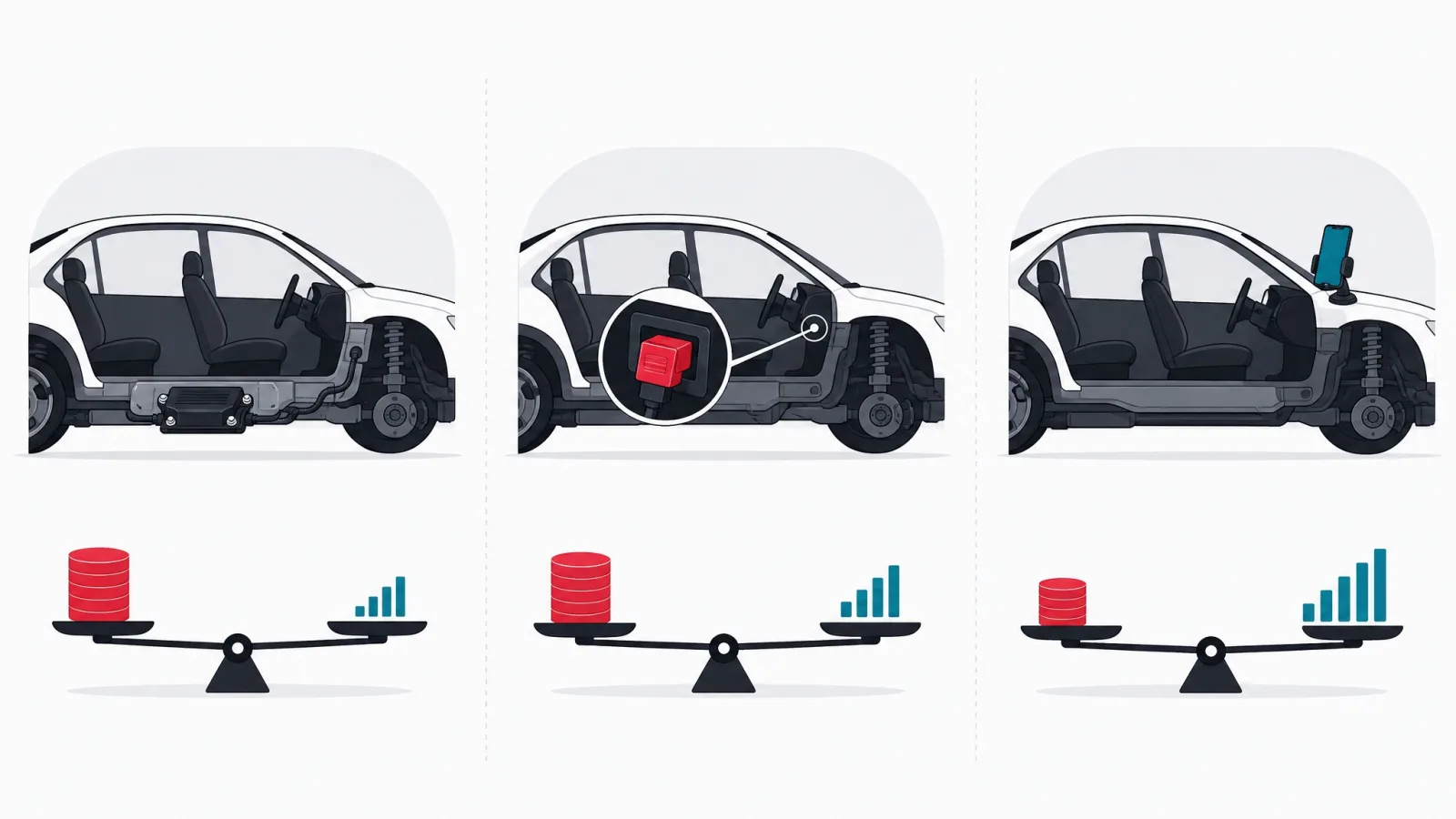
Everything downstream inherits the device decision, so make it consciously. Installed hardware trackers, wired to the vehicle with their own antenna and backup battery, deliver the best data: reliable reporting whether or not a driver cooperates, engine bus access for odometer, fuel and fault codes, and tamper detection. They cost 50 to 150 dollars per unit plus installation, which means fleet onboarding is a hardware logistics operation, and the platform inherits device management scope: provisioning, firmware tracking, health monitoring and an RMA workflow. Commercial platforms serving contracted logistics or compliance-bound segments end up here regardless of where they start.
OBD-II dongles split the difference: self-installed into the diagnostic port in seconds, engine data without professional installation, at 30 to 80 dollars per unit. Their weaknesses are physical and behavioral: ports are occupied, incompatible on some vehicle classes, and dongles can be unplugged by exactly the drivers whose behavior the fleet wants visibility into. They fit the small-fleet and self-service segment, where shipping a dongle in an envelope is the onboarding flow, and the platform must treat unplug events as first-class signals rather than data gaps.
Phone-based tracking through the driver app costs nothing in hardware and onboards in minutes, which makes it the MVP-friendly choice and the right answer for segments where the driver, not the vehicle, is the unit of work, courier networks, field service technicians in their own cars. The data is worse in every dimension: no engine data, tracking stops when the app is killed or the battery saver intervenes, background location on modern mobile platforms is a permissions battle, and attribution is to a person who may drive different vehicles. Platforms that start phone-based should design the event model so hardware sources can join later without remodeling, because successful ones always add hardware eventually.
The honest strategy for most products is a staged mix: phones for the design-partner MVP if the segment tolerates it, dongles for self-service small fleets, installed hardware as the platform moves upmarket, with the ingestion gateway abstracting all three into the same canonical events. What the mix forbids is pretending the tiers are equivalent: reports must carry data-quality context (a fuel report from engine bus data is an audit, one inferred from phone positions is an estimate), and pricing usually tiers with the device class because the value delivered does too. The IoT integration guide goes deeper on the sensor layer beyond location.
The three device classes, compared
| Installed tracker | OBD dongle | Driver phone | |
|---|---|---|---|
| Hardware cost per vehicle | $50 to 150 plus install | $30 to 80, self-install | None |
| Engine and fuel data | Yes | Yes | No |
| Works without driver cooperation | Yes | Partial | No |
| Tamper resistance | Yes | No | No |
| Onboarding speed | Days, scheduled | Minutes | Minutes |
| Fits | Compliance, enterprise | Small fleet self-serve | Courier, field service MVP |
What each source can actually deliver. The gateway abstracts them; the product must not pretend they are equal.
The team, and how the work actually sequences

The MVP team is five to seven people with two specialists the generic web team lacks. The core: a lead engineer who has built event-driven systems, two backend engineers on the ingestion path and the domain modules, one frontend engineer on the dispatcher console and map, one mobile engineer on the driver app, and QA with real device testing discipline. The specialists: someone who has worked with telematics protocols and device quirks (or a plan to acquire that knowledge in the first month against real hardware), and product design time focused on the dispatcher console, because operations software lives or dies on a screen a dispatcher stares at for eight hours.
The sequence that works starts with real data flowing before any feature is built: devices or phones from the design-partner fleet reporting into the gateway in week two or three, because every assumption about data quality, reporting frequency and device behavior gets corrected by contact with reality, and correcting them under a built product costs multiples. The live map comes next, not because it is the hardest module but because it is the trust module: the pilot fleet's dispatcher looking at their own vehicles moving accurately is the moment the project becomes credible inside the customer.
From there the phases in the module map run with a discipline worth stating: each module ships to the pilot fleet when it is usable, not when it is complete, and the roadmap reorders based on what the pilot actually uses. Fleet operators are concrete people; they will tell you the report they printed and the alert they ignored. The anti-pattern is building the full module map against the original spec for a year: fleet software specs written before pilot contact are wrong in the details that decide adoption, and twelve months of unvalidated building delivers a museum of reasonable guesses.
Plan the operational scaffolding as scope, not as an afterthought, because fleet software is operated, not just shipped: device health monitoring (a silently dead tracker is data loss a customer discovers at claim time), ingestion observability with per-device lag metrics, a support runbook for the inevitable device RMA and SIM issues, and staging infrastructure that can replay recorded device streams for testing. Teams that budget only for features discover the operations bill in the first production month, paid in engineer attention at the worst possible time.
The build discipline
Do this
- Real devices in week twoData reality corrects assumptions cheaply before features are built on them.
- Ship the live map firstThe trust module: the pilot dispatcher watching their own fleet move accurately.
- Reorder by pilot usageOperators tell you what they printed and what they ignored. Believe them over the spec.
- Budget device operationsHealth monitoring, RMA runbooks, replay testing. Fleet software is operated.
Not this
- Build a year against the specPre-pilot specs are wrong in the details that decide adoption.
- Treat the driver app as a viewportOffline queuing, battery respect and permission flows are product work, or drivers uninstall it.
- Write positions through the APIThe demo-scale trap. Stream architecture is the domain's physics.
- Defer tenancy on a commercial productRetrofitting organization scoping into a live schema is a rewrite.
The budget, honestly
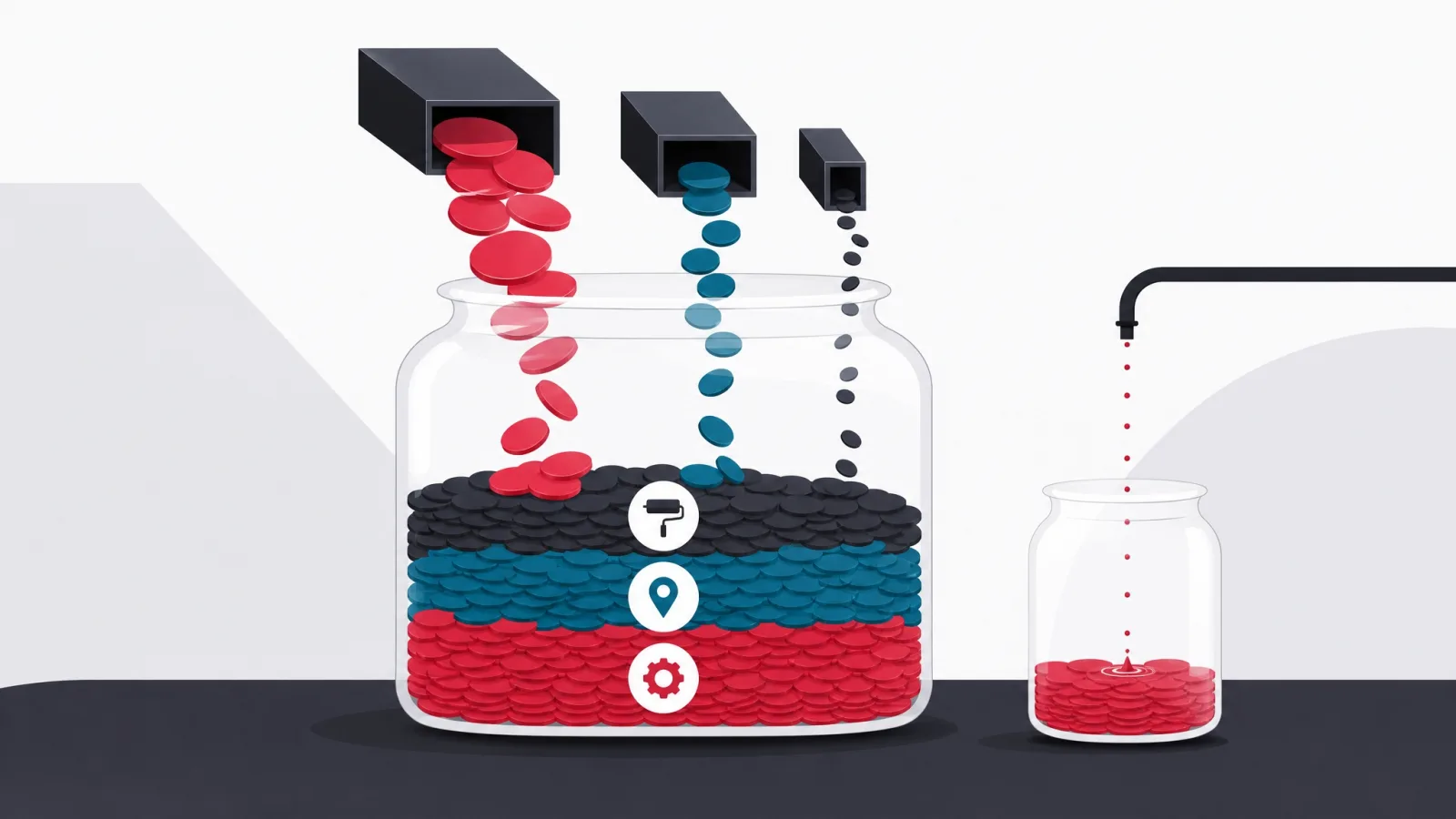
A single-segment MVP, the foundation and operations families plus one workflow module, driver app included, runs 4 to 7 months with the team above. At blended offshore rates of 25 to 45 dollars an hour, the arithmetic the offshore rate benchmark develops in full, that lands between 120,000 and 250,000 dollars; at Western agency rates, multiply by three to four. The range within the band is driven by the device strategy (phone-only MVPs sit low, installed-hardware MVPs carry integration and device-management scope), the workflow module's depth, and how much of the dispatcher console demands custom interaction design versus assembling proven patterns.
The asset economics phase, maintenance, fuel, inspections, adds 3 to 4 months and 80,000 to 150,000 dollars, and deserves its own business case because it changes the product's economics: this is the phase that moves the platform from a visibility tool competing on price to a savings engine that documents its own ROI. Fuel card integrations and maintenance shop connections each add integration projects of 15,000 to 40,000 dollars depending on the counterparty's API maturity, a line that surprises teams who assumed a documented API means a small task.
The commercial-platform surcharge is the one most builders underestimate. Multi-tenant administration, subscription billing, white-label theming, a public API with keys and rate limits, SOC 2 shaped security work for enterprise buyers, and the integration catalog that sales conversations assume: together these are 6 to 12 additional engineer-months spread across the first two years, roughly 100,000 to 250,000 dollars more at the same rates. None of it is visible in the demo, all of it decides whether the second and tenth customers onboard without engineering involvement, which is the definition of a product as opposed to a project.
Running costs scale with fleet count and are dominated by three lines: cellular data plans if the platform supplies connectivity (1 to 4 dollars per vehicle per month, usually passed through), infrastructure for the ingestion and storage path (modest until tens of thousands of vehicles if the time-series layer is built correctly), and the support operation for device logistics. Against those costs, commercial fleet platforms price at 15 to 45 dollars per vehicle per month depending on tier, which is the number to build the business model around: an MVP fleet of ten pilot customers at 300 vehicles total is 100,000 to 160,000 dollars of annual revenue, a figure that makes the funding plan honest about how many quarters the product needs.
The build, priced
The boundary: when building is actually right
This guide assumes the build decision is made, but the boundary deserves honest restatement because the market is crowded with mature platforms. Building is wrong for a company that just needs its own fleet managed with standard workflows: the buyer's guide maps a market where 15 to 45 dollars per vehicle per month buys years of accumulated product, and no internal build reaches feature parity inside its payback window. Operators should buy, integrate and move on, reserving engineering for the integrations that wire fleet data into their own systems.
Building is right in three situations. First, software companies entering the fleet market with a segment thesis: a vertical the incumbents serve badly, a geography they ignore, or a wedge workflow they treat as an afterthought. Second, logistics businesses whose operating model is genuinely differentiated, where the fleet workflow is the competitive advantage and configuring a generic platform means surrendering the difference. Third, companies whose product contains fleet management as a component, a delivery marketplace, an equipment rental platform, a franchise network, where per-vehicle SaaS pricing across thousands of units exceeds the build cost and the workflow must embed in a larger product anyway.
There is also a hybrid path worth naming because it is often the rational one: building the differentiated layer on top of licensed telematics infrastructure. Several telematics providers sell data-as-a-service, devices, connectivity and a normalized event API, without the fleet application layer. Building the product on that foundation trades margin and some control for eliminating the device gateway, protocol zoo and hardware logistics from scope, which can cut the MVP by a third. The trade to evaluate is dependency: the provider's per-vehicle fee sits under the product's margin forever, and migrating devices off a provider later is a real project.
Whatever the path, the commitment being made should be stated plainly: fleet management software is an operated product in a domain where the data layer never stops demanding attention, devices churn, protocols evolve, and customers renew on savings the platform must keep proving. The reward for that commitment is equally plain: operations software with documented ROI, per-vehicle pricing that compounds with fleet count, and switching costs that make earned customers durable. It is a good business built on hard engineering, in that order and not the reverse.
Build, buy, or build on licensed rails
What is the fleet software for?
-
Managing your own fleet, standard workflows
Buy a platform
Mature products at per-vehicle prices no internal build beats inside its payback window.
-
A product thesis: underserved segment or embedded component
Build
The differentiator justifies owning the stack; per-vehicle SaaS across thousands of units exceeds build cost.
-
A product thesis, but device logistics would sink the MVP
Build on telematics rails
License devices and data API, build the application layer. A third off the MVP, a fee under the margin forever.
Frequently asked questions
How much does it cost to build fleet management software?
A single-segment MVP, live tracking, trips, geofences, dispatch, a driver app and one workflow module, runs 120,000 to 250,000 dollars at offshore rates over 4 to 7 months with a team of five to seven. The asset economics phase (maintenance, fuel, inspections) adds 80,000 to 150,000 dollars, and a commercial multi-tenant platform adds 100,000 to 250,000 dollars more across two years for tenancy, billing, white-label and API work. Western agency rates multiply the figures by three to four.
What modules does fleet management software need?
Four families in dependency order: the foundation (device ingestion, vehicle and driver registry, live state, trip building), operations (dispatch, routing, driver app, alerting), asset economics (maintenance scheduling, fuel monitoring, inspections), and platform (analytics, integrations, API, administration). The foundation and operations families make a sellable MVP; the asset family is what operators renew for, because it documents its own savings.
What architecture does fleet software require?
Event-driven, built around a device gateway that normalizes tracker protocols into canonical events on a stream, with live state, time-series storage, trip building and a rules engine consuming that stream independently. A 500-vehicle fleet generates millions of position events daily, arriving late, duplicated and out of order, so request-response designs that write positions through an API into a relational table collapse well before commercial scale.
Should the platform use hardware trackers, OBD dongles or driver phones?
It is a segment decision. Installed trackers (50 to 150 dollars plus installation) deliver engine data, tamper resistance and driver-independent reporting, and are unavoidable for compliance-bound and enterprise fleets. Dongles self-install in seconds and fit small-fleet self-service. Phones cost nothing and onboard instantly but lose engine data and depend on driver cooperation, which fits courier and field service MVPs. Most successful platforms end up supporting a mix behind one ingestion gateway.
How long does it take to build fleet management software?
A focused MVP for one fleet segment takes 4 to 7 months to a pilot fleet using it daily; the asset economics modules add 3 to 4 months; and a commercial multi-tenant platform with billing, white-label and an integration catalog is realistically a two-year product investment. The single best schedule protection is getting real devices reporting in week two, because data reality corrects assumptions cheaply before features are built on them.
Should a company build or buy fleet management software?
Buy, if the need is managing your own fleet with standard workflows: mature platforms at 15 to 45 dollars per vehicle per month beat any internal build inside its payback window. Build, if there is a product thesis: an underserved segment, a genuinely differentiated operating model, or fleet management embedded as a component of a larger product where per-vehicle SaaS pricing across thousands of units exceeds build cost. A hybrid path, building the application layer on licensed telematics infrastructure, cuts the MVP by about a third in exchange for a per-vehicle fee under the margin.
When the build case is made and the question becomes who builds it, AgileTech is a leading AI software development company in Vietnam with shipped fleet and logistics platforms in production.
Source: https://agiletech.vn/blog/how-to-build-fleet-management-software/ · (c) AgileTech Vietnam. Printed from agiletech.vn.