 Nguyen Manh Thang
Chief Executive Officer, AgileTech Vietnam
Nguyen Manh Thang
Chief Executive Officer, AgileTech Vietnam
- Published
- Last updated
- Read time
- 10 min
Read the AI overview
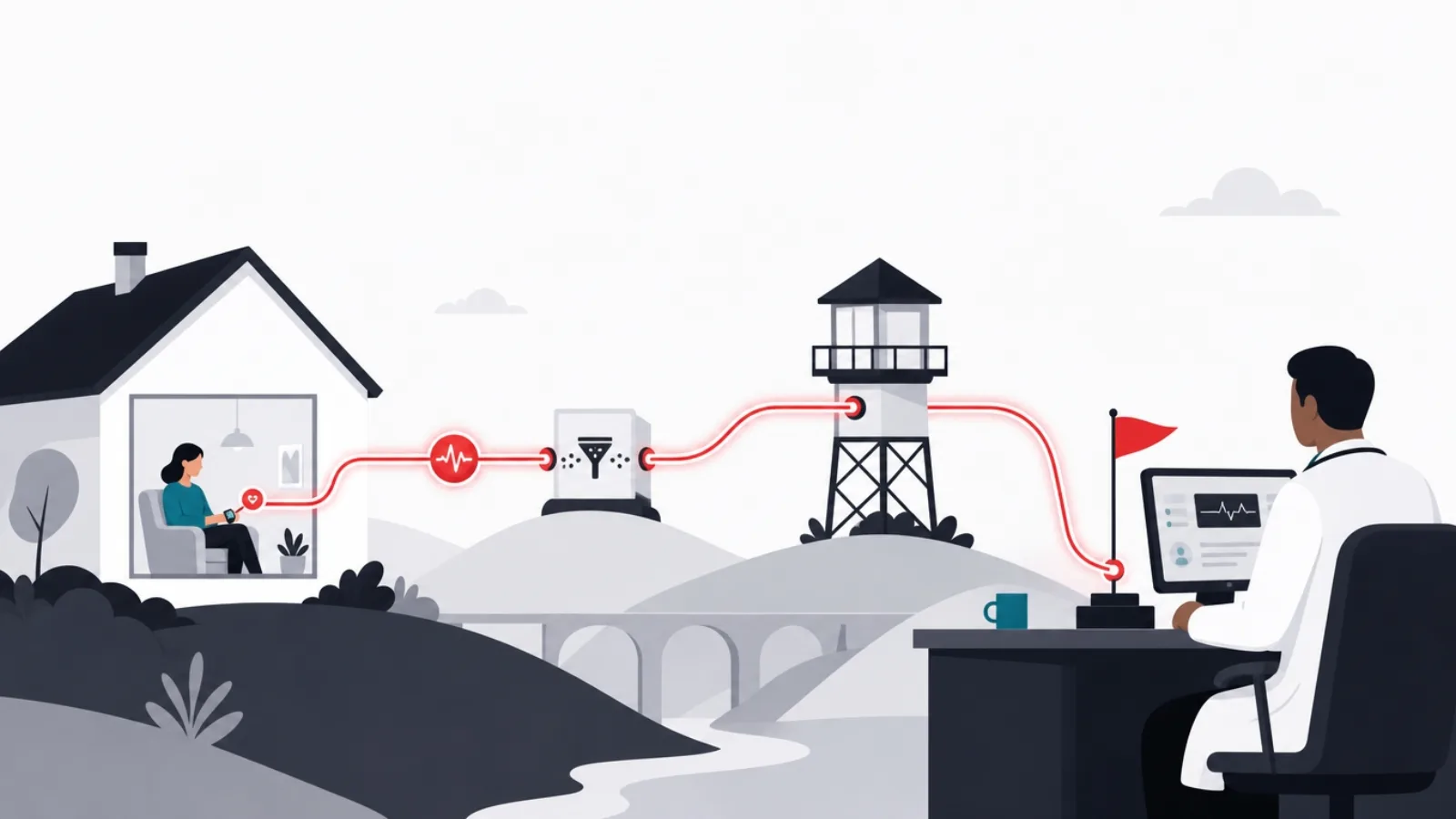
Remote patient monitoring software moves physiological data, blood pressure, glucose, weight, oxygen saturation, heart rhythm, from devices in patients' homes to clinical decisions, through a pipeline with five stages: device connectivity, ingestion at scale, normalization into clinical units, analytics that turn readings into signals, and clinical workflow where humans act. The software succeeds or fails on two things the pipeline alone does not guarantee: a clinical program around it, enrollment, personalized thresholds, staffed escalation, and reimbursement-aware operations, and alert discipline, because programs that page clinicians for every out-of-range reading drown in noise within weeks. A credible RPM platform, device integrations, the pipeline, clinical dashboards, EHR write-back and billing support, runs 350,000 to 800,000 dollars over 8 to 14 months, with device logistics and clinical staffing as the standing costs that dominate at scale.
Remote patient monitoring is where healthcare's episodic habits meet continuous data. A hypertensive patient's blood pressure exists between visits; a heart failure patient's weight gain announces decompensation days before symptoms do; post-surgical recovery has a daily signature that a twice-yearly appointment cannot see. RPM software exists to catch these signals, and reimbursement systems in the US and elsewhere now pay providers to run it, which is why the category has moved from pilot projects to standing clinical programs.
This guide treats RPM as what it is: a data pipeline with a clinical program wrapped around it. It walks the pipeline stage by stage, devices, ingestion, normalization, analytics, clinical workflow, then covers the program mechanics that decide outcomes, enrollment, thresholds, escalation, billing, the alert fatigue problem that deserves its own section because it kills more programs than any technical failure, the integration into the EHR estate, and the build economics for provider organizations and health companies commissioning these platforms.
It closes the healthcare arc this cluster has been building: the telemedicine platform guide covers the visit channel RPM extends into continuous care, the hospital systems guide maps the estate RPM integrates into, and the EMR integration guide details the write-back machinery this page assumes. RPM is the edge of that estate reaching into the patient's home.
Key takeaways
- RPM is a pipeline, not an app: device connectivity, ingestion, normalization, analytics and clinical workflow are five different engineering problems, and the weakest stage sets the program's ceiling.
- The clinical program is half the product: enrollment and device logistics, personalized thresholds, staffed escalation and reimbursement-aware operations decide outcomes as much as the software does.
- Alert fatigue is the number-one killer: personalized thresholds, trend-based signals and triage tiers separate programs that catch deterioration from programs clinicians learn to ignore.
- Device strategy is a build decision: cellular-connected devices win on adoption for older and chronic populations; Bluetooth-plus-app stacks win on cost and device breadth; most serious programs run both.
- RPM data must land in the record: readings, alerts and interventions write back to the EHR over FHIR, or the program creates a shadow chart at exactly the clinical moments that matter most.
- A credible platform runs 350,000 to 800,000 dollars over 8 to 14 months; device logistics and monitoring staff, not software, dominate the cost of running the program at scale.
What RPM is, and the shapes it takes

The core loop is simple to state: devices in the patient's daily environment measure physiology, the measurements flow to a platform, the platform turns them into signals, and a clinical team acts on the signals, adjusting medication, calling the patient, pulling them into a visit through exactly the telemedicine channel this cluster has already mapped. The loop's value is time: deterioration caught days early, titration cycles compressed from months of appointment ping-pong into weeks of data-driven adjustment, and recovery tracked without asking a post-surgical patient to travel. Everything else in this guide is the engineering and operations that make that simple loop true at scale.
The program shapes are worth distinguishing because they stress the platform differently. Chronic disease monitoring, hypertension, diabetes, heart failure, COPD, is the volume core: long enrollments, daily-or-so readings, slow trends punctuated by deterioration events, and reimbursement structures built around monthly monitoring time. Post-acute and post-surgical monitoring runs shorter and hotter: weeks-long enrollments, tighter thresholds, faster escalation, with the goal of catching complications and preventing readmissions that hospitals are penalized for. Hospital-at-home programs are the acute extreme: inpatient-grade care in the home with continuous vitals, the most demanding reliability tier. And wellness-adjacent monitoring, wearables feeding lifestyle programs, sits outside clinical RPM and should be architecturally separated from it, because mixing consumer wellness data into clinical alerting pipelines pollutes both.
The reimbursement context explains the category's growth and shapes the software directly. US billing codes pay for device supply and setup, for the transmission of readings across a month with a minimum-days threshold, and for clinical monitoring time in tracked increments, which means the platform must count things payers count: days with readings per month, minutes of clinical review per patient, who did the reviewing and when. Similar structures exist in other systems. This is not billing trivia; it is product architecture, because a platform that cannot produce audit-grade evidence of readings received and minutes spent leaves the program's revenue unclaimable, and unclaimable revenue is how clinically successful pilots die at budget review.
The honest limits belong in the definition too. RPM measures what devices measure, and adherence decays: enrollment-month compliance is high, month-six compliance is a program-design achievement, not a default. Signals are probabilistic: a weight spike might be decompensation or a heavy meal, which is why thresholds personalize and humans stay in the loop. And the population that benefits most, older, sicker, less technology-fluent, is the population that consumer-grade app-and-Bluetooth experiences serve worst, which drives the device strategy decisions the next section covers. Programs designed against these limits work; programs designed against brochure assumptions produce dashboards of missing data.
The RPM vocabulary
- RPM
- Remote patient monitoring: clinical programs that collect physiological data from patients outside care settings and act on it.
- Cellular device
- A monitoring device with its own connectivity that transmits readings without a phone, app or home network: the adoption workhorse for older populations.
- Reading days
- Days per month with at least one transmitted reading: the adherence unit reimbursement thresholds are built on.
- Threshold / trend alert
- Signals from a single out-of-range reading versus signals from a pattern over time; mature programs weight trends heavily.
- Monitoring time
- Tracked clinical review minutes per patient per month: a billable, auditable quantity the platform must measure natively.
- Hospital-at-home
- Acute inpatient-grade care delivered in the home with continuous monitoring: the highest-reliability tier of RPM.
The device layer: connectivity is a clinical decision

The device roster maps to the conditions: blood pressure cuffs for hypertension, glucometers and continuous glucose monitors for diabetes, scales for heart failure, pulse oximeters for respiratory disease and post-COVID pathways, ECG patches and consumer wearables for rhythm, thermometers and spirometers for their niches. Each brings its own data cadence, a CGM streams hundreds of readings a day while a scale sends one, its own units and quirks, and its own regulatory status, and the platform's device abstraction layer exists to absorb exactly this variety: one internal representation of an observation, however it arrived.
Connectivity is the decision with clinical consequences. Cellular devices, with embedded SIMs transmitting directly, remove every step between measurement and platform: no app, no pairing, no home Wi-Fi, no smartphone requirement, which for the older, sicker populations RPM serves most is frequently the difference between 80 percent and 40 percent sustained adherence. Their costs are per-device hardware premiums and connectivity fees. Bluetooth-plus-app stacks invert the trade: cheaper devices, far wider device choice, richer patient engagement through the app, at the price of pairing friction, phone dependency, and the silent data gaps that arrive when an OS update breaks background sync, a failure mode every RPM engineer learns by pager. Serious programs run both, cellular as the adherence default for high-risk enrollments, app-based where the population supports it, and the platform architecture should assume the mix from day one.
Aggregator services, device-platform intermediaries that normalize many manufacturers behind one API, are the build-versus-buy question of this layer, and the assemble posture from the rest of this cluster applies: integrating an aggregator buys dozens of device types in weeks and converts per-device engineering into a per-reading or per-patient fee, while direct manufacturer integrations earn their keep for the program's core high-volume devices where unit economics and data fidelity justify owning the integration. Most credible platforms end up hybrid: direct integrations for the two or three devices that carry the program, an aggregator for the long tail, and the abstraction layer making the difference invisible upstream.
Logistics is the unglamorous half of the device layer and a standing operational cost the software must serve: provisioning devices to enrolled patients, kitted, charged, pre-paired or SIM-activated; tracking the fleet, who has what, what firmware, what battery state, because a dead battery is a silent data gap wearing a hardware costume; supporting the inevitable how-do-I-use-this calls with device-state visibility; and recovering or replacing hardware at disenrollment. Platforms built without fleet operations tooling, inventory, device-state dashboards, patient-level connectivity health, push these costs into spreadsheets and phone calls, and at a few hundred patients the spreadsheets lose. The device layer, done honestly, is a small logistics company with an API.
Device strategy, learned the hard way
Do this
- Default high-risk patients to cellularNo pairing, no app, no smartphone requirement. Adherence is the clinical outcome; buy it at the hardware layer.
- Abstract devices behind one observation modelOne internal representation however data arrives: direct, aggregator, cellular or app.
- Build fleet visibility earlyBattery, firmware, last-transmission per device. A dead battery is a silent clinical data gap.
- Go hybrid on integrationsDirect for the two or three core devices, an aggregator for the long tail, invisible upstream.
Not this
- Assume the smartphoneThe populations RPM helps most are the least served by app-and-Bluetooth stacks. Design for no-phone enrollment.
- Treat missing data as absence of newsA patient who stops transmitting is a signal, often the most important one. Alert on silence.
- Mix wellness wearables into clinical alertingConsumer data pollutes clinical pipelines. Separate the tiers architecturally.
- Leave logistics to spreadsheetsProvisioning, tracking and recovery at scale need tooling. The spreadsheets lose at a few hundred patients.
The pipeline: ingestion, normalization, analytics

Ingestion is a scale-and-reliability problem with a healthcare accent. Readings arrive from cellular gateways, manufacturer clouds, aggregator webhooks and patient apps, at volumes that range from one weight a day to CGM streams, and the ingestion tier's obligations are the unglamorous ones: never lose a reading, deduplicate the retries and multi-path deliveries that device ecosystems generate, timestamp honestly across time zones and device-clock drift, and queue through downstream outages, because the pipeline's consumers will fail and the readings must survive it. Idempotent ingestion with durable queues is standard equipment, and the audit obligation runs from the first byte: reception itself is billable evidence under reading-day thresholds, so the ingestion log is a financial record as well as a clinical one.
Normalization turns manufacturer payloads into clinical data, and it is where device variety goes to be tamed: units reconciled, mmol/L and mg/dL, kilograms and pounds; measurement context preserved, cuff position, pre- or post-meal, device model and firmware, because context changes clinical meaning; quality flags applied, out-of-physiologic-range values, error codes, suspected-artifact readings, quarantined rather than deleted; and everything mapped to standard clinical vocabularies, observations coded in the terminologies the EHR world speaks, so the write-back stage has FHIR-shaped data to send. The normalization layer is also where patient-device attribution is enforced, which household-shared devices make less trivial than it sounds: a scale used by two spouses generates someone's data, and the platform had better know whose.
The analytics tier turns normalized readings into clinical signals, and restraint is its virtue. The workhorse layers are deterministic: personalized threshold rules, this patient's acceptable blood pressure range, set clinically, not population defaults; trend rules, weight up two kilograms in three days for a heart failure patient, a sustained drift in resting heart rate; and adherence rules, the missing-data signals that flag disengagement or a dead battery. Above these, predictive models, deterioration scores, risk stratification, earn their place only with clinical validation and clear operational meaning: a score that changes what a nurse does at 10 AM is a product feature, a score that decorates a dashboard is a liability, and models that touch clinical decisions inherit regulatory obligations that deserve deliberate scoping. Most programs achieve their outcomes on well-tuned deterministic rules; models are the second act, not the foundation.
The signal output, whatever produced it, lands in a triage structure rather than a firehose: severity tiers with different routing and clocks, critical signals paging now, routine ones batching into worklists, context attached, the trend, the last contact, the care plan, so the responder is not archaeology-bound, and every signal carrying its disposition lifecycle: acknowledged, actioned, resolved, with timestamps, because response time is a quality metric programs report and improve. This structure is the load-bearing wall between the pipeline and the humans, and it is the direct input to the alert fatigue economics the next section treats as the program's survival problem.
The clinical workflow: where readings become care

The monitoring workspace is the platform's clinician cockpit, and its design decides daily efficiency the way the telemedicine cockpit decides visit time. The shape that works is a population-to-patient funnel: a triage worklist of active signals ordered by severity and waiting time, not a wall of per-patient tiles; one-click descent into the patient view, the trends, the thresholds, the care plan, the contact history, on one screen; and actions embedded where the data is, call the patient, message them, adjust a threshold, schedule a telemedicine visit, escalate to the physician, document the review. Every action doubles as the time-tracked, attributable event that billing and quality reporting need, captured as a side effect of doing the work rather than as a separate documentation chore, which is the design detail that keeps monitoring staff from drowning in administrative residue.
The staffing model wrapped around the workspace is a program decision the software must flex to. The dominant pattern is nurse-led monitoring: nurses or trained monitoring staff work the triage queue under protocols, standing orders that let them handle defined situations, coach patients and adjust within bounds, escalating to physicians when protocol boundaries are crossed. Some programs centralize monitoring in a hub serving many clinics; some distribute it into each practice; vendors increasingly offer monitoring-as-a-service staffing on top of their platforms. Each pattern changes the software's tenancy, permissions and escalation routing, and the platform that hardcodes one pattern forecloses the others: staffing models are configuration, not architecture, in a platform meant to outlive its first customer.
Escalation paths connect monitoring to the rest of the care system, and they are clinical design encoded in software. A signal that exceeds nurse protocol routes to the responsible physician with context and urgency attached; a deteriorating patient pulls into a same-day telemedicine visit, the channel the platform guide built, or an in-person slot; an acute signal triggers the emergency pathway, including the honest one, instructing the patient to call emergency services, with the program documenting its role. Every path has a clock and a fallback: unacknowledged critical signals re-page and climb, because the failure mode that ends programs is the critical alert that sat unseen in a queue overnight. Timers, escalation chains and acknowledgment discipline are cheap software and expensive lessons.
The patient side of the workflow is engagement engineering with clinical stakes, and it borrows exactly the lessons the mental health guide develops: the daily measurement is a habit to be architected, reminders timed to routine, streak-tolerant nudges when a day is missed, friction removed everywhere, which is the deep synergy with cellular devices, where the habit is just stepping on the scale. Feedback closes the loop: patients who see their own trends, understand what the numbers mean, and receive human acknowledgment, a nurse's note after a rough week, adhere at rates unattached programs never reach. Education content, symptom check-ins that add subjective context to objective readings, and family or caregiver visibility for the populations that need it complete the layer. Adherence is manufactured by this design, and it is the single input the whole program's value rests on.
The escalation ladder, encoded
| Tier | Handled by | Clock | Fallback |
|---|---|---|---|
| Routine review | Monitoring nurse, worklist order | Same business day | Carries to next day with aging flag |
| Protocol action | Nurse under standing orders | Hours | Physician notification if bounds crossed |
| Physician escalation | Responsible physician | Defined per program, hours | Re-page; climb to covering physician |
| Urgent clinical | Same-day telemedicine or in-person visit | Same day | Emergency pathway if unreachable |
| Emergency | Patient directed to emergency services | Immediate | Program documents and follows up |
The standard RPM escalation tiers: who acts, on what clock, with what fallback when the clock expires.
Alert fatigue: the problem that actually kills programs

The failure sequence is so common it deserves narration. A program launches with population-default thresholds, every reading outside textbook range generates an alert, and week one produces hundreds: the hypertensive patient whose baseline runs high fires daily, the scale's Monday artifacts fire weekly, and the monitoring nurse's queue becomes a wall of noise with real deterioration buried somewhere in it. Staff adapt the only way humans can, by triaging faster and trusting less, then by batch-dismissing, and within a quarter the program has trained its own clinicians to ignore it. The deterioration event it eventually misses was not undetected; it was alert number 340 of 400 that Tuesday. Nothing about the pipeline failed. The signal design did.
The countermeasures are known and they compound. Personalized thresholds are the foundation: alert bounds set against this patient's baseline and care plan at enrollment, reviewed at intervals, because a reading alarming for one patient is Tuesday for another. Trend-weighted signaling cuts single-reading noise: sustained drifts and pattern breaks carry more clinical information than any lone spike, and programs that shift weight from threshold alerts to trend alerts routinely cut volume severalfold while catching deterioration earlier. Suppression and aggregation do the janitorial work: repeat readings inside an already-open alert attach rather than re-fire, artifact-flagged values quarantine, and known-context periods, a medication change window with expected fluctuation, damp the rules that the context invalidates.
The operational half of the countermeasure is measurement and tuning as a standing discipline. The metrics that matter: alerts per patient per week, actionability rate, what fraction of alerts led to a real clinical action, time-to-acknowledgment by tier, and dismissal patterns by rule, because a rule dismissed 98 percent of the time is a noise generator with a clinical citation. Mature programs run alert governance the way hospitals run order-set governance: a named clinical owner, a review cadence, rule changes versioned and evaluated against the metrics, and the humility to delete rules that do not earn their interruptions. The platform's job is to make this measurable and adjustable without engineering tickets: rule configuration, per-rule analytics and safe experimentation are product features, not internal tools.
Calibrated well, the numbers describe a different program: single-digit alerts per nurse per patient per month, actionability rates that keep trust high, critical signals acknowledged in minutes because they are rare enough to mean something, and a monitoring team whose attention is spent on the patients who need it, which was the entire premise. The broader lesson generalizes across this cluster's healthcare arc: in clinical software, the scarce resource is clinician attention, and every design decision, thresholds, alert routing, documentation burden, cockpit layout, is ultimately an allocation of that attention. RPM just makes the economics visible enough to measure, which is why programs that master alert discipline tend to be the ones that master everything else.
The alert economics, in numbers
Integration into the estate, and the compliance frame

RPM data must land in the record, and the argument is the same one the hospital systems guide makes for every module: readings, alerts and monitoring interventions that live only in the RPM platform are a shadow chart, invisible to the physician making medication decisions in the EHR, invisible to the emergency department the patient arrives at, and invisible to the quality reporting the program will be judged by. The write-back machinery is FHIR-shaped: observations flowing to the EHR at clinically sensible granularity, daily summaries and flagged events rather than every CGM tick, monitoring encounters documented where billing requires, and care-plan context read back the other way, because the RPM platform needs the problem list and medication list to threshold intelligently. Everything the EMR integration guide says about per-EHR dialects and certification timelines applies verbatim.
The workflow integration matters as much as the data integration: physicians should meet RPM inside the tools they already live in, the EHR inbox message for an escalation, the flowsheet view of trended readings, the SMART on FHIR panel launching the RPM cockpit in patient context, rather than being asked to adopt another login and another tab. Programs that achieve in-workflow presence get physician engagement; programs that ask clinicians to visit a separate portal get monitoring nurses printing summaries, which is both a workflow failure and a quiet compliance smell. Enrollment flows similarly: ordering RPM like any other order, from the EHR, with eligibility and consent handled in the flow, is what makes the program scale past its champions.
The compliance frame assembles pieces this cluster has already built, with device-specific additions. The data path is PHI end to end: HIPAA-grade architecture, encrypted transport from device gateways inward, BAAs across the chain, manufacturer clouds and aggregators included, and audit logging that here does double duty as billing evidence. The device layer adds its own tier: medical-device regulation governs the hardware and, depending on claims and function, can reach the software, particularly analytics that drive clinical decisions, so the boundary between decision support that informs clinicians and functionality that diagnoses is a scoping decision with regulatory counsel in the room. Add reimbursement integrity, the reading-day and monitoring-minute evidence the billing codes demand, kept audit-ready, and international variation for platforms crossing borders, and the compliance posture is: assembled from known parts, none skippable.
Security deserves its device-shaped paragraph: an RPM fleet is thousands of network endpoints in uncontrolled environments, and the platform inherits the exposure. The disciplines are the IoT standards applied with clinical seriousness: device identity and authenticated transport for everything inbound, no reading accepted from an unattested source; firmware update paths managed and monitored, because unpatchable devices become permanent liabilities; anomaly detection on the ingestion edge, a device suddenly transmitting impossible volumes or patterns is either broken or compromised; and fleet-wide revocation ready for the day a device model's vulnerability drops. The threat model is not theoretical, medical IoT advisories arrive steadily, and procurement should weight a manufacturer's security posture as heavily as its accuracy specifications.
The integration and compliance checklist
- FHIR write-back at sensible granularityDaily summaries and flagged events to the record; monitoring encounters documented where billing needs them.
- In-workflow physician presenceEHR inbox escalations, flowsheet trends, SMART on FHIR launch. No separate portal as the physician's front door.
- Enrollment as an EHR orderOrdered like any test, consent and eligibility in the flow. This is what scales past program champions.
- BAAs to the edge of the chainManufacturer clouds and aggregators included. The data path is PHI from the cuff onward.
- Billing evidence by constructionReading days, monitoring minutes, reviewer attribution: audit-ready as a side effect of the workflow.
- Fleet security disciplineDevice identity, attested transport, firmware management, ingestion anomaly detection, revocation readiness.
Build economics and the road to a running program
The build follows the assemble posture that governs this cluster: buy the commodity layers, device connectivity through aggregators and manufacturer APIs, cloud infrastructure, communication rails, and build the product, the observation model and pipeline, the analytics and alert governance machinery, the monitoring cockpit, the patient experience, the EHR integration, the billing evidence engine. A credible platform on that posture, two or three direct device integrations plus an aggregator, the five-stage pipeline, triage and cockpit, FHIR write-back to one or two EHRs, and reimbursement reporting, lands at 350,000 to 800,000 dollars over 8 to 14 months with a team of 6 to 10, the familiar healthcare team shape: engineers with regulated-domain history, a clinical product owner, and practicing clinicians in the design loop from sprint one.
The recurring economics deserve equal billing because they dominate at scale. The software's standing costs are the cluster's standard 25 to 40 percent of build annually, integration maintenance, compliance, rails. The program's standing costs are larger: device fleet economics, hardware, cellular connectivity, logistics, replacement, running per-patient-per-month figures that the reimbursement rates were designed around, and monitoring labor, the nurses working the queues, which is the single largest line in any program at scale. This is why alert discipline is an economic policy as much as a clinical one, every noise alert is paid nurse time, and why the platform features that multiply nurse efficiency, triage quality, one-screen cockpits, documentation as a side effect, have the fastest payback of anything in the roadmap.
The staged road mirrors the healthcare arc's pattern. Stage one proves the loop clinically: one condition, hypertension or heart failure being the classic starts, one device kit, cellular-first, personalized thresholds, a nurse-led workflow, and write-back to the anchor EHR, run as a pilot with defined cohorts and honest metrics, adherence, alert actionability, time-to-intervention, and the clinical outcomes the condition defines. Stage two makes it a program: the second and third conditions, the billing evidence engine earning its reimbursement, alert governance running on real data, and the fleet tooling that turns device logistics from heroics into operations. Stage three makes it a platform: multi-tenancy for additional sites or customers, the second EHR, predictive layers where the data now justifies them, and the hospital-at-home tier if the ambition runs that far. Each stage's gate is the same: the loop demonstrably catching deterioration and the economics demonstrably claimable.
The closing frame belongs to the arc this guide completes. Telemedicine gave healthcare a visit channel without a waiting room; the hospital estate gave it a federation that one admission flows through; RPM extends both into the patient's kitchen, where the scale and the cuff live, and where the earliest signals of trouble actually appear. The engineering lessons are continuous across all three: clinical workflow is the product, integration is the spine, clinician attention is the scarce resource, compliance is architecture, and the teams that succeed are the ones that model the physical reality, a nurse's queue, a patient's bathroom scale, an interface engine's feed, before writing the first screen. Build RPM that way and the simple loop at the top of this guide becomes true: readings become signals, signals become actions, and actions arrive days earlier than the appointment calendar ever could.
The staged road to a running program
-
Stage one: prove the loopMonths 1 to 8
One condition, cellular-first kit, personalized thresholds, nurse-led workflow, write-back to the anchor EHR. Pilot with honest metrics.
-
Stage two: make it a programMonths 8 to 16
More conditions, the billing evidence engine claiming reimbursement, alert governance on real data, fleet operations tooling.
-
Stage three: make it a platformYear 2
Multi-tenancy, the second EHR, validated predictive layers, hospital-at-home if ambition runs there.
-
Every stage's gateThe gate
Deterioration demonstrably caught earlier, and the economics demonstrably claimable. Both, or the stage is not done.
Frequently asked questions
What is remote patient monitoring software?
The platform that moves physiological data, blood pressure, glucose, weight, oxygen saturation, heart rhythm, from devices in patients' homes to clinical decisions. It runs a five-stage pipeline: device connectivity, ingestion, normalization into clinical units, analytics that turn readings into triaged signals, and a clinical workflow where monitoring staff act, escalate and document. Around the software sits the program: enrollment, device logistics, personalized thresholds, staffed escalation and reimbursement-aware operations.
How much does it cost to build an RPM platform?
A credible platform, two or three direct device integrations plus an aggregator, the full pipeline, a triage cockpit, FHIR write-back to one or two EHRs, and audit-grade billing evidence, runs 350,000 to 800,000 dollars over 8 to 14 months with a team of 6 to 10 including clinical advisors. The standing costs dominate at scale: 25 to 40 percent of build annually for the software, plus device fleet economics and monitoring nurse labor, which is the largest line in any running program.
What is alert fatigue in remote monitoring, and how is it prevented?
The failure sequence where population-default thresholds generate hundreds of noise alerts, staff learn to batch-dismiss, and the program trains its clinicians to ignore it, missing real deterioration in the noise. The countermeasures: thresholds personalized to each patient's baseline, trend-weighted signals that cut volume severalfold, suppression of repeats and artifacts, and alert governance as a standing discipline, per-rule actionability metrics, a named clinical owner, and the deletion of rules that do not earn their interruptions.
Should RPM programs use cellular or Bluetooth devices?
Both, routed by population. Cellular devices with embedded SIMs need no phone, app or pairing, which for older, higher-risk patients is frequently the difference between 80 and 40 percent sustained adherence, at a hardware and connectivity premium. Bluetooth-plus-app stacks are cheaper with wider device choice and richer engagement, at the price of pairing friction and silent sync failures. Serious programs run a hybrid fleet behind one device abstraction, defaulting high-risk enrollments to cellular.
Does RPM data need to integrate with the EHR?
Yes, or the program runs a shadow chart at exactly the moments that matter: readings, alerts and interventions invisible to the physician adjusting medications and to the emergency department the patient arrives at. Write-back flows over FHIR at clinically sensible granularity, daily summaries and flagged events rather than every tick, with monitoring encounters documented for billing. Physician-side presence belongs in the EHR workflow itself: inbox escalations, flowsheet trends, SMART on FHIR panels, not a separate portal.
How does RPM reimbursement shape the software?
Directly. US billing codes pay for device setup, for transmission months that meet reading-day thresholds, and for clinical monitoring time in tracked increments, so the platform must count what payers count: days with readings per patient per month, minutes of review with reviewer attribution, all audit-ready. Silence detection protects both the patient and the claim, and documentation captured as a side effect of the monitoring workflow, rather than as separate paperwork, is what keeps the program's economics claimable at scale.
If an RPM program is on your roadmap and the device-to-dashboard pipeline needs building, AgileTech is a top AI software development company in Vietnam with teams that have shipped connected-care products.
Source: https://agiletech.vn/blog/remote-patient-monitoring-software/ · (c) AgileTech Vietnam. Printed from agiletech.vn.